• Research
  • Emissary
  • About
  • Experts
Carnegie Global logoCarnegie lettermark logo
DemocracyIran
  • Donate
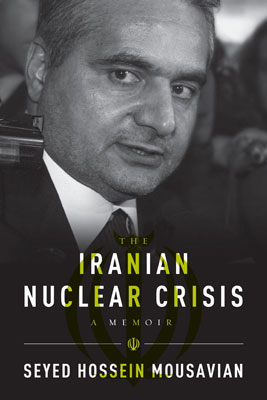
The Iranian Nuclear Crisis: A Memoir
Book

The Iranian Nuclear Crisis: A Memoir

The first detailed Iranian account of the diplomatic struggle between Iran and the international community, begins in 2002 and takes the reader into Tehran’s deliberations as its leaders wrestle with internal and external adversaries.

Link Copied
By Seyed Hossein Mousavian
Published on May 3, 2012

Additional Links

Nook - $10.39Paperback - $19.95Hardback - $49.95Kindle - $15.99iTunes - $15.99
Program mobile hero image

Program

Nuclear Policy

The Nuclear Policy Program aims to reduce the risk of nuclear war. Our experts diagnose acute risks stemming from technical and geopolitical developments, generate pragmatic solutions, and use our global network to advance risk-reduction policies. Our work covers deterrence, disarmament, arms control, nonproliferation, and nuclear energy.

Learn More
Program mobile hero image

Program

South Asia

The South Asia Program informs policy debates relating to the region’s security, economy, and political development. From strategic competition in the Indo-Pacific to India’s internal dynamics and U.S. engagement with the region, the program offers in-depth, rigorous research and analysis on South Asia’s most critical challenges.

Learn More

Source: Washington, DC: Carnegie Endowment for International Peace, 2012

The first detailed Iranian account of the diplomatic struggle between Iran and the international community, The Iranian Nuclear Crisis: A Memoir begins in 2002, when news about Iran’s clandestine uranium enrichment and plutonium production facilities emerged, and takes the reader into Tehran’s deliberations as its leaders wrestle with internal and external adversaries.

Seyed Hossein Mousavian, previously the head of the Foreign Relations Committee of Iran’s Supreme National Security Council and spokesman for Tehran’s nuclear negotiating team, provides readers with intimate knowledge of Iran’s interactions with the International Atomic Energy Agency and global powers.

Mousavian’s personal story comes alive as he vividly recounts his arrest in 2007 on charges of espionage. This and other dramatic episodes of diplomatic missions tell much about the author and the swirling dynamics of Iranian politics and diplomacy—undercurrents that must be understood now more than ever.

As intense debate continues over the direction of Iran’s nuclear program, Mousavian weighs the likely effects of military strikes, covert action, sanctions, and diplomatic engagement, along with their potential to resolve the nuclear crisis.

Advance Praise

“A fascinating, insightful, and new treatment from the perspective of an intimately involved former Iranian senior official on Iran’s nuclear program and responses to it. For those familiar with the details, there is much new information about the Iran side, its ideas, strategies, disputes, and aims. U.S. experts will have some key questions but will learn much from this extraordinary book.”

—Thomas R. Pickering, former U.S. under secretary of state

"…remarkable new book…"    

—David Ignatius, Washington Post

“…a fascinating insider’s account…”

—Philip Stephens, Financial Times

About the Author

Seyed Hossein Mousavian

Princeton University

Seyed Hossein Mousavian
Princeton University
Middle EastIranPolitical ReformSecurityNuclear Policy

Carnegie does not take institutional positions on public policy issues; the views represented herein are those of the author(s) and do not necessarily reflect the views of Carnegie, its staff, or its trustees.

More Work from Carnegie Endowment for International Peace

  • Commentary
    Strategic Europe
    The EU Equivocating on Turkey Is Bad Geopolitics

    Following Ursula von der Leyen’s gaffe equating Turkey to Russia and China, relations with Ankara risk deteriorating even further. Without better, more consistent diplomatic messaging, how can the EU pretend to be a geopolitical power?

      Sinan Ülgen

  • Woman standing amid debris from buildings
    Commentary
    Emissary
    Trump’s National Security Decisionmaking Is Broken

    Here’s why—and what the next president needs to do to fix the process.

      Daniel C. Kurtzer, Aaron David Miller

  • Commentary
    Carnegie Politika
    The Rada Reawakens: Ukraine’s Messy Politics Returns

    The return of parliamentary politics reflects a broader shift from earlier expectations of a settlement and elections toward the reality of a prolonged war.

      Balázs Jarábik

  • This picture taken on July 1, 2021 during a press tour provided by the Lebanese Air Force shows an aerial view of agricultural fields in Lebanon's eastern Bekaa Valley. -
    Article
    Climate Justice in Lebanon: Knowledge, Power, and Environmental Equity

    When municipalities and local actors are empowered with regulatory authority, knowledge, and resources, they can fill critical governance gaps.

      Sabine Saad

  • Commentary
    Carnegie Politika
    What Does Nuclear Proliferation in East Asia Mean for Russia?

    Troubled by the growing salience of nuclear debates in East Asia, Moscow has responded in its usual way: with condemnation and threats. But by exacerbating insecurity, Russia is forcing South Korea and Japan to consider radical security options.

      James D.J. Brown

Get more news and analysis from
Carnegie Endowment for International Peace
Carnegie global logo, stacked
1779 Massachusetts Avenue NWWashington, DC, 20036-2103Phone: 202 483 7600
  • Research
  • Emissary
  • About
  • Experts
  • Donate
  • Programs
  • Events
  • Blogs
  • Podcasts
  • Contact
  • Annual Reports
  • Careers
  • Privacy
  • For Media
  • Government Resources
Get more news and analysis from
Carnegie Endowment for International Peace
© 2026 Carnegie Endowment for International Peace. All rights reserved.