

Q&A
Eugene Rumer
{
  "authors": [
    "Eugene Rumer"
  ],
  "type": "legacyinthemedia",
  "centerAffiliationAll": "dc",
  "centers": [
    "Carnegie Endowment for International Peace",
    "Carnegie Russia Eurasia Center"
  ],
  "collections": [],
  "englishNewsletterAll": "ctw",
  "nonEnglishNewsletterAll": "",
  "primaryCenter": "Carnegie Endowment for International Peace",
  "programAffiliation": "russia",
  "programs": [
    "Russia and Eurasia"
  ],
  "projects": [],
  "regions": [
    "North America",
    "United States",
    "Caucasus",
    "Russia",
    "Eastern Europe",
    "Western Europe"
  ],
  "topics": [
    "Security",
    "Military",
    "Foreign Policy",
    "Global Governance"
  ]
}
Source: Getty
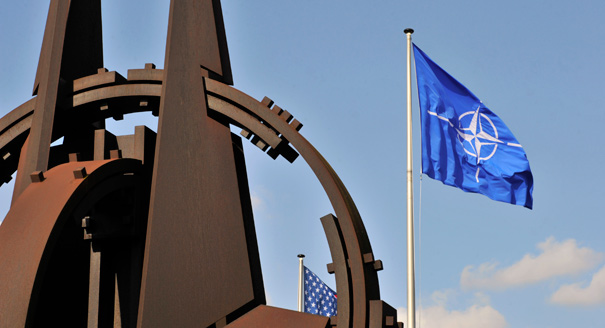
The Wales summit will be NATO’s most difficult test in a generation, but in the wake of the Ukraine crisis, NATO is finally treating the issue of enlargement with the seriousness it deserves.
Source: European Leadership Network
NATO foreign ministers’ announcement that no country will be invited to join the alliance at the summit in Wales in September is to be applauded as a responsible step in the face of the most profound crisis to confront the allies since the end of the Cold War. Perhaps, this is the silver lining of the cloud over the alliance caused by the Ukraine crisis: for the first time in many years, NATO members are treating the issue of enlargement with the seriousness it deserves.
The annexation of Crimea by Russia—the first outright land grab in Europe by a major power since the end of the Cold War—has sent a powerful reminder that war has not been banned from the continent forever. The crisis in Ukraine is a signal that the post-Cold War era of relative peace and harmony (assuming one ignores the violent dissolution of Yugoslavia as part of Europe’s old legacy) was really an interlude, that force still matters, and states rely on it rather than on shared values to advance their interests.
At Cold War’s end, the alliance’s original purpose summarized by its first Secretary General Lord Ismay as “to keep the Russians out, the Americans in, and the Germans down” seemed to have outlived itself. In post-Cold War Europe, what role could a military alliance, created to defend against the Soviet Union, play? So, instead of going out of business, NATO invented a new purpose for itself—to shore up the young democracies in the east. The idea of NATO enlargement was born.The spread of democracy and stability to Europe’s east and beyond would be NATO’s new post-Cold War mission. It was rarely, if ever, acknowledged officially that once reinvented, NATO would still hedge against the specter of Russia’s hostile resurgence. The fact that prospective alliance members wanted to join it precisely to hedge against Russia’s resurgence was mentioned a lot less frequently than their desire to join the community of market democracies. Thus, the expansion was billed as a move toward, not against Russia, designed to bring the zone of stability, democracy and free market closer to its borders.
NATO enlargement was advertised as the solution to everyone’s problems. Russia would eventually, if not at first, accept and welcome it. It would be essentially a cost-free venture in terms of new defense commitments and would focus on promotion of shared values rather than on the alliance’s original mission—collective defense. To the United States, the enlargement’s advocates promised that Europe would assume a greater share of NATO’s burden. To Western Europe they promised a greater say in alliance management. Eastern Europe would benefit from NATO’s help in their post-Communist transition. And Russia would benefit from a stable and secure neighborhood between it and Europe.
Like all best laid plans this one didn’t quite follow the original blueprint. Burden-sharing between Europe and the United States remains one of the alliance’s weak spots. Eastern Europe has done as well as could be expected in its post-Communist transformation, but remains insecure as some of the countries nearest to Russia seem to find NATO’s security guarantee not as strong as once thought and are keen to get American boots on the ground as an extra precaution against Russia. Russia, needless to say, has not come around to like NATO enlargement, and having recovered a measure of its old strength has through two conflicts—in Georgia in 2008 and Ukraine in 2014—signaled that it has had enough of NATO enlargement and is not going to take it anymore.
The result is an alliance in crisis. Eastern Europe is insecure. Western Europe—a long-forgotten designation—wants to protect its economic ties with Russia, and avoid a new crisis and more defense spending. The United States is coping with crises elsewhere, and after proverbially holding Europe’s hand for over two decades since the end of the Cold War, can reasonably expect Europe to take the lead in dealing with its security problems.
The Ukraine crisis has reminded the people and governments on both sides of the Atlantic that NATO still has an important military role to play on the continent, and that it is an alliance not only of shared values, but of shared interests and military capabilities, that its purpose was not only to advance the principles of democracy and market capitalism, but to deter, dissuade, and if need be defend by using military power. In other words, its top priority is the security of its member states.
Against this powerful reminder, the idea of expanding the alliance again is hardly rational. It has been thrown around loosely—invite Georgia as a deterrent to Russia, perhaps even Ukraine, offer membership to Montenegro and Macedonia. Ignored, or forgotten in this loose talk is the very idea that NATO membership is not a merit badge or reward for good behavior, but that it comes with an ironclad security guarantee and that new members must contribute to the security of the entire alliance. That last key point, set out by NATO two decades ago as it prepared to admit new members, has been often overlooked as an anachronism, but is well worth remembering now.
The Wales summit in September will be NATO’s most difficult test in a generation. It will have to reassure its new members, address the perennial problem of burden-sharing, and—most important—agree on a credible way forward for meeting its core mission of military security for all of its members. Unless the core is healthy, new growth will not be possible.
This article was originally published by the European Leadership Network.
Director and Senior Fellow, Russia and Eurasia Program
Rumer, a former national intelligence officer for Russia and Eurasia at the U.S. National Intelligence Council, is a senior fellow and the director of Carnegie’s Russia and Eurasia Program.
Recent Work
Eugene Rumer
Eugene Rumer
Carnegie does not take institutional positions on public policy issues; the views represented herein are those of the author(s) and do not necessarily reflect the views of Carnegie, its staff, or its trustees.

Trump has promised Belarus a massive potash deal. But Minsk is seeking something greater: restored Western transit and greater room for maneuver from Russia.

Balázs Jarábik

Before the next wave of EU enlargement takes place, the union needs to grapple with thorny questions of how power is distributed among its members.


Emil Sondaj Hansen, Ditte Brasso Sørensen

The real test may come after the leaders leave the room.



Sheena Chestnut Greitens, Oriana Skylar Mastro, Yukon Huang, …

The Horn of Africa countries are among those facing a new security calculus.


Andrew Leber, Lesley Anne Warner

The European far right might fail to steer EU policy in the direction Russia wants, but they will create enough chaos inside Europe to benefit the Kremlin.

Dimitar Bechev