

Q&A
Paul Haenle, Philippe Le Corre
{
  "authors": [
    "Philippe Le Corre"
  ],
  "type": "legacyinthemedia",
  "centerAffiliationAll": "dc",
  "centers": [
    "Carnegie Endowment for International Peace"
  ],
  "collections": [],
  "englishNewsletterAll": "asia",
  "nonEnglishNewsletterAll": "",
  "primaryCenter": "Carnegie Endowment for International Peace",
  "programAffiliation": "AP",
  "programs": [
    "Asia",
    "Europe"
  ],
  "projects": [],
  "regions": [
    "East Asia",
    "China",
    "Western Europe",
    "United Kingdom",
    "Iran"
  ],
  "topics": [
    "Economy",
    "Foreign Policy"
  ]
}
Source: Getty
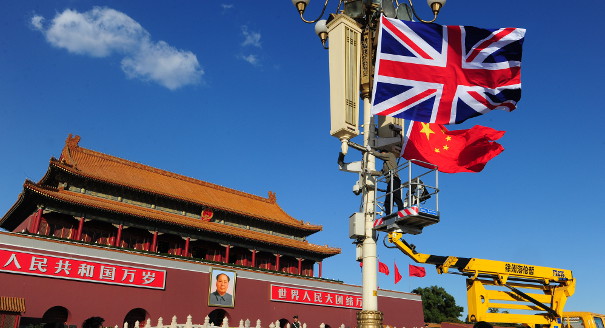
If and when the UK decides to close the curtain on its EU membership, China will be there, if and only if it suits Beijing’s own agenda.
Source: Institut Montaigne
During her recent visit to China, Prime Minister Theresa May emphasized one fact: after leaving the EU, "we - the United Kingdom - will be free to strike our own trade deals". As a first step towards a post-Brexit commercial agreement, the UK and China signed a “joint trade and investment review”, which is quite different from a trade agreement (hardly possible while the UK remains part of the EU). Meanwhile, £9 billion deals were signed.
This was the first time a British leader made an official trip to China since the 2016 Brexit referendum, but it was also a “return visit” following President Xi Jinping’s grand reception in London in October 2015. At the time, Prime Minister David Cameron and Chancellor of the Exchequer George Osborne announced the beginning of a “golden era” between the UK and China. Both men are now out of government following the result of the referendum they organised - and lost. The current Prime Minister is seen as less sympathetic to the China partnership than her predecessor. For example, she waited many months before giving the go-ahead to the €7 billion Hinckley Point nuclear plant funded by Chinese investments, a first for any Western nation. This program is now launched, but the new government’s hesitancy raised eyebrows in China.
The UK is already the EU’s top recipient for Chinese foreign direct investment (€23 billion in 2016) and has become China’s second largest trade partner in Europe (€62 billion). Still, the UK's trade deficit with China was €28.7 billion in 2016 (£25.4 billion), the highest on record. Would Brexit really make the UK China’s best friend per former Prime Minister David Cameron’s original dream?
Other Chinese investments include stakes in Thames Water, Heathrow and Manchester airports, London’s tallest building (the “Cheesegrater”) and British companies such as Weetabix, Pizza Express, and Sunseekers, not to forget two Premier League football clubs — Southampton FC and West Bromwich Albion. Huawei, a controversial Chinese telecommunication infrastructure company (which U.S. security agencies unanimously consider to be a potential threat to national security), is now a major supplier to British Telecom and employs about 1.000 staff.
The list goes on, and includes a growing presence in the City of London, the real “jewel of the crown” for China, which needs to internationalize further its currency, the Renminbi (RMB). In May 2016, London was granted the privilege of becoming a key-RMB trading platform alongside New York and Hong Kong. Chinese Treasury bonds are now being issued in London as the RMB is now included in the IMF’s basket of currencies. But China does not want to miss out on the Eurozone and the EU’s 420 million consumer market. No doubt other financial centres such as Frankfurt and Paris will also have their share.
Beijing’s man in London, Ambassador Liu Xiaoming, has been missioned to focus on the Sino-British friendship “beyond Brexit”. Negotiations on the future of the UK-Europe relationship may be moving slowly, but China is “ready to join hands with British friends from all sectors" he declared late last year to members of Parliament. “We are ready to join hands with each and every one of you present today and with British friends from all sectors to build a lasting China-UK "Golden Era" that will bear more "golden fruits" and deliver more benefits to the people of our two countries”, he said.
China’s state banks have raised their profile in London. Through capital increases, China is also a major shareholder in Britain’s largest bank, HSBC, a key-player in the Belt and Road Initiative, Beijing’s “New Silk Road”. Stepping in for Prime Minister Theresa May at the BRI summit in Beijing last May, British Chancellor Philip Hammond insisted that “Britain, lying at the Western end of the Belt and Road, is a natural partner in this endeavour”. For all the hopes of British engineering companies receiving huge consulting fees for infrastructure projects, it seems China is determined to use its own engineers and advisers, or sometimes the local ones. Moreover, Theresa May failed to give her full support to the BRI, when in China a couple of weeks ago.
From the beginning, there seemed to have been a divide within the British government on how to deal with China. The Foreign Office and the Home Office (previously run by a cautious Theresa May) had sent warnings about cyber espionage and the lack of reciprocity for British companies. There were also concerns about reactions across the Atlantic, after a senior White House official accused London of “constant accommodation” towards China, three years ago. The official was referring to London breaking ranks with European and American allies by being the first Western country to join Beijing’s new Asian Infrastructure Investment Bank, in 2015.
With Britain looking for partners outside the EU, there will surely be more accommodation, no less, which will heighten the risk of damaging further the relationship with Donald Trump’s United States, bracing itself for a possible trade war with China.
There are other issues at stake. The opacity of the Chinese economic system makes it difficult to foresee which direction China’s globalization will take next, besides pushing its exports growth in order to maintain a 6.5 percent growth rate. With a Chinese political system tightening its grip and imposing capital controls, many questions remain unanswered. If China is to play a larger role in the City, would the latter be able to maintain transparency regulations or would it have to redefine itself to match Chinese interests? What about money laundering?
Since the referendum, many British politicians have continued to publicly avoid controversial subjects such as human rights in China, Tibet, Taiwan, or even the political situation inside the former British colony of Hong Kong, now a special administrative region of China. A few weeks ago, it was also revealed that David Cameron had become vice chairman of a new £750 million UK government-backed China investment fund to “help British and Chinese businesses in sectors such as technology, healthcare and infrastructure”. Interestingly, "the fund will be domiciled in the Republic of Ireland", a country that will of course remain part of the EU. No doubt London is preparing for tomorrow’s challenges.
It is fair to say that Beijing was first taken aback by the 2016 referendum’s result. Originally, it wanted to use Britain as a key-entry point to the European Union single market. With Brexit looming, a stand-alone UK is looking for new partners. Last October’s 19th Communist Party Congress clearly stated China’s intention to be a top world player and interact with many countries. Post-Brexit, China will not be averse to make use of the UK’s main asset, i.e. its financial centre. As for Chinese previous plans to invest in the “northern powerhouse” (in the north of England) or poorer English regions, they seem to have faded away. If and when the UK decides to close the curtain on its EU membership, China will be there, if - and only if - it suits its own agenda.
This article was originally published by the Institut Montaigne.
Former Nonresident Senior Fellow, Europe Program
Philippe Le Corre was a nonresident senior fellow in the Europe Program at the Carnegie Endowment for International Peace.
Recent Work

Paul Haenle, Philippe Le Corre

Erik Brattberg, Philippe Le Corre, Paul Stronski, …
Carnegie does not take institutional positions on public policy issues; the views represented herein are those of the author(s) and do not necessarily reflect the views of Carnegie, its staff, or its trustees.
A leak of Russian gas price data helps establish that China is paying Russia far less than Central Asian countries and Gazprom’s former European customers.

Sergey Vakulenko

China’s political future will be shaped between now and next October. As the Communist Party enters its intense “campaign season” to prepare for a major political transition in 2027, reading Beijing's actions and responses may become more difficult as domestic politics weigh on its behavior more than usual.

Damien Ma

The EU can impose sanctions but struggles to enforce them without the United States. With Washington increasingly disinterested in backing European interests, the bloc must now fend for itself.


Nicu Popescu, Tiago Antunes
Global and rising powers will need to engage with Africa’s priorities and agency in order to secure the continent’s increasingly attractive partnerships.
Fonteh Akum

Rubio’s recent visit brought welcome attention, but more capital requires governance changes that may be a hard sell for regional governments.

Jennifer B. Murtazashvili