

Commentary
- +3
Marwan Muasher, Amr Hamzawy, Rain Ji, …
{
  "authors": [
    "Yasmine Farouk"
  ],
  "type": "commentary",
  "centerAffiliationAll": "dc",
  "centers": [
    "Carnegie Endowment for International Peace",
    "Malcolm H. Kerr Carnegie Middle East Center"
  ],
  "collections": [],
  "englishNewsletterAll": "menaTransitions",
  "nonEnglishNewsletterAll": "",
  "primaryCenter": "Carnegie Endowment for International Peace",
  "programAffiliation": "MEP",
  "programs": [
    "Middle East"
  ],
  "projects": [],
  "regions": [
    "North America",
    "United States",
    "Middle East",
    "Iran",
    "Saudi Arabia"
  ],
  "topics": [
    "Political Reform",
    "Security",
    "Foreign Policy"
  ]
}
Source: Getty
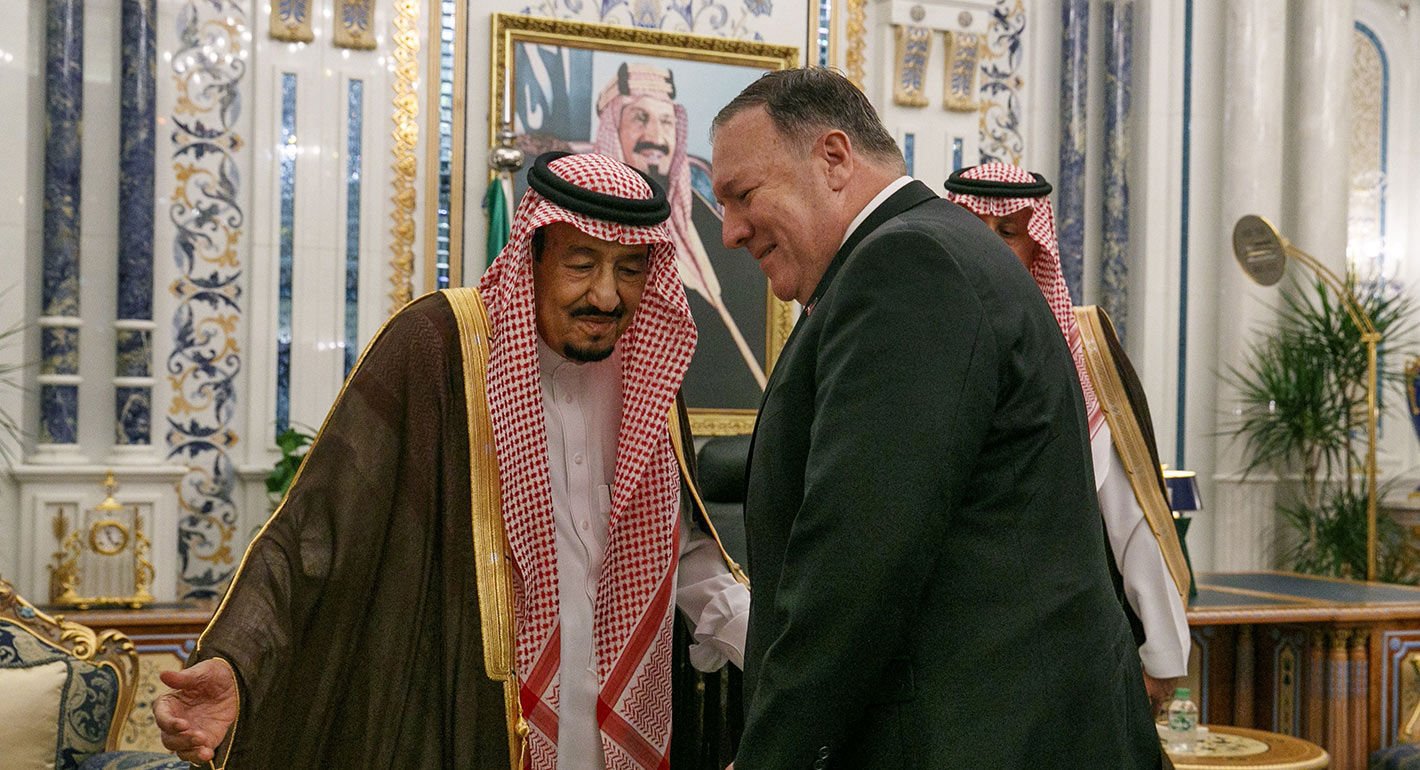
Riyadh has far more to lose than Washington from escalation with Tehran. A policy of incremental Saudi engagement offers the kingdom a way out of the crisis.
While visiting the Saudi capital on May 21, 2017, for his first official trip overseas, U.S. President Donald Trump called for an international effort to “isolate Iran, deny it funding for terrorism, and pray for the day when the Iranian people have the just and righteous government they deserve.”
Since then, Saudi Arabia has applauded the U.S. withdrawal from the Iran nuclear deal and encouraged the U.S. maximum pressure campaign on Iran. Yet, as tensions mount dangerously in the Gulf, Riyadh has had little control over how U.S. policy is unfolding. Without leverage, Saudi Arabia must absorb the brunt of the fallout of U.S.-Iran military escalation. Saudi Arabia should use the crisis to revisit its own Iran policy.
The kingdom should start by asking if the U.S. approach is serving Saudi interests. Riyadh’s current all-or-nothing Iran policy matches with the U.S. view. It demands that Iran become a “normal state,” as the Saudi crown prince Mohammed Bin Salman put it, before Saudi Arabia re-engages.
But it is Saudi Arabia, not the United States, that will bear the costs of the Iranian response to the U.S. maximum pressure campaign. Limiting how this escalation plays out in Saudi waters and territory gives the kingdom a strong incentive for a more pragmatic approach. It is time for the Saudis to shift gears by de-escalating their role in the conflict and trying to prevent a U.S.-Iran war, which would harm the kingdom and its interests.
The attacks on Saudi ships in the Gulf and escalating Houthi attacks on Saudi territory are no coincidence. The Iranian regime has few cards to play to spark international pressure on the United States to de-escalate, but those it does have come at Saudi Arabia’s expense. Trump administration officials believe the maximum pressure policy is working, and they expect full Saudi support, regardless of the consequences. Maximum pressure may offer some short-term benefits to the kingdom, but the road to war is long. If the status quo continues, then more Saudi ships may be sunk, and more Saudi civilians and soldiers may be killed.
The crown prince said recently, “The Kingdom doesn’t want a war in the region.” But to stop one, the Saudi and Iranian governments must talk to each other. This might be the first step in a longer incremental process that would address the threats Iran poses to Saudi Arabia one at a time.
The United States cannot blame Saudi Arabia if it chooses to engage. Trump has repeatedly made overtures to leaders of U.S. antagonists, and Secretary of State Mike Pompeo even said that the United States is “prepared to engage in a conversation [with Iran] with no preconditions.” A Saudi step in the same direction would give Riyadh leverage in subsequent U.S.-Iran negotiations. The Iranian minister of foreign affairs, Javad Zarif, has already suggested a non-aggression pact with the Gulf states that Saudi Arabia’s new friends in Moscow are ready to facilitate.
Even if there is an all-out war, Trump has proved himself a fickle friend. Trump’s Iran policy is a new testament to his “America First” mentality that sees allies’ security as collateral damage. His position is that other powers who are more heavily and strategically dependent on oil from the Gulf should be responsible for preserving their own interests. The United States will not invest in Gulf security beyond arms sales, unless there are significant attacks against narrowly defined U.S. interests. And it would take some serious convincing on Capitol Hill to get the U.S. Congress to allow military operations in defense of Saudi Arabia, given many lawmakers’ opinions of the kingdom’s human rights record. But bold Saudi diplomacy could enhance Saudi Arabia’s reputation on the Hill.
Saudi Arabia’s European and Asian partners are watching the situation closely. But some may be reluctant to provide significant assistance to prevent escalation, in the absence of a U.S. security guarantee. Direct talks between Saudi Arabia and Iran to find a safe exit ramp from the current crisis could patch the credibility of Riyadh’s claims not to want war with Tehran.
Saudi Arabia’s own regional allies would also welcome a new Saudi policy on Iran with incremental but realistic objectives. International and regional support for the kingdom’s security becomes more likely if Saudi Arabia shows credible signs of distancing itself from the current military escalation. Such a shift may also open the door to an honorable and regionally supported exit from Yemen and a realistic implementation of the U.S. project of a Middle East Strategic Alliance.
Saudi Arabia and Iran have attempted this kind of incremental engagement before. With the exception of the United States, the countries that signed the Iran nuclear deal are ready to consider that agreement as a first step toward a comprehensive form of engagement with Iran that deals with other Iranian threats to Saudi Arabia and the region one at a time. Such an incremental approach provides a next step that the current Trump policy hasn’t been able to supply. Saudi Arabia will pay a steep price for the U.S.-led campaign against Iran. The kingdom should choose a wiser path and seek to take its fate into its own hands.

Former Nonresident Scholar, Middle East Program
Yasmine Farouk was a nonresident scholar in the Middle East Program at the Carnegie Endowment for International Peace.
Recent Work


Marwan Muasher, Amr Hamzawy, Rain Ji, …
Yasmine Farouk
Carnegie does not take institutional positions on public policy issues; the views represented herein are those of the author(s) and do not necessarily reflect the views of Carnegie, its staff, or its trustees.

In an interview, Rozina Ali discusses her new book on the rise and manifestations of Islamophobia in the United States.

Michael Young

While the EU and European governments are embracing the much-lauded middle-power moment, this entails three difficult conundrums.

Richard Youngs
The middle power moment will not be defined by sovereign states alone, and California stands out for its potential contributions to international cooperation.


Ian Klaus, Stewart Patrick

Ex-president Gurbanguly Berdimuhamedov remains interested in politics, but his son Serdar, Turkmenistan’s current president, is becoming increasingly independent and willing to break with his father’s legacy. If their covert rivalry goes too far, both risk losing power.

Galiya Ibragimova

Europe is facing rising populism internally as well as external pressures from Russia, China, Turkey, and the United States.

Dimitar Bechev