
• Research
  • Emissary
  • About
  • Experts
Carnegie Global logoCarnegie lettermark logo
DemocracyIran
  • Donate
{
  "authors": [
    "Kathryn Botto"
  ],
  "type": "other",
  "centerAffiliationAll": "dc",
  "centers": [
    "Carnegie Endowment for International Peace"
  ],
  "collections": [],
  "englishNewsletterAll": "asia",
  "nonEnglishNewsletterAll": "",
  "primaryCenter": "Carnegie Endowment for International Peace",
  "programAffiliation": "AP",
  "programs": [
    "Asia"
  ],
  "projects": [],
  "regions": [
    "East Asia",
    "South Korea"
  ],
  "topics": [
    "Political Reform",
    "Security",
    "Foreign Policy"
  ]
}

Source: Getty

Other

Moon Jae-in: Putting North Korea at the Center

It is impossible to divorce the U.S.-South Korean alliance and inter-Korean issues, or to separate them from the overall context of international relations not only in Northeast Asia, but also in the global arena.

Link Copied
By Kathryn Botto
Published on Jun 24, 2020
Program mobile hero image

Program

Asia

The Asia Program in Washington studies disruptive security, governance, and technological risks that threaten peace, growth, and opportunity in the Asia-Pacific region, including a focus on China, Japan, and the Korean peninsula.

Learn More

Source: Korea Economic Institute of America

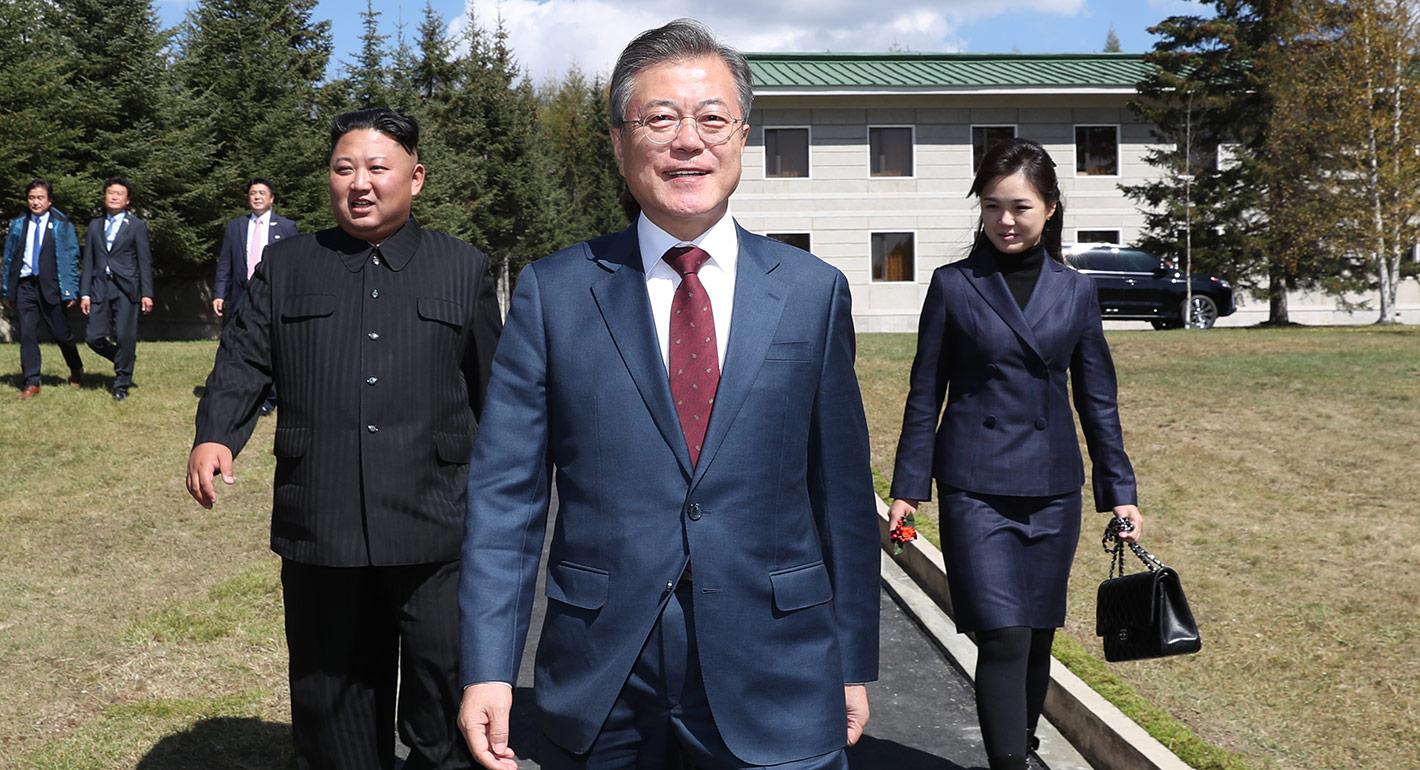
While President Moon Jae-in has a calmer demeanor than his mentor and friend, former President Roh Moo-hyun, there can be no doubt that his vision for transforming Northeast Asia is as far-reaching. While Moon has been more careful to assuage the U.S. president, less abrasive in his language toward Japan, and more strategic in reaching out to leaders in China and Russia, his strategy of putting North Korea at the forefront of regional realignment has similar geopolitical ambition. The objective is the rejuvenation of a reintegrated peninsula with the capacity to steer actions by all of the great powers rather than falling prey again to their machinations that are not in Korea’s interest.

During his presidential election campaign, candidate Moon remarked of his life-long friend, Roh Moo-hyun: “If I take the office, I’ll tell him at his memorial service, ‘Now you rest in peace. I’ll realize your unachieved dreams.’” Though Moon served as a top aide in the Roh administration, he saw himself as ultimately returning to a career in law. But Roh’s tragic suicide galvanized Moon to enter electoral politics for the first time and win a seat in the National Assembly. It was fitting, then, that when Moon gave his first speech on his vision for inter-Korean relations at the Körber Foundation on July 6, 2017 he characterized himself as “inheriting” the engagement policy of his progressive predecessors Roh and Kim Dae-jung.

Read Full Text

This article was originally published by the Korea Economic Institute of America.

About the Author

Kathryn Botto

Former Senior Research Analyst, Asia Program

Kathryn Botto was a senior research analyst in the Asia Program at the Carnegie Endowment for International Peace. Her research focuses on Asian security issues, with particular emphasis on the Korean Peninsula and U.S. defense policy towards East Asia.

Kathryn Botto
Former Senior Research Analyst, Asia Program
Political ReformSecurityForeign PolicyEast AsiaSouth Korea

Carnegie does not take institutional positions on public policy issues; the views represented herein are those of the author(s) and do not necessarily reflect the views of Carnegie, its staff, or its trustees.

More Work from Carnegie Endowment for International Peace

  • Pashinyan shaking hands
    Commentary
    Emissary
    At Stake in Armenia’s Election: Peace and Russian Influence

    Regardless of the outcome, there’s another path to ensuring that progress doesn’t stall.

      Zaur Shiriyev

  • Commentary
    Emissary
    Trump and Xi Are Angling for Three Years of Stability

    But their "principal to principal" model will only be as effective as the political strength of each leader back home.

      • Damien Ma

      Damien Ma

  • Recruit polices vow as they join in the police at Beijing Public Security Bureau on February 18, 2011 in Beijing, China. (
    Paper
    China’s Police and Security Cooperation Agreements

    China’s Ministry of Public Security is often portrayed as a domestic law enforcement agency, but it is also a global security actor. This paper explores how MPS has used international law enforcement and security cooperation agreements—over 200 since 2006—to advance China’s vision of security in a changing global environment.  

      • Sheena Chestnut Greitens

      Sophie Zhuang, Sheena Chestnut Greitens, Cameron Waltz

  • Commentary
    Carnegie Politika
    Could Migrants From India and Africa Solve Russia’s Labor Shortage?

    The demands of the Kremlin’s war in Ukraine, demographic problems, and public hostility toward Central Asians mean Russia does not have enough workers.  

      Salavat Abylkalikov

  • Commentary
    Strategic Europe
    Europe Should Not Let Nuclear Nonproliferation Die

    Amid uncertainty caused by the Iran war, the global drive for nonproliferation has stalled. With Europe diplomatically marginalized and countries reassessing their nuclear options, efforts to curb the spread of nuclear weapons risk becoming irrelevant.

      • Jane Darby Menton

      Jane Darby Menton

Get more news and analysis from
Carnegie Endowment for International Peace
Carnegie global logo, stacked
1779 Massachusetts Avenue NWWashington, DC, 20036-2103Phone: 202 483 7600
  • Research
  • Emissary
  • About
  • Experts
  • Donate
  • Programs
  • Events
  • Blogs
  • Podcasts
  • Contact
  • Annual Reports
  • Careers
  • Privacy
  • For Media
  • Government Resources
Get more news and analysis from
Carnegie Endowment for International Peace
© 2026 Carnegie Endowment for International Peace. All rights reserved.