

Article
Thomas de Waal, Areg Kochinyan, Zaur Shiriyev
{
  "authors": [
    "Thomas de Waal"
  ],
  "type": "commentary",
  "centerAffiliationAll": "",
  "centers": [
    "Carnegie Endowment for International Peace",
    "Carnegie Europe"
  ],
  "collections": [
    "Europe’s Eastern Neighborhood"
  ],
  "englishNewsletterAll": "",
  "nonEnglishNewsletterAll": "",
  "primaryCenter": "Carnegie Europe",
  "programAffiliation": "",
  "programs": [],
  "projects": [],
  "regions": [
    "Europe",
    "Eastern Europe",
    "Western Europe",
    "Belarus"
  ],
  "topics": [
    "Democracy",
    "Foreign Policy"
  ]
}
Source: Getty
As the crisis intensifies in Belarus, how should the EU prepare to help the country transition politically?
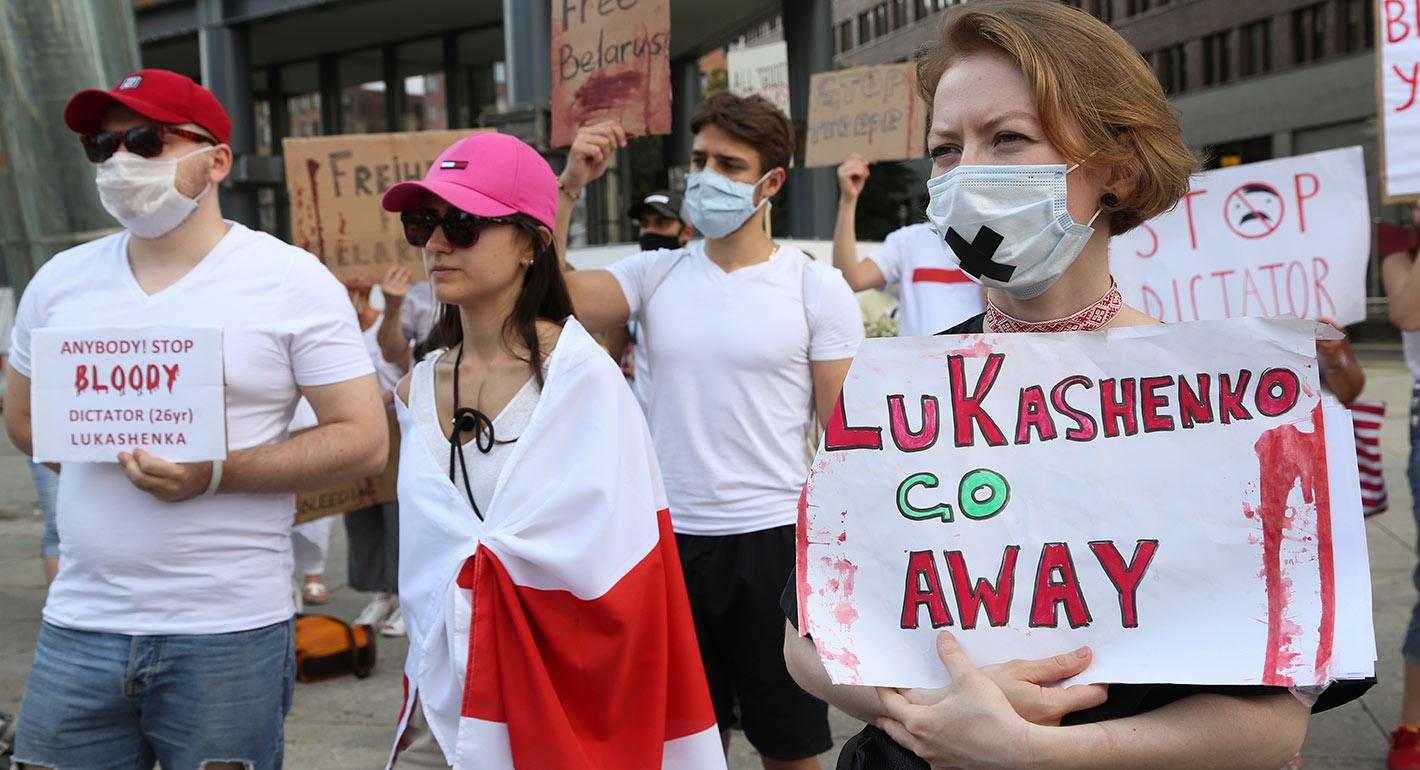
The political crisis in Belarus is now so protracted that analysts are reaching for chess metaphors. The opposition owns the streets of the capital city, Minsk, as another huge demonstration proved again on Sunday, September 27. Yet Belarusian President Alexander Lukashenko, whose sickening brutality has shocked the world, is not giving up power any time soon. His bizarre secret inauguration ceremony on September 23 was the stunt of a man who is both stubborn and weak.
Moscow is trying to wait things out, giving some support to Lukashenko, but keeping its options open. As in a chess endgame, too bold a move for any of the players could spell doom.
The same is true of the EU. The strange thing about the EU’s response is that it cannot afford to be too active: if Europe is seen to support the democratic opposition too openly, this paradoxically could throw a lifeline to Lukashenko. His last card is to show the Russians that he is confronting a genuine threat of a Western takeover and that Moscow is losing a strategic buffer.
This is why EU High Representative Josep Borrell has been emphatic in focusing on the egregious human rights abuses, while saying that the geopolitical choice of the country “belongs to [the] Belarusian people.”
The EU actually has very little leverage in Belarus. It has been largely absent from the country over the last three decades and provides only about 30 million euros in annual grant assistance, a tiny fraction of what it gives to neighboring Ukraine.
The fiasco over the EU’s failure to impose sanctions because of the Cypriot veto has little practical effect on the ground. Unlike their Russian counterparts, few Belarusian officials fear EU sanctions as the Belarusians do not keep major assets in EU countries. But the episode is highly damaging to the EU’s ambition to be a strong actor. If credibility is to be restored, the upcoming European Council meeting must rectify this quickly.
Europe’s strength is its long-term vision. A recent survey shows that the younger generation now strongly identifies with Western democracy and has rejected the Soviet values of “stability” that are the core of Lukashenko’s brand. Support for Lukashenko is estimated at just 26 percent.
So the struggle is all about the medium to longer term. Lukashenko is now the president that no one wants. The man who famously liked to try to do the “Eurasian shuffle” and play both the West and Russia has now alienated both. Russian political commentator Gleb Pavlovsky acidly calls Lukashenko “a traitor who got tangled up in his betrayals.” The bizarre inauguration ceremony of which even Moscow was not informed only confirms that his legitimacy has collapsed—speaking on Radio Free Europe/Radio Liberty, one opposition supporter called it a “farewell banquet.”
So the day of reckoning is postponed, but quite soon—in a few months’ time, perhaps—the question will arise as to who can frame the better vision for Belarus for the future.
There are plenty of signs that Russian President Vladimir Putin and his administration are planning for this scenario as well. Putin never liked Lukashenko—just as former Russian president Boris Yeltsin never liked him before that. The insightful Belarusian commentator Artyom Shraibman says he has become a “toxic asset” for Russia.
The charge sheet was already long before this election took place: indiscreet interviews where Lukashenko spilled the beans on private conversations with the Russian leadership; his refusal to accept the Russian takeover of Crimea in 2014; his earlier refusal to recognize Abkhazia and South Ossetia and his political flirtation with Moscow’s bête noire, Mikheil Saakashvili. In the recent election campaign, Lukashenko once again ran as the protector of Belarusian sovereignty against Moscow and had thirty-two Russian security personnel arrested for being alleged members of the Wagner mercenary group.
The $1.5 billion assistance package that Putin promised in Sochi looks less impressive once you read economists’ parsing of the numbers. Belarus has so many debts to Russia that, as one commentator put it, "In reality this is money being transferred from one Russian pocket to another.”
The sum of this turn of events is that Moscow cares about Lukashenko and Belarus mainly in negative terms. The Kremlin does not want to see Lukashenko hastily removed as that could set a bad precedent for Putin’s own future. The Kremlin doesn’t want to see Belarus lean toward the West as Ukraine has since 2014.
The EU can do better than that. That is why it is important that Brussels makes its pitch to the whole of Belarusian society and signals that the opposition Coordination Council is not its only interlocutor.
The key audience the EU should have in mind is one that it cannot even talk to directly: the Belarusian elite. Many of them are surely waiting to see when and if they should jump ship and abandon Lukashenko.
With these floating voters in mind, the EU can prepare to announce a big assistance package which could be made available as soon as a democratic transition has occurred in Belarus. That package will put the EU on the same kind of friendly terms as it has with Armenia, without predicating a geopolitical path for the country. As Ryhor Astapenia has written, a package of this sort “would send a strong signal to economic reformers who remain inside Lukashenka’s system, giving them a genuine choice between a functioning Belarusian economy or sticking with Lukashenka.”
The EU could offer economic support coordinated with the IMF, the World Bank, the European Bank for Reconstruction and Development, and the European Investment Bank. This support could be aimed particularly at the industrial assets that Russia has its eye on; support for the country’s IT sector, which is now struggling; and the eventual promise of visa liberalization, as Georgia, Moldova, and Ukraine now enjoy.
The challenge will be mainly inside Brussels: how to keep focused and coordinated on a small country, and how to raise enough money to make the package credible (even if the 1 billion euro figure mentioned by the Polish prime minister looks highly optimistic). If Brussels can keep its own house together, it can be there for Belarus once the smoke clears on the day after Lukashenko.

Senior Fellow, Carnegie Europe
De Waal is a senior fellow at Carnegie Europe, specializing in Eastern Europe and the Caucasus.
Recent Work

Thomas de Waal, Areg Kochinyan, Zaur Shiriyev
Thomas de Waal
Carnegie does not take institutional positions on public policy issues; the views represented herein are those of the author(s) and do not necessarily reflect the views of Carnegie, its staff, or its trustees.
Although Ukrainian strikes have led to a noticeable decline in the physical volume of Russian oil exports, the rise in prices has more than made up for it.

Sergey Vakulenko
Five problems—and solutions—to make it actually work as a tool of great power competition.
Afreen Akhter
The Russian leadership wants to avoid a dangerous precedent in which it is squeezed out of Iran by the United States and Israel—and left powerless to respond in any meaningful way.

Nikita Smagin
One is hopeful. One is realistic. One is cautionary.

Andrew Leber, Sam Worby
In Ukraine, Gaza, and Iran, AI warfare has come to dominate, with barely any oversight or accountability. Europe must lead the charge on the responsible use of new military technologies.

Raluca Csernatoni