

Article
Zaha Hassan
{
  "authors": [
    "Zaha Hassan"
  ],
  "type": "commentary",
  "blog": "Emissary",
  "centerAffiliationAll": "dc",
  "centers": [
    "Carnegie Endowment for International Peace"
  ],
  "collections": [
    "Palestine/Israel Projects"
  ],
  "englishNewsletterAll": "menaTransitions",
  "nonEnglishNewsletterAll": "",
  "primaryCenter": "Carnegie Endowment for International Peace",
  "programAffiliation": "MEP",
  "programs": [
    "Middle East"
  ],
  "projects": [
    "Shrinking Civic Spaces for Palestine/Israel Discourse"
  ],
  "regions": [
    "North America",
    "United States",
    "Middle East",
    "Israel",
    "Palestine"
  ],
  "topics": [
    "Security",
    "Global Governance"
  ]
}
Source: Getty
Too much is at stake: too many Palestinian and Israeli lives, too much U.S. credibility, and too high the risk of regional conflagration.
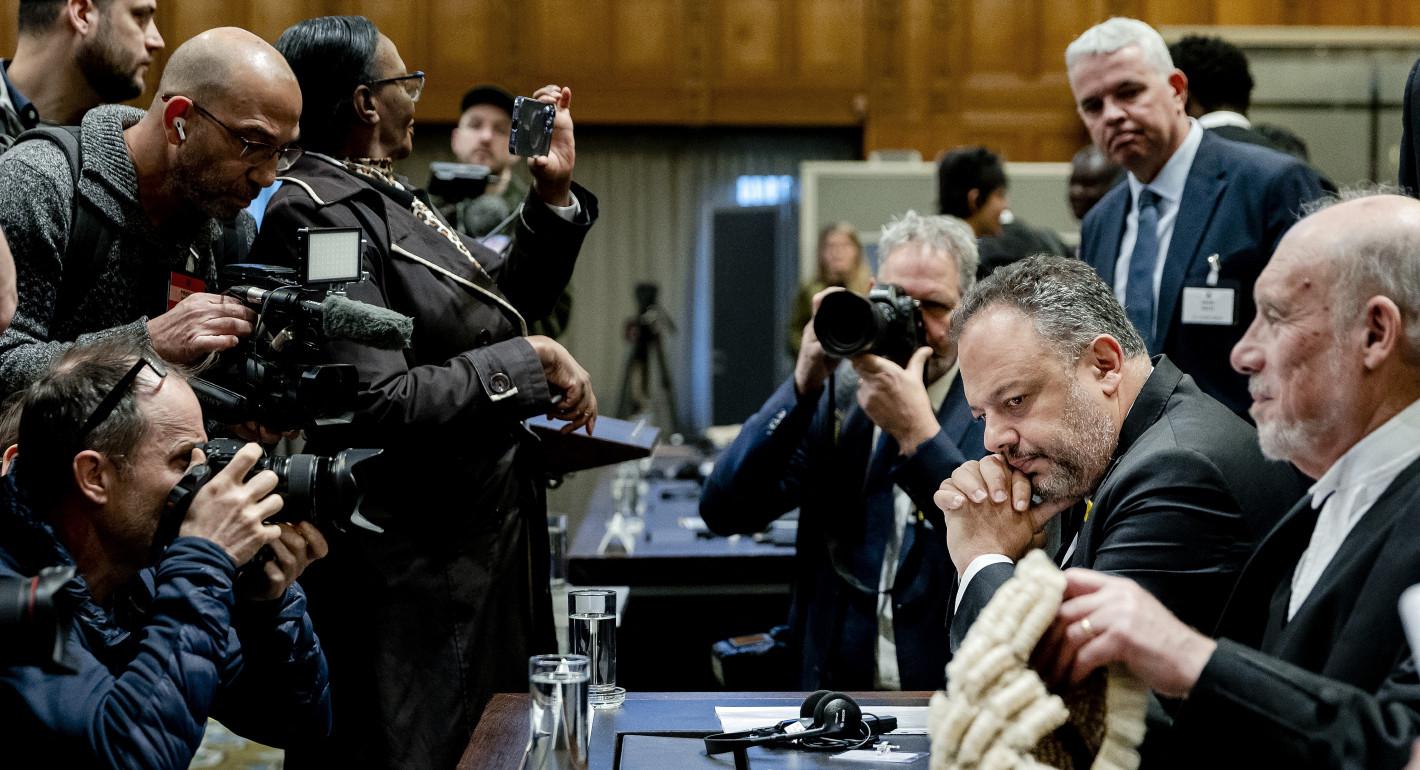
Last week, South Africa presented a well-argued case before the International Court of Justice (ICJ), the UN’s judicial arm, alleging Israel is committing genocide in Gaza. Israel denies the charges and claims its actions in Gaza are self-defense. A state-to-state complaint about “the crime of crimes” should be a big deal to the administration of U.S. President Joe Biden, particularly when it involves a close ally receiving around $4 billion per year in U.S. security assistance (and fast-tracked for more). Yet the response of U.S. officials has been milquetoast, dismissing the case as meritless and without any factual basis. At the same time, the White House has also asserted that it has made no legal assessment about Israel’s conduct in Gaza or how U.S. weapons may have been misused.
How can both things be true? Either the United States has information about whether Israel is acting within the constraints of international law, including the 1948 Genocide Convention, or it is completely in the dark. The United States cannot have it both ways. Too much is at stake: too many Palestinian and Israeli lives, too much U.S. credibility, and too high the risk of regional conflagration.
Of course, the Biden administration knows what is taking place inside Gaza. It knows because it has had surveillance drones flying above Gaza since October 7. It knows because U.S. intelligence analysts are likely following journalists who are risking their lives to report and the Palestinians in Gaza who are live-streaming via TikTok, Instagram, and Telegram. It knows which types of munitions Israel has been dropping, firing, and shooting into Gaza’s densely populated cities and refugee camps because it is Israel’s principal supplier, and it knows what kind of damage these munitions do when used in such areas.
Numerous reports and accounts from UN special rapporteurs, the United Nations Children’s Fund, the World Food Programme, Human Rights Watch, Save the Children, the Norwegian Refugee Council, and others explain the impacts of Israel’s war inside Gaza. Their reports are all public, as are the statements of their representatives. These organizations also report that civilians and civilian infrastructure are being targeted, that the vast majority of those killed are women and children, that the bombing is indiscriminate and not in proportion to the threat posed, and that hundreds of thousands of the 2.3 million Palestinians in Gaza are being forcibly displaced, starved, and deprived of water and medical treatment. They say that Palestinians are being killed in their homes and shelters, they are being killed when they try to flee, and they are being killed in the so-called safe zones that Israel has designated. They say 100,000 more Palestinians could die in the days and weeks to come if the bombing does not stop and a massive amount of humanitarian aid is not allowed in.
But knowing the facts on the ground is not the same as assessing them. And an assessment is needed in order to get to a legal conclusion that would require the United States to act to put in place a ceasefire. As a party to the Genocide Convention, the United States is required to “undertake to prevent and punish” the crime of genocide. That commitment becomes meaningless if the United States can simply look away when the party accused of international crimes is an ally or if the outcome of an assessment is inconvenient. As Biden has stated, preventing genocide is both a “moral duty and a matter of national and global importance.” That is why the White House has an atrocity prevention and response strategy and why the Elie Wiesel Genocide and Atrocities Prevention Act requires the State Department to monitor for such events around the world and prepare annual reports on what it is doing to prevent them. The act also requires foreign service officers to be trained to spot the early warning signs for such grave human rights violations and an all-of-government approach to prevent genocide from happening.
The United States may want to maintain its certainty that Israel is not committing any grave human rights violations in Gaza by avoiding an assessment, but the ICJ case—which is supported by at least fifty countries, the Arab League, and the Organization of Islamic Cooperation—may force its hand, even if a decision on the case’s merits takes years. South Africa’s request for provisional relief, which includes a call for an immediate ceasefire and entry of humanitarian aid, may be only days away. The burden of proof required for provisional relief —“plausibility” that a violation of the Genocide Convention has occurred—is less than what is required for a final ruling.
The ICJ will likely rule that the provisional relief burden has been met, because the Israeli acts in Gaza are so well-documented, as is the apparent genocidal intent of Israeli officials leading the war. The most egregious of these statements includes directives to military personnel about starving Gaza, expressions of support for “voluntary immigration” of Palestinians, and the use of biblical analogies in speeches to soldiers about the permissibility of killing all innocents in war.
Time is running out for Palestinians in Gaza. But it is also running out for the Biden administration. South Africa is reportedly preparing to file a complaint against the United States for complicity in the commission of genocide. Attempts to quietly coax and cajole Israel into opening up one more crossing for humanitarian aid or to allow one more truckload of supplies in from Egypt will not make for a convincing argument at the ICJ.
The United States must make an assessment about Israel’s actions in Gaza and act accordingly. The Biden administration must lead a renewed effort at the UN Security Council for a resolution calling for an immediate ceasefire, and it must be willing to back up the resolution with the full measure of its resolve, including suspending military assistance to Israel. U.S. inaction would continue to jeopardize Palestinians’ lives, risk an outbreak of regional war, and carry the permanent stain associated with a possible ICJ finding that the United States was complicit in or failed to prevent genocide. The U.S. response to the ICJ cannot be that it never made an assessment.

Senior Fellow, Middle East Program
Zaha Hassan is a human rights lawyer and a senior fellow at the Carnegie Endowment for International Peace.
Recent Work
Zaha Hassan
Zaha Hassan, Charles H. Johnson
Carnegie does not take institutional positions on public policy issues; the views represented herein are those of the author(s) and do not necessarily reflect the views of Carnegie, its staff, or its trustees.

It signals a new era of tech diffusion and warfare.

Steve Feldstein

Despite its flop at the box office, the film raises important questions for the climate community to answer.

Leonardo Martinez-Diaz

The acknowledgment has sparked fears of a new arms race with China and Russia.

Chris O’Meara
The summit may be remembered as a fatal blunder, when Washington, Beijing, and the AI industry collectively chose ceremony over action.

Jeffrey Prescott
The real test may come after the leaders leave the room.



Sheena Chestnut Greitens, Oriana Skylar Mastro, Yukon Huang, …