

Paper
Christopher Shell
{
  "authors": [
    "Christopher Shell"
  ],
  "type": "commentary",
  "blog": "Emissary",
  "centerAffiliationAll": "dc",
  "centers": [
    "Carnegie Endowment for International Peace"
  ],
  "collections": [],
  "englishNewsletterAll": "americanStatecraft",
  "nonEnglishNewsletterAll": "",
  "primaryCenter": "Carnegie Endowment for International Peace",
  "programAffiliation": "ASP",
  "programs": [
    "American Statecraft"
  ],
  "projects": [],
  "regions": [
    "North America",
    "Haiti",
    "Central America and the Caribbean"
  ],
  "topics": [
    "Democracy",
    "Security"
  ]
}
Source: Getty
Its latest round of instability runs the risk of exacerbating an already dire crisis for its citizens and neighbors.
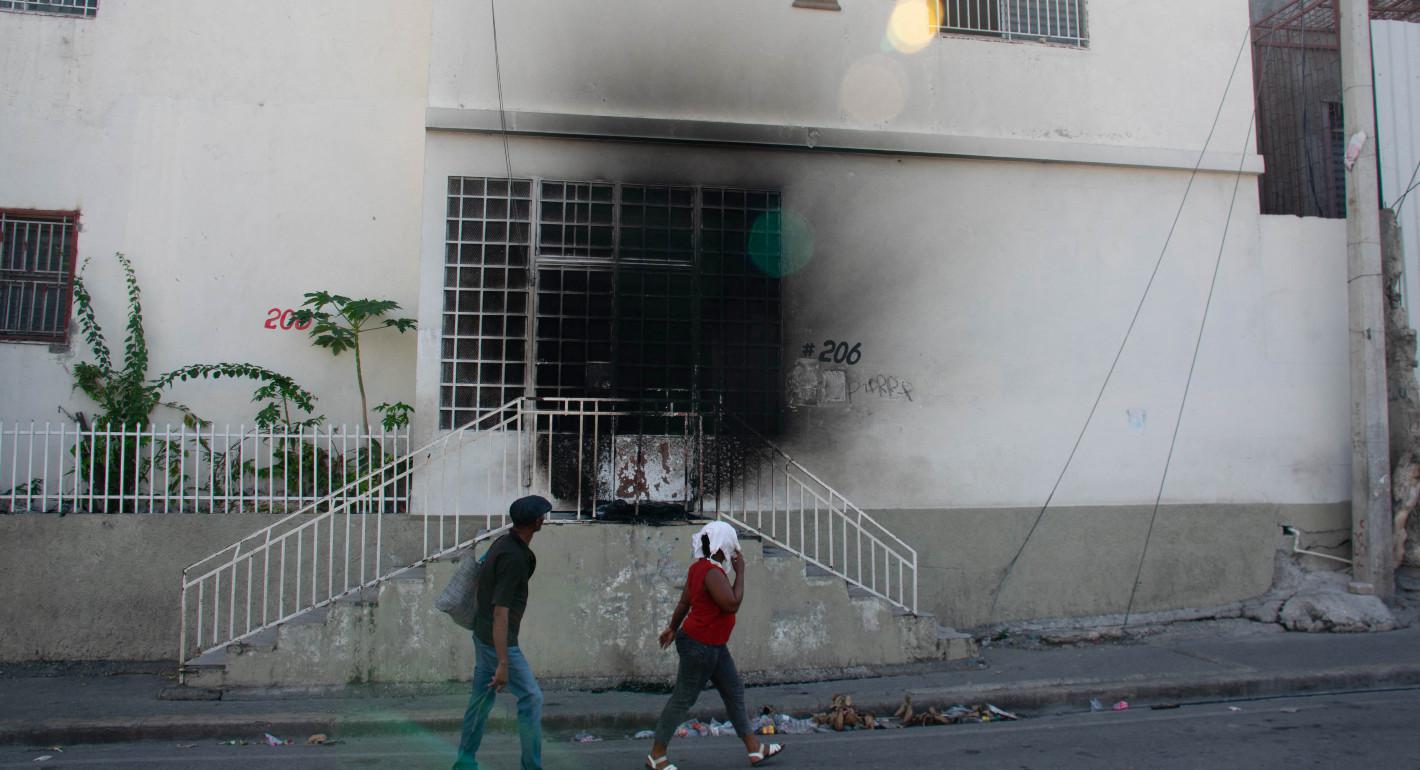
Six months since the UN Security Council approved a Kenyan-led multinational support mission to Haiti, the capital of Port-au-Prince has once again descended into chaos.
This latest iteration of gang violence includes attacks on the National Penitentiary—which resulted in the escape of almost 4,000 prisoners, many of whom are affiliated with gangs—and the country’s main international airport. Haiti’s top gang leader and former police officer Jimmy “Barbecue” Chérizier announced that unless Haitian Prime Minister Ariel Henry resigns, there will be “civil war that will lead to genocide.”
This round of violence looks like a last-ditch effort to remove Henry before international peacekeepers arrive to the island and potentially ensconce his rule. Henry’s regime is vastly unpopular among many Haitians. So too, however, is the gang rule responsible for impeding badly needed humanitarian aid and the deaths of thousands of civilians following the 2021 assassination of president Jovenel Moïse. Moïse’s death, followed by Henry’s power grab, created a vacuum in which gangs control roughly 80 percent of Port-au-Prince and wage warfare that has displaced 300,000 civilians and killed 1,200 people this year.
The UN’s initial plan to address the chaotic and violent situation in the capital was to deploy 1,000 Kenyan police to provide security. But a week after that October decision, the Kenyan High Court ruled that sending police to Haiti was unconstitutional.
Henry was in Kenya this week to sign a bilateral deal with Kenyan President William Ruto that would unblock the legal obstacles to the deployment of Kenya’s peacekeeping force. This possibility seems to have unleashed the latest wave of violence, and as of Wednesday, Henry had not returned to Haiti.
Although the multinational force has received criticism from those in Haiti and abroad, it has significant buy-in from African and Caribbean nations. The Bahamas, Bangladesh, Barbados, Benin, Chad, and Jamaica have formally pledged troops to support the Kenyan peacekeeping force. The United States has also pledged $200 million in logistical support, alongside Canada’s nearly $60 million and France’s $4 million.
Since Moïse’s assassination, the administration of U.S. President Joe Biden has remained resolute against sending U.S. troops, likely influenced by the painful lessons of previous U.S. interventions in Haiti in the 1990s and early 2000s. But Biden still stands behind the deployment of the Kenyan contingent. And although the administration has been clear that it wishes to see democratic order restored in Haiti, several House Democrats believe that U.S. support for the peacekeeping force will not alleviate Haiti’s protracted violence and poverty and will only maintain the status quo. In a December letter to Secretary of State Antony Blinken, six Democratic lawmakers noted, “Another armed foreign intervention in Haiti . . . risks further destabilizing the country, endangering more innocent people, and entrenching the current, illegitimate regime.”
Washington will almost certainly not budge from its position in support of a multinational security force. However, a subtle but significant shift in U.S. policy may be underway. Since 2021, Henry enjoyed U.S. backing, even as he postponed elections and refused to discuss terms for a transitional government. (Haiti’s last elections were held in 2016.) But increased pressure from Washington could finally force Henry to facilitate a transitional government in preparation for the security mission.
When asked if the United States has asked Henry to resign from power, U.S. Ambassador to the UN Linda Thomas-Greenfield responded that Henry has been asked to “move forward on a political process” that will lead to elections—actions she deemed “urgent.” Furthermore, Caribbean leaders, whom Washington has worked with closely to combat Haiti’s issues, recently revealed that they presented Henry with the option of resigning, which he rejected. This appeal shows that the desire to see a transition in power to avoid further devastation has expanded to regional leaders. After all, Haiti’s political instability runs the risk of exacerbating an already dire migrant crisis in the Caribbean that has taxed the humanitarian capabilities of the Bahamas, Dominican Republic, and Turks and Caicos.
Henry’s exit could appease gang leaders and quell the violence—if only for a moment. But that could risk opening the door for gang leaders and other not-so-favorable political actors to fill the void. For instance, Chérizier, who is accused of multiple human rights crimes, or former rebel leader Guy Philippe, who spent several years in a U.S. prison for money laundering but is now in Haiti calling for Henry’s resignation, might end up in power.
Haiti’s continued violence remains tragic for both its citizens and its neighbors. Washington may have to accept the fact that its tacit support of Henry has reached its limit. Facilitating a pathway for Henry’s exit and the election of a leader chosen by the people may be what stands between stability or more violence in Haiti.
Former Fellow, American Statecraft Program
Christopher Shell was a fellow in the American Statecraft Program at Carnegie Endowment for International Peace.
Recent Work
Christopher Shell
Christopher Shell
Carnegie does not take institutional positions on public policy issues; the views represented herein are those of the author(s) and do not necessarily reflect the views of Carnegie, its staff, or its trustees.

It signals a new era of tech diffusion and warfare.

Steve Feldstein
Fatima El Mansouri is the country’s first female prime minister. She’s also a privileged insider in a largely ceremonial position.

Sarah Yerkes

The Horn of Africa countries are among those facing a new security calculus.


Andrew Leber, Lesley Anne Warner
They face an uphill climb, but they could draw on a strategy that other diplomats have used in the past.


Shana Tabak, Alejandro Martin Rodriguez

The books, podcasts, and films that explain the world it made.
Andrew Leber