

Commentary
The real test may come after the leaders leave the room.
- +1
Sheena Chestnut Greitens, Oriana Skylar Mastro, Yukon Huang, …
{
  "authors": [
    "Toby Dalton",
    "Ariel (Eli) Levite"
  ],
  "type": "commentary",
  "blog": "Emissary",
  "centerAffiliationAll": "dc",
  "centers": [
    "Carnegie Endowment for International Peace"
  ],
  "englishNewsletterAll": "ctw",
  "nonEnglishNewsletterAll": "",
  "primaryCenter": "Carnegie Endowment for International Peace",
  "programAffiliation": "NPP",
  "programs": [
    "Nuclear Policy"
  ],
  "projects": [],
  "regions": [
    "Iran",
    "Israel",
    "United States"
  ],
  "topics": [
    "Nuclear Policy",
    "Security",
    "Defense"
  ]
}
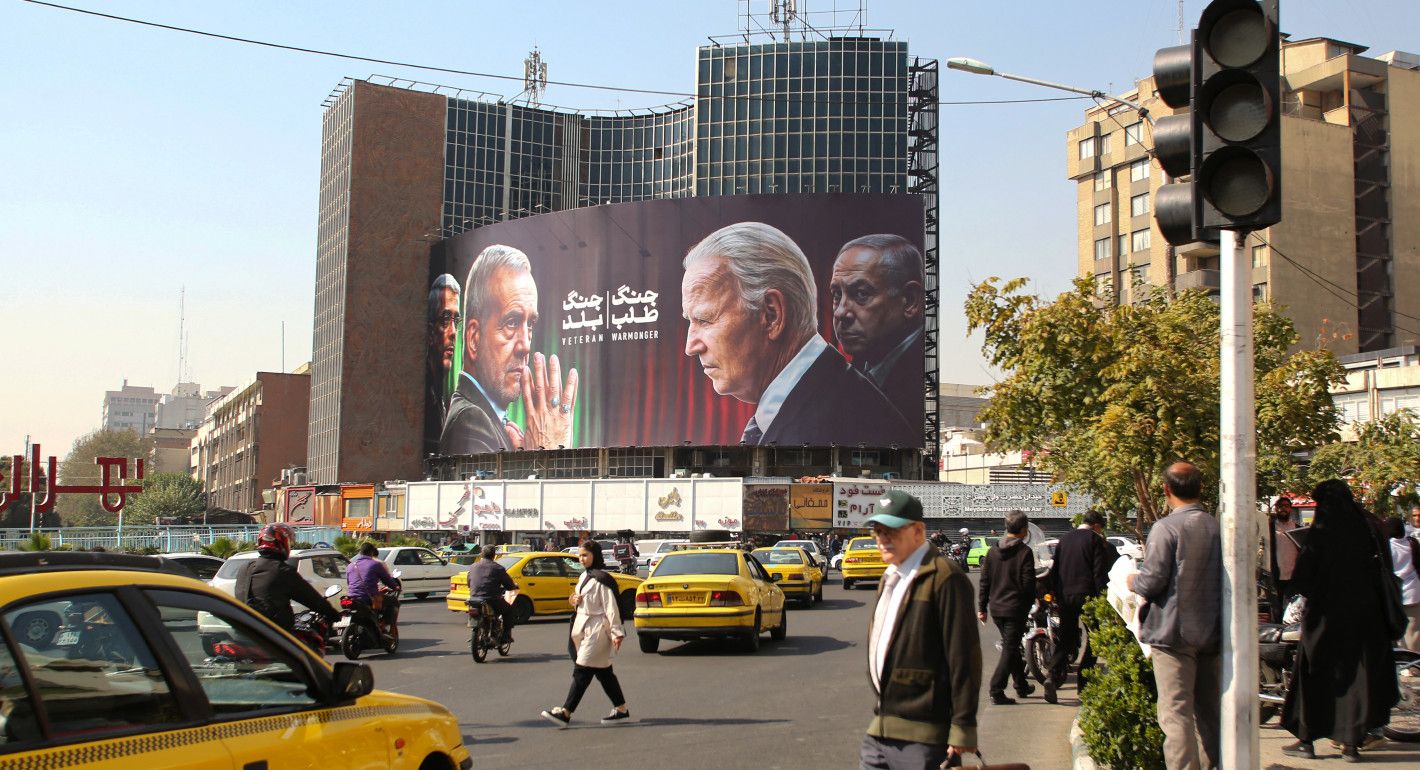
People walk past a billboard in Tehran on October 27. (Photo by Atta Kenare/AFP via Getty Images)
The best option already has a successful playbook from 2013.
Israel’s military attack against Iran’s air defense and missile programs on October 26—retaliation for Iran’s missile barrage against Israel earlier this month—leaves Tehran exposed to further strikes and may have stalled its ability to weaponize its nuclear program temporarily. However, even if Iran is now more vulnerable, it may also be more determined to go nuclear down the road—something Iranian officials have previous warned that they might decide to do.
If Iran chooses to ignore warnings from the United States and others and to strike back at Israel, Israel is likely to next target Iranian oil facilities, a major source of income for the heavily sanctioned economy. This could trigger a catastrophic chain reaction: Iranian nuclearization, which motivates others in the region to follow suit, and leads Israel and the United States to attack Iran to preempt this proliferation cycle.
How can the antagonists avert this outcome?
Clearly the conditions are not ripe for lengthy and elaborate negotiations akin to those that resulted in the now-defunct 2015 nuclear deal known as the Joint Comprehensive Plan of Action (JCPOA). That type of diplomacy is unlikely to yield the quick and reassuring results needed to exit a deepening escalation cycle.
Impediments to diplomacy exist on both sides. Iran tends to drag out negotiations and drive a very hard bargain. Tehran also would reasonably demand reassurance that Washington will not once again renege on a deal or fail to deliver the sanctions relief it hopes to get in return for making concessions. Iran’s nuclear advances to date, its destabilizing support of regional militias, and its assistance for Russia’s war on Ukraine all promise to make comprehensive negotiations too difficult.
Meanwhile, regardless of the election result, the next U.S. administration will not be staffed or prepared for significant diplomatic undertakings until spring 2025 at the earliest. The high likelihood of messy U.S. politics after the election also indicates the need to avoid agreements that would require any type of congressional imprimatur.
Given these constraints and the imperative to avert a nuclear chain reaction, what can be realistically done now?
The best option is a repetition of the secret U.S.-Iran dialogue, facilitated in and by Oman, that yielded an interim nuclear restraint agreement in 2013 and led ultimately to the JCPOA. The dialogue fell far short of producing a formal agreement, but it did yield understandings, laid down as principles of conduct to which both sides agreed to adhere until a more elaborate deal could be attained. Now, as then, the primary U.S. objective—presumably shared by Iran—would be to clarify and record expectations about mutually observable interim de-escalatory steps.
This approach does not require formal or even direct diplomacy, which Iranian officials have preferred to avoid, and Oman could once again act as the go-between. Nor would it require sign-off from the U.S. Congress. Most importantly, it would not foreclose the option for either side to abandon this stopgap measure (at each capital’s own peril) or, preferably, seek a subsequent formal accord to complement or even supplant it.
Several enabling conditions exist for secret de-escalation negotiations to succeed. First, none of the antagonists seek escalation; all will be manifestly worse off if they cannot avert it. Second, there’s no immediate need to negotiate vexing verification arrangements beyond Iran’s fragile implementation of International Atomic Energy Agency safeguards inspections. Third, the United States and Israel possess intimate knowledge of Iran’s nuclear activities, and Iranian officials fully understand that they cannot conceal secret weapons work for long. Finally, the key principals who led the 2013 negotiations are all in positions of authority in both governments: Iranian Foreign Minister Abbas Araghchi, Central Intelligence Agency Director William Burns, and National Security Advisor Jake Sullivan.
There are a few obvious quid pro quos that could form the substantive basis of a tacit de-escalation agreement. For its part, the United States should insist that Iran refrain from enriching uranium to a weapons-grade purity of 90 percent and casting uranium into weapons-usable metal. Even more critically, Washington should caution Tehran against conducting any work on nuclear weaponization and systems integration, including mating nuclear-capable warheads with missiles or otherwise preparing its military for nuclear operations. In return, the United States could reassure Iran that no attack will be conducted against its nuclear assets and facilities. An absence of military nuclear work would make it easy to uphold that commitment even if Iran and Israel carry out further attacks.
These expectations could form the backbone of a recorded mutual understanding to last for a fixed time—six to nine months, say—that each side could verify using its own national means. These could be expanded, extended, and even transitioned into a more formalized agreement before the one remaining critical element of the JCPOA—the UN-adopted sanctions “snapback” provision—expires in October 2025.
Although the parties have little room for maneuver, there is a now a narrow window in which to pursue interim nuclear restraints. U.S. and Iranian officials must act quickly to prevent a descent into a far more chaotic and violent period in the Middle East. Reaching such an understanding would not only be a fitting coda to the current U.S. administration’s effort to reign in the Iranian program, but also would create breathing room for further diplomacy while the next administration gets its act together.
The latest from Carnegie scholars on the world’s most pressing challenges, delivered to your inbox.

Senior Fellow and Co-director, Nuclear Policy Program
Toby Dalton is a senior fellow and co-director of the Nuclear Policy Program at the Carnegie Endowment. An expert on nonproliferation and nuclear energy, his work addresses regional security challenges and the evolution of the global nuclear order.

Senior Fellow, Nuclear Policy Program, Technology and International Affairs Program
Levite was the principal deputy director general for policy at the Israeli Atomic Energy Commission from 2002 to 2007.
Carnegie does not take institutional positions on public policy issues; the views represented herein are those of the author(s) and do not necessarily reflect the views of Carnegie, its staff, or its trustees.

The real test may come after the leaders leave the room.



Sheena Chestnut Greitens, Oriana Skylar Mastro, Yukon Huang, …

The Horn of Africa countries are among those facing a new security calculus.


Andrew Leber, Lesley Anne Warner
Why governance of rapidly evolving technology will be distributed and complex.


Stewart Patrick, Scott Singer

It should address the shortcomings of previous crisis communication efforts and adapt to the demands of frontier AI.

Lucy Luo
Washington’s decision to support some UN functions while letting others wither is pulling the organization apart at the seams.
Stewart Patrick, Theodore Zaritsky