

Commentary
Despite its flop at the box office, the film raises important questions for the climate community to answer.
Leonardo Martinez-Diaz
{
  "authors": [
    "Toby Dalton",
    "Celia McDowall"
  ],
  "type": "commentary",
  "blog": "Emissary",
  "centerAffiliationAll": "dc",
  "centers": [
    "Carnegie Endowment for International Peace"
  ],
  "collections": [
    "U.S. Nuclear Policy"
  ],
  "englishNewsletterAll": "ctw",
  "nonEnglishNewsletterAll": "",
  "primaryCenter": "Carnegie Endowment for International Peace",
  "programAffiliation": "NPP",
  "programs": [
    "Nuclear Policy"
  ],
  "projects": [],
  "regions": [
    "United States",
    "South Korea",
    "North Korea",
    "Iran"
  ],
  "topics": [
    "Nuclear Policy",
    "Foreign Policy"
  ]
}
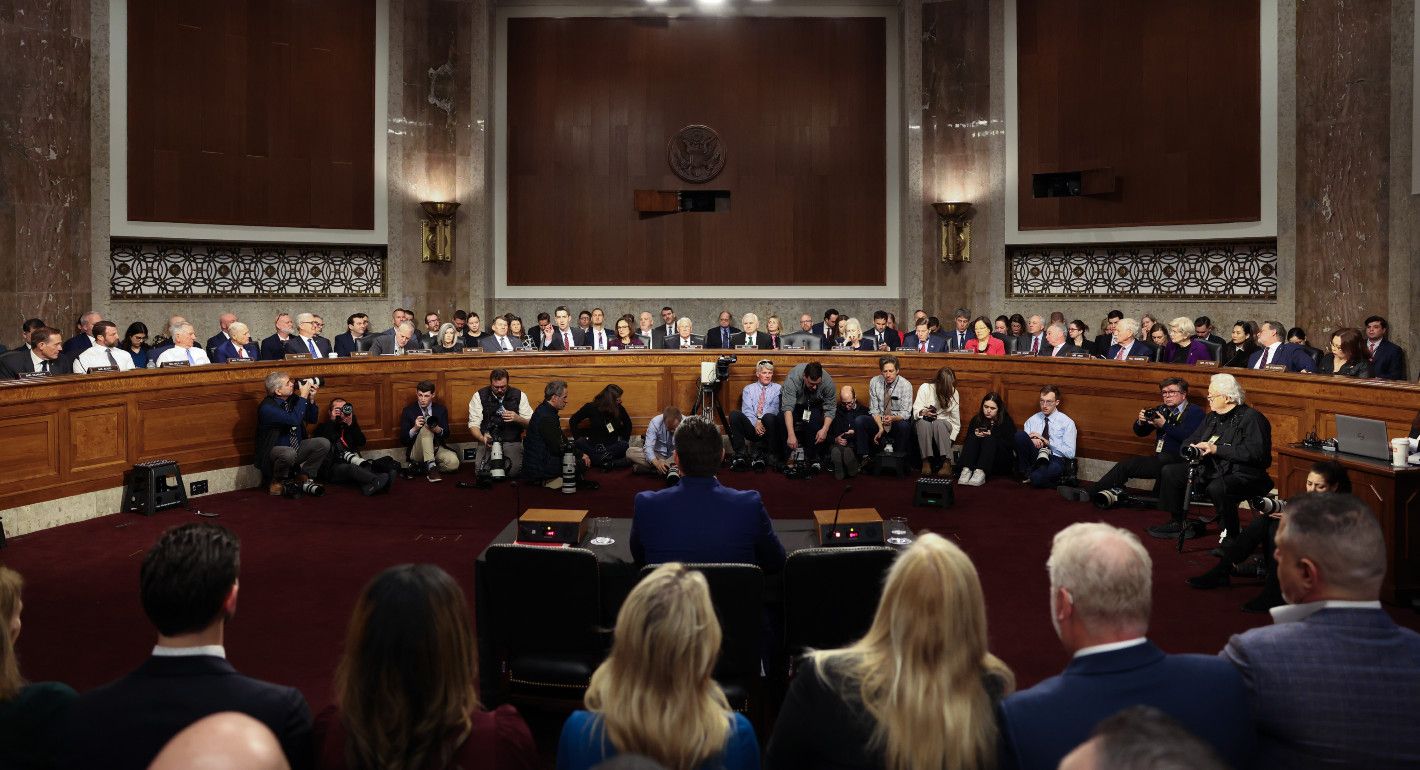
A Senate Armed Services confirmation hearing on January 14, 2025. (Photo by Kayla Bartkowski/Getty Images)
Some candidates have advocated for changes that would upend long-standing U.S. policy, making the Senate confirmation process more vital than ever.
In its first month in office, the administration of President Donald Trump has taken steps that could upend America’s alliance system. Leaders and officials in allied capitals in Europe and Asia now rightly wonder whether Trump would follow through on treaty commitments to come to their defense if they were attacked. An obvious and unsurprising consequence of this U.S. policy reversal, given the threat of aggression from Russia, China, and North Korea, is growing interest among U.S. allies in the protection of nuclear weapons.
For example, shortly before his party prevailed in Germany’s national election on February 23, incoming chancellor Friedrich Merz stated in an interview, “We must prepare for the possibility that Donald Trump will no longer uphold NATO’s mutual defense commitment unconditionally.” He argued that “We need to have discussions with both the British and the French—the two European nuclear powers—about whether nuclear sharing, or at least nuclear security from the U.K. and France, could also apply to us.” Separately, on February 25, South Korean Foreign Minister Cho Tae-yul argued in a National Assembly session that “it’s premature to talk about [nuclear weapons as a] Plan B, but that doesn’t mean it’s off the table.” He added, “Given that international situations are developing in unpredictable directions, this is a principled response that we must prepare for all possible scenarios.”
As these statements portend, if the Trump administration proceeds to dismantle the U.S. alliance system, more states—whether U.S. allies or adversaries—likely will seek nuclear weapons. This could have catastrophic effects on the ability of future administrations to prevent conflict, stop the further spread of nuclear weapons, and sustain the capacity to contain Chinese aggression.
In the coming weeks, several individuals nominated for senior positions at the State and Defense Departments and National Nuclear Security Administration (NNSA) will face Senate confirmation hearings. These nominees include Thomas DiNanno to be undersecretary of state for arms control and international security, Elbridge Colby to be undersecretary of defense for policy, and Brandon Williams to be NNSA administrator.
These individuals and subsequent nominees for assistant secretary–level positions at relevant agencies (including the Commerce and Treasury Departments) will be charged with managing the U.S. alliance system and maintaining U.S. programs—including financial tools and export controls—to prevent the spread of nuclear weapons. This assumes that these departments and the expert government staff needed to perform these functions survive the Department of Government Efficiency’s “wood chipper.”
The confirmation process offers an important opportunity for members of Congress to press these individuals on the potential implications of the Trump administration’s alliance policies for U.S. national security, especially with regard to threats of nuclear war and the spread of nuclear weapons.
U.S. security alliances with South Korea and Japan, through which the United States extends nuclear deterrence (the so-called nuclear umbrella) and positions military forces in the region, are critical to protecting U.S. security and economic interests in East Asia. These alliances have also prevented both Seoul and Tokyo from seeking nuclear weapons, another pillar of bipartisan U.S. national security policy for more than sixty years. With an increasingly assertive China and growing nuclear threats from North Korea, these alliances remain an important force multiplier for the United States.
Colby has argued for policies that could significantly alter U.S. alliance commitments, encourage the spread of nuclear weapons, and ultimately weaken U.S. power relative to China. In a May 2024 interview with Chosun Ilbo, for instance, he offered, “North Korea is clearly the biggest threat to South Korea, and I don’t think it’s right to rule out the possibility of South Korea arming itself with nuclear weapons as North Korea advances its nuclear capabilities.” He added, “It’s time to put all options, including South Korea’s own nuclear armament, on the table and discuss them.” He appears to believe that nuclear armament by East Asian allies and an abandonment of the U.S. extended deterrent could help the United States reduce its defense burden and concentrate its force posture on containing China.
Whereas Colby has frequently made such arguments, other nominees’ views on issues of nuclear proliferation and U.S. alliances are less well known. However, DiNanno is clearly a skeptic of some international nuclear institutions.
Given the potential for a major departure from past practice on these issues, members of Congress should query nominees for relevant national security positions on the potential harmful implications for the United States. Below are several key issues and questions worthy of debate.
Sustaining U.S. geopolitical power: Any additional state that acquires nuclear weapons dilutes U.S. national power. The presence of nuclear weapons in key regions inherently increases risks to U.S. military operations; this creates a deterrence effect that diminishes the comparative advantages of maintaining preponderant conventional military capability. Further, it complicates the U.S. ability to manage the potential for conflict and conflict escalation. This is true regardless of whether the proliferator is a U.S. ally, partner, or adversary. Driven by that understanding, the United States has extended deterrence to allies both as a means of preventing conflict that would harm U.S. interests and to incentivize allies not to seek nuclear weapons.
Risk of conflict with North Korea and China: If South Korea pursues nuclear weapons with U.S. support or tolerance, the risk of conflict with North Korea and/or China could actually increase in the near term. In the years it would take South Korea to deploy a survivable nuclear force, both North Korea and China would have strong incentives to disrupt or destroy its nuclear program militarily or through other actions that could easily escalate to conflict.
Further, if South Korea succeeded in acquiring a survivable nuclear force, it could be tempted to take provocative actions intended to force North Korean capitulation or topple the Kim Jong Un regime. This is not far-fetched: it appears that prior to his aborted martial law attempt in December 2024, South Korean President Yoon Suk-yeol’s administration on several occasions took or planned actions intended to provoke a North Korean military response that would have permitted Yoon to suspend the constitution.
Stopping future nuclear weapons proliferation: South Korean interest in nuclear weapons is understandable in light of the growing threats it faces and questions about the reliability of U.S. security commitments. However, encouraging or tolerating nuclear armament by any U.S. ally would reverse decades of efforts to prevent the spread of nuclear weapons. These efforts have included maintaining the international system that enables monitoring and early warning of nuclear proliferation and facilitating peaceful nuclear energy trade as part of the grand bargain for states not pursuing nuclear weapons. This system of treaties and institutions has been remarkably successful and a long-standing pillar of U.S. national security.
Sorting through the potential implications for U.S. national security, U.S. forces deployed overseas, and the American economy is vital before signing on to major changes in policy toward allies and nuclear proliferation. Senate committees must explore nominees’ views on these issues and challenge simplistic promises of reduced defense burden and lower risks to U.S. interests.
Proliferation News is a biweekly newsletter highlighting the latest analysis and trends in the nuclear policy community.

Senior Fellow and Co-director, Nuclear Policy Program
Toby Dalton is a senior fellow and co-director of the Nuclear Policy Program at the Carnegie Endowment. An expert on nonproliferation and nuclear energy, his work addresses regional security challenges and the evolution of the global nuclear order.
Celia McDowall
Former Research Assistant, Nuclear Policy Program
Carnegie does not take institutional positions on public policy issues; the views represented herein are those of the author(s) and do not necessarily reflect the views of Carnegie, its staff, or its trustees.

Despite its flop at the box office, the film raises important questions for the climate community to answer.

Leonardo Martinez-Diaz

The acknowledgment has sparked fears of a new arms race with China and Russia.

Chris O’Meara
The summit may be remembered as a fatal blunder, when Washington, Beijing, and the AI industry collectively chose ceremony over action.

Jeffrey Prescott

The real test may come after the leaders leave the room.



Sheena Chestnut Greitens, Oriana Skylar Mastro, Yukon Huang, …

The Horn of Africa countries are among those facing a new security calculus.


Andrew Leber, Lesley Anne Warner