

Paper
Sarah Yerkes, Natalie Triche, Amr Hamzawy
{
  "authors": [
    "Sarah Yerkes"
  ],
  "type": "commentary",
  "blog": "Emissary",
  "centerAffiliationAll": "dc",
  "centers": [
    "Carnegie Endowment for International Peace"
  ],
  "englishNewsletterAll": "menaTransitions",
  "nonEnglishNewsletterAll": "",
  "primaryCenter": "Carnegie Endowment for International Peace",
  "programAffiliation": "MEP",
  "programs": [
    "Middle East"
  ],
  "projects": [],
  "regions": [
    "United States",
    "Israel",
    "Iran",
    "Middle East"
  ],
  "topics": [
    "Security",
    "Defense",
    "Domestic Politics",
    "Foreign Policy"
  ]
}
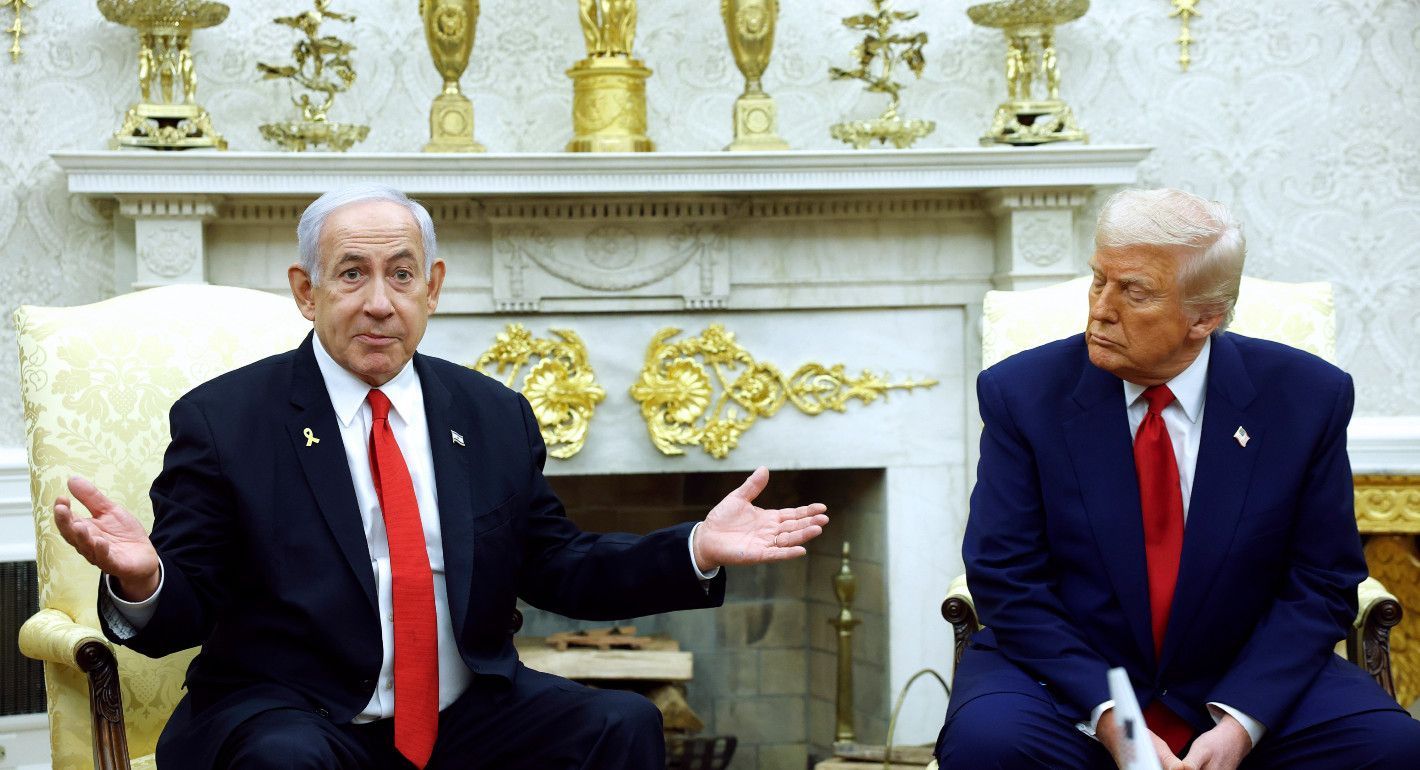
Netanyahu and Trump in the Oval Office in April. (Photo by Kevin Dietsch/Getty Images)
If the Israeli prime minister wants the United States to stay in the Iran war, there is a good chance he will get his way.
One person with tremendous sway over U.S. President Donald Trump’s actions in Iran was not in the Situation Room on Saturday, as the U.S. struck Iranian nuclear facilities: Israeli Prime Minister Benjamin Netanyahu. During their decades-long relationship, the two have shifted between mutual high praise and outright hostility. But despite some real and serious disagreements, they always find their way back to each other.
Case in point: Trump’s comments this week about his strong partnership with Netanyahu and praise for Israeli military actions in Iran. The relationship shows no signs of the divisions that had crept up over the past several weeks, as Trump excluded Netanyahu from the latest Iran talks and from negotiations to release the remaining American hostages in Gaza. Now, how the conflict between Israel and Iran evolves depends significantly on whether the Trump-Netanyahu relationship holds firm—and whether the Israeli leader will be able to maintain his sway over the U.S. president.
Although Trump may believe he is pulling the strings, he has clearly and repeatedly allowed himself to be manipulated by Netanyahu, especially during his first term. Perhaps the clearest example was the Trump administration’s decision to officially recognize both Jerusalem as the capital of Israel and Israeli control over the occupied Golan Heights without getting anything from Israel. Recognition of Jerusalem was a major bargaining chip in the U.S. diplomatic toolbox that numerous administrations had held on to, but Trump gave it to Netanyahu for free.
Additionally, Israel has never been interested in diplomacy with Iran and actively fought the Iran nuclear deal during former president Barack Obama’s administration. This opposition created a division between the United States and Israel until Trump took the United States out of the Iran deal—at Netanyahu’s suggestion—in 2018. More recently, as Trump engaged in his own negotiations with Iran, Netanyahu’s repeated insistence that Iran was deceiving Trump and a military option was necessary pushed the president to defy his own advisers and members of his party, who were adamant that the United States not join Israel in its military actions.
This was perhaps most stark in Trump’s rejection of Director of National Intelligence Tulsi Gabbard’s assessment that Iran was not actively working on developing a nuclear weapon. Trump taking Netanyahu’s beliefs over his own intelligence community’s findings is a clear sign of the prime minister’s sway over the president.
Understanding Netanyahu’s approach requires remembering that this campaign is an existential issue for the Israeli leader, making him more willing to take large risks to eke out an Israeli victory. His popularity among the Israeli public plummeted in the wake of the October 7 Hamas attacks and the subsequent war in Gaza. Although he has managed to regain some support, he also recently barely survived an attempt at dissolving the Israeli Knesset. A victory against Iran—whether that means taking out Iran’s nuclear capabilities or bringing about regime change (which is far less likely)—would help solidify his reputation as “Mr. Security” and could go a long way in convincing Israelis that they should keep him in the driver’s seat.
It is not only Gabbard whom Trump ignored. Nearly all of Trump’s closest advisers—Vice President JD Vance, Secretary of State Marco Rubio, and Secretary of Defense Pete Hegseth—have publicly tried to play down the possibility of regime change and emphasize that the U.S. endgame is destroying Iranian nuclear ambitions. But Trump’s language in public and on social media has repeatedly contradicted his cabinet. He has also countered the Defense Department’s statements that it is too early to assess how successful Saturday’s strikes were, insisting that the United States has completely destroyed Iran’s nuclear facilities, despite a lack of evidence to support his claims.
Additionally, Trump’s most fervent allies in Congress, including Representative Marjorie Taylor Greene, have criticized the U.S. airstrikes, emphasizing that Trump ran for office promising to end wars, not start them. Some Republicans in Congress are also seeking to assert their powers under Article I of the Constitution, calling the strikes a declaration of war, which can only be done by Congress. However, nothing in the past five months suggests that Trump will be bound by normal U.S. procedure or policy or that Congress will act.
Trump has been clear since his first term that eliminating Iran’s nuclear program was one of his key goals, and whether he is satisfied with the extent and success of U.S. actions is unclear. The Iranian attack on Al Udeid Air Base in Qatar signals an escalation—albeit a mild one—rather than a shift toward diplomacy, but Trump’s initial response to Iran’s attack (which caused no American or Qatari casualties) was one of peace, not war.
What is clear is that Netanyahu is not finished with Iran. The Israeli Defense Forces are continuing their attacks on Iranian targets, despite indications of a ceasefire, and are not limiting those attacks to nuclear facilities. Speaking with reporters on Tuesday morning, Trump was visibly angry with Israel for continuing to carry out those strikes. But if history can teach us anything, it is that if Netanyahu wants the United States to stay in the war, there is a good chance he will get his way.

Acting Co-Director and Senior Fellow, Middle East Program
Sarah Yerkes is acting co-director and a senior fellow in the Middle East Program at the Carnegie Endowment for International Peace. Her research focuses on democracy and governance, U.S. foreign policy towards the Middle East and North Africa, and political and economic reform in Tunisia.
Recent Work

Sarah Yerkes, Natalie Triche, Amr Hamzawy
Carnegie does not take institutional positions on public policy issues; the views represented herein are those of the author(s) and do not necessarily reflect the views of Carnegie, its staff, or its trustees.
Fatima El Mansouri is the country’s first female prime minister. She’s also a privileged insider in a largely ceremonial position.
Sarah Yerkes

The acknowledgment has sparked fears of a new arms race with China and Russia.

Chris O’Meara

The summit may be remembered as a fatal blunder, when Washington, Beijing, and the AI industry collectively chose ceremony over action.

Jeffrey Prescott

The real test may come after the leaders leave the room.



Sheena Chestnut Greitens, Oriana Skylar Mastro, Yukon Huang, …

The Horn of Africa countries are among those facing a new security calculus.


Andrew Leber, Lesley Anne Warner