

Commentary
Despite its flop at the box office, the film raises important questions for the climate community to answer.
Leonardo Martinez-Diaz
{
  "authors": [
    "Emma Whitmyer",
    "Darcie Draudt-Véjares"
  ],
  "type": "commentary",
  "blog": "Emissary",
  "centerAffiliationAll": "dc",
  "centers": [
    "Carnegie Endowment for International Peace"
  ],
  "collections": [
    "Korea: Emerging Player"
  ],
  "englishNewsletterAll": "asia",
  "nonEnglishNewsletterAll": "",
  "primaryCenter": "Carnegie Endowment for International Peace",
  "programAffiliation": "AP",
  "programs": [
    "Asia"
  ],
  "projects": [],
  "regions": [
    "United States",
    "South Korea",
    "North Korea"
  ],
  "topics": [
    "Security",
    "Economy",
    "Foreign Policy"
  ]
}
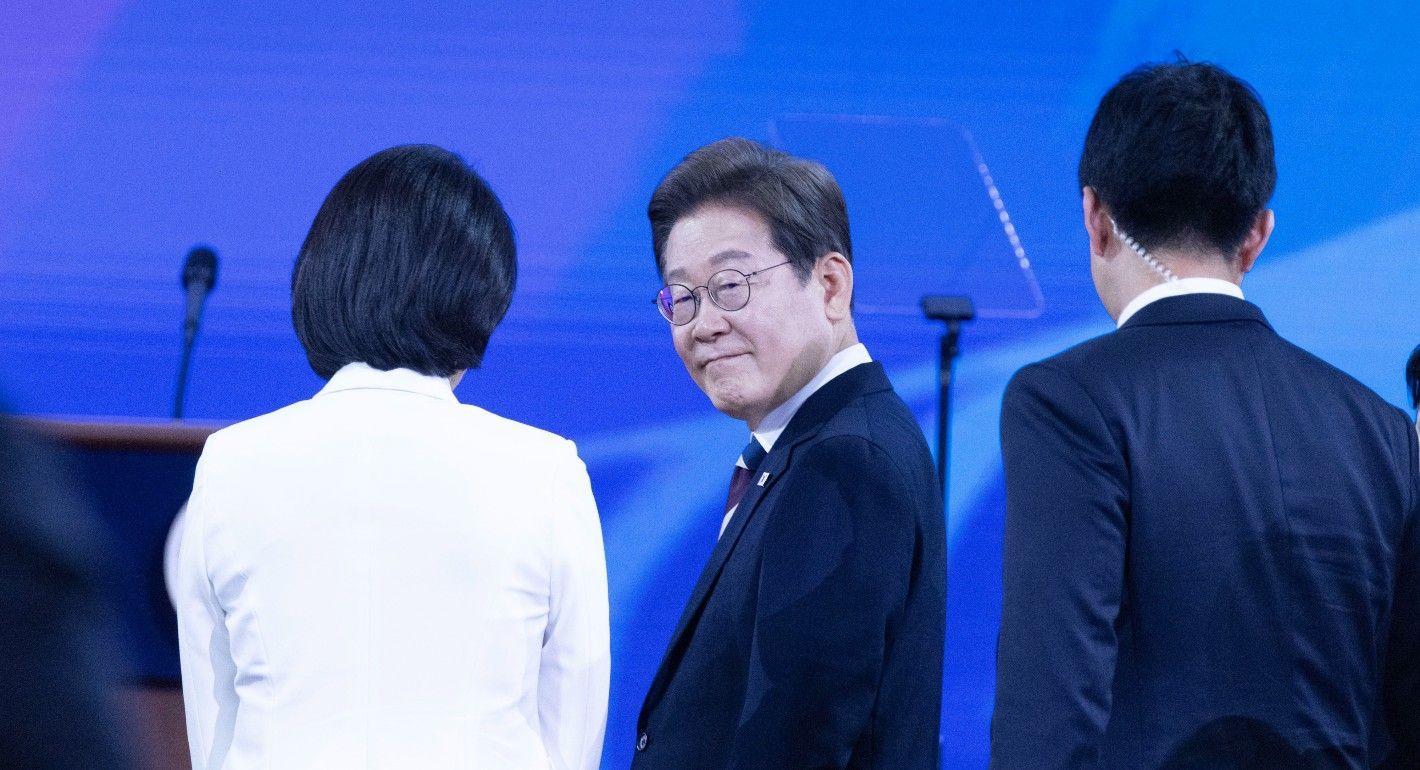
Lee at his inauguration on June 04, 2025 in Seoul. (Pool photo by Jeon Heon-Kyun/Getty Images)
At the White House, Lee will have to navigate Trump’s transactional approach to foreign policy with the partnership’s deeper concerns.
South Korean President Lee Jae Myung will travel to Washington on August 25 for his first bilateral meeting with U.S. President Donald Trump. The summit comes after a July trade deal in which Washington cut its reciprocal tariff on Seoul to 15 percent from the initially proposed 25 percent, while South Korea committed to a $350 billion investment pledge in the United States and $100 billion in U.S. energy purchases in the form of liquified natural gas. But this hard-won tactical accomplishment masks deeper concerns about whether transactional dealmaking can sustain the seventy-five-year-old strategic partnership.
Korean officials had anticipated the second Trump administration would revive friction between the two treaty allies, given Trump’s past concerns about trade deficits and military cost burden-sharing. This linking of trade and security commitments was a key feature of Trump’s first-term management of the alliance, including with the threats to withdraw troops over discontent with the trade imbalance amid efforts to renegotiate the Korea-U.S. free trade agreement.
However, Korean officials came into the first four months of Trump’s second term at a disadvantage because they lacked leadership after the political turmoil that upended the government in the months prior. This meant that when Lee took office in June, Trump was already moving quickly on his planned unilateral tariffs. Next week’s summit will test whether Korean leadership can manage Trump’s unpredictable negotiating style, as he might introduce last-minute demands into the summit, including on defense burden-sharing.
Although the two countries have already reached a trade deal, the summit remains an important test for Lee and the U.S.-Korea relationship. The $350 billion investment package represents more than just economic cooperation—it’s Lee’s bet that deep economic integration can insulate Korea from Trump’s unpredictability. Among those funds, $150 billion will be dedicated to shipbuilding cooperation, and the rest will go to semiconductors, secondary batteries, biologics, and energy.
But Lee faces the same challenge as other world leaders in Trump’s Oval Office this year: the risk of being publicly criticized for seeming to fall short of expectations. The military dimension of the comprehensive strategic partnership that prior American politicians and officials have trumpeted as the linchpin of U.S. security in the Indo-Pacific will likely prove more contentious than economic cooperation. Trump has regularly called for South Korea to pay more for the 28,500 U.S. troops stationed on its soil.
Additionally, Trump could threaten potential troop reductions—either to cut the total 28,500 troops to 10,000 as recommended by one former senior Trump administration adviser, or a more modest reduction to 24,000 suggested recently by the Trump administration. Outside the conventional security drawdown, changing the force structure on the peninsula might also reignite Seoul’s uncertainty over the U.S. nuclear umbrella. Although domestic support to develop South Korea’s own indigenous nuclear weapons program isn’t new, it has been growing in recent years. A reduced U.S. military presence could further accelerate this trend, especially among South Korean policymakers and the public who doubt the reliability of extended deterrence.
While trade and troop drawdowns have been the topline concerns of ROK officials, the potential for Trump to take a renewed interest in personal diplomacy with North Korean leader Kim Jong Un will pose a particular challenge for Lee, who—in line with his progressive lineage—has expressed openness to dialogue with Pyongyang but received no response. If Trump moves to sideline Seoul in favor of direct engagement with Kim, it would repeat a pattern of “Seoul-bypassing” from his first term that frustrated South Korean officials.
However, geopolitical dynamics have shifted greatly since Trump and Kim’s 2019 meeting in Hanoi, which was largely regarded as a failure among policy circles. At the time, Kim and Trump had different expectations of the nuclear negotiations, and neither would like a rematch unless there’s clearer consensus ahead of time. Moreover, Kim has doubled down on Russian patronage related to Pyongyang’s support of Moscow in the war in Ukraine, which leaves not only South Korea but also China in the backseat. But the prospect of U.S. troop reductions—which would be viewed as a strategic win for Kim—could bring the North Korean leader to the negotiating table, since force levels weren’t previously part of the discussion.
In addition, Pyongyang could still overshadow South Korea’s diplomatic goals—both at the summit and in the wider region. During the first Trump administration, joint military exercises with South Korea were suspended, sometimes at the surprise of South Korean officials. A similar move in the second Trump administration could carry negative consequences for both countries. China, North Korea, and Russia would welcome the suspension, as it likely would weaken the U.S.–South Korea military cooperation and reduce American strategic visibility in the region. Additionally, scaling back U.S. troops on the Korean Peninsula would align with Beijing’s interests in a diminishing American presence in its neighborhood.
The relationship between Seoul and Beijing will be a key focus of the Washington meeting —the first major test for Lee’s self-styled pragmatic foreign policy. Lee has opted out of attending China’s Victory Day celebrations in September, but a high-level official could serve as emissary depending on how the Trump meeting unfolds. South Korea will host the APEC Summit in Gyeongju, South Korea, at the end of October, where both Trump and Chinese President Xi Jinping are likely to attend. The form and style of the great power leaders’ meetings, as well as their meetings with Lee during APEC, will send clear messages about where Seoul sits between Washington and Beijing.
However, whether Trump will attend as planned is a key data point for Seoul. The U.S. president’s recent pattern of postponed meetings and last-minute renegotiations this year sends problematic signals across the Indo-Pacific. In June, Japan canceled its annual 2+2 security talks with the United States after the Trump administration demanded Tokyo boost defense spending to 3.5 percent of GDP, according to the Financial Times. Secretary of State Marco Rubio’s planned July trip to the region was also postponed to focus on the Middle East crisis. These disruptions suggest two things relevant to allies around the world. First, Washington treats alliance maintenance as optional when other priorities emerge. Second, the hollowing out of the national security and diplomacy apparatus hampers Washington's ability to manage complex alliance relationships while maintaining strategic advantage over China, Russia, and other adversaries.
The real test will be whether Trump makes additional financial and strategic demands at the summit—requests that won’t be revealed until the two leaders are in front of the cameras, given Trump’s showmanship tactics. On the economic side, this could include requests for more direct investment commitments or expanding Korea’s industrial base in the United States beyond the already substantial package.
Strategically, Trump may press Lee for clearer statements on what role South Korea would commit in the event of a Taiwan Strait contingency—a point of growing concern in Seoul as officials try to decipher the second Trump administration’s China policy. How Lee navigates these potential surprises will signal whether Washington’s transactional approach can sustain the deeper trust needed for alliance management in an era of great power competition.
The latest from Carnegie scholars on the world’s most pressing challenges, delivered to your inbox.
Emma Whitmyer
Emma Whitmyer is a policy researcher focused on issues relating East Asia, particularly the Korean Peninsula and U.S. alliances in the region. She has previously served as a senior program officer at the Asia Society Policy Institute and as a junior scholars fellow with the South Korean Ministry of Foreign Affairs in Seoul.

Fellow, Asia Program
Darcie Draudt-Véjares is a fellow for Korea studies in the Asia Program at the Carnegie Endowment for International Peace. Her research focuses on South Korean political economy, governance, and foreign policy, particularly the intersection of economics, technology, and geopolitics.
Carnegie does not take institutional positions on public policy issues; the views represented herein are those of the author(s) and do not necessarily reflect the views of Carnegie, its staff, or its trustees.
Despite its flop at the box office, the film raises important questions for the climate community to answer.
Leonardo Martinez-Diaz

The acknowledgment has sparked fears of a new arms race with China and Russia.

Chris O’Meara
The summit may be remembered as a fatal blunder, when Washington, Beijing, and the AI industry collectively chose ceremony over action.
Jeffrey Prescott

The real test may come after the leaders leave the room.



Sheena Chestnut Greitens, Oriana Skylar Mastro, Yukon Huang, …

The Horn of Africa countries are among those facing a new security calculus.


Andrew Leber, Lesley Anne Warner