

Paper
Sarah Yerkes, Natalie Triche, Amr Hamzawy
{
  "authors": [
    "Amr Hamzawy"
  ],
  "type": "commentary",
  "blog": "Emissary",
  "centerAffiliationAll": "dc",
  "centers": [
    "Carnegie Endowment for International Peace"
  ],
  "collections": [
    "Regional Security in the Middle East and North Africa"
  ],
  "englishNewsletterAll": "menaTransitions",
  "nonEnglishNewsletterAll": "",
  "primaryCenter": "Carnegie Endowment for International Peace",
  "programAffiliation": "MEP",
  "programs": [
    "Middle East"
  ],
  "projects": [],
  "regions": [
    "Israel",
    "Palestine",
    "Egypt",
    "Jordan",
    "United States",
    "Middle East"
  ],
  "topics": [
    "Domestic Politics",
    "Foreign Policy"
  ]
}
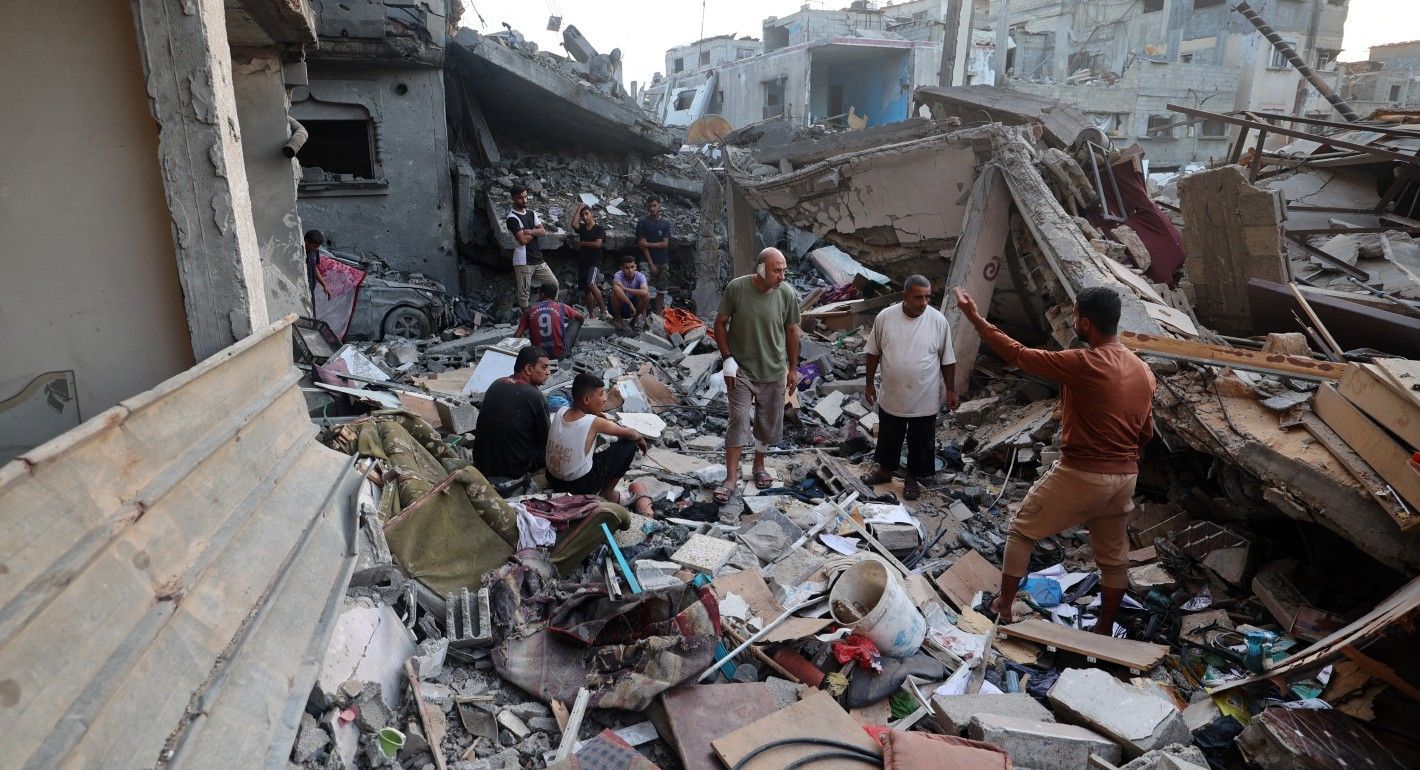
Palestinians examine a building hit by an Israeli strike in the central Gaza Strip on September 28, 2025. (Photo by Eyad Baba/AFP via Getty Images)
The obstacles to implementation will be numerous and substantial.
U.S. President Donald Trump’s proposed peace plan for the Gaza Strip, unveiled on Monday during meetings with Israeli Prime Minister Benjamin Netanyahu, comes at a crossroads. On the eve of the war’s two-year anniversary, the humanitarian dimensions of the crisis increasingly are intersecting with political pressures and security priorities. This makes any approach to reconstruction and stability in Gaza a difficult test: Can this peace plan reconcile its ambitions with the reality on the ground?
Trump’s proposal offers a comprehensive vision for rebuilding the Gaza Strip and halting the cycle of violence. The twenty-point plan is based on four integrated frameworks: security, reconstruction and development, political and administrative arrangements, and international and regional cooperation.
For security, the plan emphasizes the return of Israeli hostages (living and dead) in exchange for the release of a number of Palestinian prisoners and detainees. Without specifying a timeline, the plan calls for a gradual withdrawal of Israeli forces and establishes mechanisms for disarming Hamas and other resistance movements. To ensure sustainability, the plan requires continuous monitoring of borders and crossings, as well as training of Palestinian security forces under international supervision. It also includes arrangements for the establishment of specialized security units—the International Stabilization Force—to oversee implementation and contain potential threats or outbreaks of violence.
In terms of development, the plan addresses the reconstruction of basic services such as electricity, water, and health care, as well as the rebuilding of schools and hospitals. It also offers support for small- and medium-sized economic projects to provide job opportunities for the local population. The plan emphasizes transparency in aid management, in order to prevent exploitation by armed or outlaw groups. This measure is a prerequisite both for building Gaza’s citizens’ confidence in international security efforts and for creating an environment conducive for other measures’ success.
The plan rejects the displacement of Palestinians and emphasizes their continued presence in the Gaza Strip, while providing opportunities for education, employment, and healthcare. This contradicts both Trump’s previous rhetoric and the Israeli right’s staunch commitment to forced displacement, which is a war crime. Although uncomfortably ambiguous, the plan also stipulates the right of return to Gaza for those who have left or will leave.
As for the political and administrative aspects, Trump’s proposal reflects a desire to restructure local governance in Gaza in order to ensure the independence of the civil administration from any armed influence. This would be implemented by the Board of Peace, a proposed committee that would be chaired by Trump and would include several civil society organizations that would monitor progress. The plan also includes mechanisms for facilitating coordination between the Board of Peace and the United Nations, its agencies, and international bodies, including clear legal and political guarantees to protect Palestinian rights, thus strengthening the plan’s legitimacy.
The regional and international dimension is based on Egypt, Jordan, and the United States forming the International Stabilization Force, and Egypt and Jordan training Palestinian security forces to assume responsibilities in Gaza after the transitional period. It also relies on Arab, Islamic, and European countries to provide financial, political, and technical support. The plan emphasizes that the participation of Arab and Islamic countries and international parties must be accompanied by a clear definition of the responsibilities and obligations on both the Israeli and Palestinian sides. This division aims to ensure effectiveness, prevent conflict, and protect the rights of the people of Gaza.
The plan concludes by indicating that ending the war in Gaza, restoring security, disarmament, and stabilizing its administration—along with the Palestinian National Authority’s commitment to implementing specific reform programs—could open the door to negotiations on the legitimate right of the Palestinian people to build their state.
The Trump plan for Gaza is comprehensive and ambitious, and it enjoys broad regional and international support. However, the expected implementation obstacles are numerous and substantial. On the one hand, ensuring Israel’s commitment not to use force once the plan is implemented and the ceasefire takes effect will be a challenge. It will require careful regional and international monitoring, ongoing coordination, and a sustained American role to avoid any setbacks that could immediately plunge Gaza back into a cycle of violence. On the other hand, Hamas’s willingness to disarm and adhere to regional and international security supervision poses a fundamental roadblock, especially given the lack of clear lines and timing for the withdrawal of Israeli forces from the Gaza Strip.
The success of the plan also requires enabling regional partners to support it. In particular, Egypt and Jordan’s role in the formation of the International Stabilization Force and participation in security management through the training of Palestinian police personnel must be clearly outlined. Any ambiguity on the part of the Israeli and Palestinian sides regarding their commitments contained in the plan, or hesitation in defining the mechanisms and limits of Egypt, Jordan, and other Arab countries’ contributions, could undermine the effectiveness of the security arrangements. The risk here is leaving the local administration, under guidance from the Board of Peace, unsupported as it faces complex security and humanitarian challenges.
In this sense, balancing ambition and implementation capacity is the decisive challenge in Trump’s proposed plan. The United States will have to invest heavily, both diplomatically and politically, to ensure Israel’s adherence to its commitments. Similarly, regional parties such as Egypt, Jordan, Saudi Arabia, Qatar, the United Arab Emirates, and Türkiye will have to work with Hamas to ensure it adheres to the difficult condition of disarmament. Every plan, no matter how strategically sound, requires sustained regional and international political commitment to achieve tangible results.
From a general assessment, the Trump plan represents a step in the right direction. It combines the humanitarian and development dimensions with the security and political ones. It establishes a framework for integrating the international and Arab roles in restoring and supporting stability in Gaza. It also opens the door to a political solution to the Palestinian issue, even if it links it to reforming the Palestinian Authority and does not specify any context or timing for it. Ultimately, the plan tests the ability of all invested parties to reach consensus and assume responsibility, highlighting the need for careful management of the conflict within the context of complex internal, regional, and international balances.
The latest from Carnegie scholars on the world’s most pressing challenges, delivered to your inbox.

Director, Middle East Program
Amr Hamzawy is a senior fellow and the director of the Carnegie Middle East Program. His research and writings focus on Egypt’s and other middle powers’ involvement in regional security in the Middle East, particularly through collective diplomacy and multilateral conflict resolution
Recent Work

Sarah Yerkes, Natalie Triche, Amr Hamzawy
Amr Hamzawy
Carnegie does not take institutional positions on public policy issues; the views represented herein are those of the author(s) and do not necessarily reflect the views of Carnegie, its staff, or its trustees.

Despite its flop at the box office, the film raises important questions for the climate community to answer.

Leonardo Martinez-Diaz
Fatima El Mansouri is the country’s first female prime minister. She’s also a privileged insider in a largely ceremonial position.
Sarah Yerkes
The acknowledgment has sparked fears of a new arms race with China and Russia.

Chris O’Meara
The summit may be remembered as a fatal blunder, when Washington, Beijing, and the AI industry collectively chose ceremony over action.

Jeffrey Prescott

The real test may come after the leaders leave the room.



Sheena Chestnut Greitens, Oriana Skylar Mastro, Yukon Huang, …