
• Research
  • Emissary
  • About
  • Experts
Carnegie Global logoCarnegie lettermark logo
Democracy
  • Donate
{
  "authors": [
    "Shahram Chubin"
  ],
  "type": "legacyinthemedia",
  "centerAffiliationAll": "",
  "centers": [
    "Carnegie Endowment for International Peace",
    "Malcolm H. Kerr Carnegie Middle East Center",
    "Carnegie Europe"
  ],
  "collections": [
    "Arab Awakening"
  ],
  "englishNewsletterAll": "",
  "nonEnglishNewsletterAll": "",
  "primaryCenter": "Carnegie Endowment for International Peace",
  "programAffiliation": "",
  "programs": [
    "Nuclear Policy",
    "Middle East"
  ],
  "projects": [],
  "regions": [
    "Middle East",
    "Iran",
    "North Africa",
    "Egypt",
    "Gulf"
  ],
  "topics": [
    "Political Reform",
    "Economy"
  ]
}
In The Media

Egypt and Iran: Similarities and Contrasts

In both Egypt and Iran, youth are at the forefront of the struggle for change as both governments must struggle to generate jobs for their growing populations and diminish the growing gap between the rich and the poor.

Link Copied
By Shahram Chubin
Published on Feb 18, 2011
Program mobile hero image

Program

Nuclear Policy

The Nuclear Policy Program aims to reduce the risk of nuclear war. Our experts diagnose acute risks stemming from technical and geopolitical developments, generate pragmatic solutions, and use our global network to advance risk-reduction policies. Our work covers deterrence, disarmament, arms control, nonproliferation, and nuclear energy.

Learn More
Program mobile hero image

Program

Middle East

The Middle East Program in Washington combines in-depth regional knowledge with incisive comparative analysis to provide deeply informed recommendations. With expertise in the Gulf, North Africa, Iran, and Israel/Palestine, we examine crosscutting themes of political, economic, and social change in both English and Arabic.

Learn More

Source: Le Temps

Egypt and Iran: Similarities and ContrastsEgypt and Iran, it was famously and accurately said, are the only true nations in the Middle East; the others are only “tribes with flags.” In 1979 Iranians deposed the shah and created the Islamic Republic of Iran. The shah was not willing to use the force available to him, while his opponents did not shun violence.

In 2011, Egyptians overthrew their authoritarian government peacefully, with the military unwilling to intervene. Today Iranians demonstrate peacefully against their regime, which responds with indiscriminate violence and intimidation in repressing their right to political expression. Could the shah have saved his throne by employing force? Could the revolt in Egypt have succeeded if the army had not remained neutral? Can Iranians today, by peaceful demonstrations and superior moral courage, prevail over their own less restrained and violent oppressors?

Iran and Egypt remain the Middle East region’s most important states. They are roughly comparable in population size, with 70-plus million citizens. Both nations have a similar population profile with a large youth bulge (60 percent of citizens are under age thirty). And both countries are now largely urbanized. Perhaps Iran’s greater literacy rate (80 percent versus Egypt’s 40 percent) and higher per-capita income ($4,000 versus $2,100, respectively) accounts for an earlier record of political instability.

In any case, both states have similar challenges: how to generate over 700,000 jobs annually to employ their new graduates. Neither has done a good job of this, accounting for the steady “brain drain” from each country. At the same time, economic growth has exacerbated the gap between the rich and the poor, not least due to the endemic corruption of the elite. In the case of Iran, this has been harder to swallow because of the regime’s constant and hollow reference to “social justice.” In the case of Egypt, in light of the grotesque disparities between the two income groups, even the long-suffering fellahin reached his limit.

In Egypt the government’s mantra was one of maintaining “stability,” an appeal to the middle class’s supposed preference for order and predictability in the face of assumed threats from radical Islam. In Iran the appeal is to maintain the independence of the revolution in the face of alleged threats from outside powers and to extend its “resistance model” in the region. Neither appeal is convincing, even to its supposed audience. Stability cannot be an end in itself. And Iran’s revolution ran out of steam and support even within Iran over a decade ago.

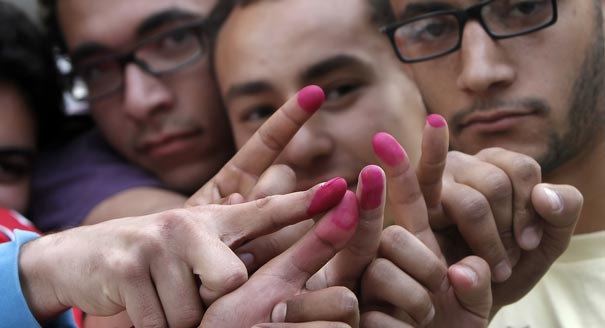
It is not surprising then to see that in both countries the youth has been at the forefront of the struggle for change. In both countries the struggle is leaderless, from the bottom-up, and coordinated by the same youth who use the new technologies of Twitter, Facebook, blogs, and texting.

In both countries the movements’ aim is respect and dignity of the individual, and a desire to be heard and treated properly, not any radical political agenda. It is a mix of idealism and nationalism, an assertion of community and fraternity. In this sense, as Olivier Roy has noted, these movements are “post-Islamist” and post-ideological.

Another feature common to the two movements and reflective of a profound if ill-understood aspect of regional politics is the marginal role of outside powers. They have not been looked to for assistance nor been in a position to supply it, even had they wanted to do so.

This is not due to the declining power and influence of the United States. Of course U.S. influence has been declining in the region over the past decade, not least because of its failure to use its influence on Israel; its misjudgments in Iraq; and its general mix of ignorance and arrogance that unfailingly alienates friend and foe alike.

No, the reason for the limited influence of outside powers is otherwise and can be simply stated. Since at least 1979, the most profound forces in the region have stemmed from its political and social dynamics (demography, urbanization, education, and ideological ferment) plus globalization. Outside powers have been spectators to most of this, as they are today in the upheaval in Egypt, Tunisia, and Iran.

This state of affairs should be welcomed for it makes the region—its states and peoples—responsible for their own actions and destiny.  Even in the case of Palestine, where the conventional wisdom has been that the parties cannot make peace if left to themselves, the parties themselves may conclude that this is the only durable peace and worth pursuing sooner rather than later.

Spontaneous unrest that snowballs and then catalyzes change elsewhere (to change the image) through a “contagion effect” distorts as much as it reveals. In a borderless world, we are all fully connected and images and events quickly travel across political frontiers. But the facts “on the ground” in each country differ: is the regime united or divided? Is it legitimate? Is it willing to use force? Are the security serves united? Does it care about its image? How strong are the forces of opposition?

Shahram Chubin
Former Nonresident Senior Fellow, Nuclear Policy Program
Political ReformEconomyMiddle EastIranNorth AfricaEgyptGulf

Carnegie does not take institutional positions on public policy issues; the views represented herein are those of the author(s) and do not necessarily reflect the views of Carnegie, its staff, or its trustees.

More Work from Carnegie Endowment for International Peace

  • Workers of automotive manufacturer VW assemble pieces of a model in the Uitenhage plant.
    Paper
    Win-Win: The Potential and Prospects of German FDI in Supporting the Structural Transformation of African Economies

    German manufacturing firms in Africa add value, jobs, and skills, while benefiting from demand and a diversification of trade and investment partners. It is in the interest of both African economies and Germany to deepen economic relations. 

      Hannah Grupp, Paul M. Lubeck
  • Commentary
    Carnegie Politika
    Has Trump the Destroyer Eclipsed Putin the Destroyer?

    Unexpectedly, Trump’s America appears to have replaced Putin’s Russia’s as the world’s biggest disruptor.

      Alexander Baunov

  • Commentary
    Strategic Europe
    The EU and India in Tandem

    As European leadership prepares for the sixteenth EU-India Summit, both sides must reckon with trade-offs in order to secure a mutually beneficial Free Trade Agreement.

      Dinakar Peri

  • Commentary
    Carnegie Politika
    Baku Proceeds With Caution as Ethnic Azeris Join Protests in Neighboring Iran

    Baku may allow radical nationalists to publicly discuss “reunification” with Azeri Iranians, but the president and key officials prefer not to comment publicly on the protests in Iran.

      Bashir Kitachaev

  • High view of parabolic trough collectors at the Xina solar plant in South Africa
    Article
    Lack of Finance Is Not the Only Constraint on Global Development

    Global development needs imagination to update the purposes, structures, and systems of outmoded institutions to make them fit for today’s world.

      David McNair

Get more news and analysis from
Carnegie Endowment for International Peace
Carnegie global logo, stacked
1779 Massachusetts Avenue NWWashington, DC, 20036-2103Phone: 202 483 7600Fax: 202 483 1840
  • Research
  • Emissary
  • About
  • Experts
  • Donate
  • Programs
  • Events
  • Blogs
  • Podcasts
  • Contact
  • Annual Reports
  • Careers
  • Privacy
  • For Media
  • Government Resources
Get more news and analysis from
Carnegie Endowment for International Peace
© 2026 Carnegie Endowment for International Peace. All rights reserved.