Relations between Saudi Arabia and Egypt, two previously staunch allies, have recently soured. This can be attributed to Egypt’s inability to perform its role as a guarantor of regional Gulf security against growing Iranian hegemony and its desire to cultivate other, less demanding, international allies—most notably Russia.
On October 10, the Egyptian delegation at the United Nations Security Council voted in favor of a Russian resolution for a ceasefire in Aleppo that would allow Russia to continue carrying out airstrikes, a move that was publicly criticized by the Saudi delegation. Interestingly, at the same meeting the Egyptian delegation also voted for France’s opposing resolution, which adopted the Saudi position calling for a no-fly zone. This seemingly contradictory stance can be explained by Egypt’s desire to appease Saudi Arabia while still cultivating a closer relationship with Russia, whom it views as a potential and reliable international ally.
However, signs of increasing tension in Egyptian–Saudi relations were apparent even before the UN vote, indicating a deeper rift. The public fallout that followed the April 2016 decision to hand over the two Egyptian islands of Tiran and Sanafir to Saudi was one example. Another was the decision by Saudi Aramco to first delay and then suspend the fuel shipments for October. Egypt receives these shipments as part of a $22 billion deal to finance its petroleum needs under favorable conditions. No reasons were given for the Saudi action, and the status of the November shipment is still unknown.
In response to Saudi Arabia’s public critique of the UN vote and the suspension of oil shipments, the pro-regime Egyptian media started a campaign against the kingdom, leaning on nationalist rhetoric of sovereignty and independence, going as far as accusing the kingdom of supporting terrorism. Khaled Salah, the editor-in-chief of Youm7, even urged Egyptians not to go to Mecca for Hajj or Umra, under the guise that it would save Egypt hard currency. This was followed by attacks on Egypt in the Saudi media, in a rare display of conflict.
The growing rift can also be attributed to Egypt’s inability to fulfill its promises to militarily defend Gulf regional security against increased Iranian penetration in Yemen and Syria. Abdel Fattah el-Sisi made this pledge himself during his presidential campaign in 2014, when he stated that military intervention to protect the Gulf states is part of the Egyptian’s army doctrine. In a meeting with a Kuwaiti delegation in 2016, this time as president, he reiterated Egypt’s commitment to the security of the Gulf states. This did not stem from the regime’s desire to extend its influence beyond its borders. As was made clear in a leaked recording of a meeting between Sisi and other military leaders, this was instead driven by the need to ensure the continuous flow of Gulf aid, most notably from Saudi Arabia.
However, Egypt has failed to keep its side of the bargain. For example, on Syria the Egyptian position is more aligned with Moscow and Tehran than with Riyadh. Saudi Arabia announced in February 2016 that it was ready to send ground troops to Syria as part of the international coalition to fight the Islamic State, after the pro-Assad forces made a number of gains aided by the Russian airstrikes that started in September 2015. Egypt responded that the readiness to send ground troops to Syria was a sovereign Saudi decision and not applicable to the Islamic Military Alliance to Fight Terrorism—a Saudi-led coalition including Egypt and 37 other countries. Egypt’s decision to publicly distance itself from the Saudi announcement reflects its recognition of the alliance’s aim of countering Iranian hegemony in Syria. Sisi further declared that Egypt backs the need for a negotiated settlement in Syria, though he did not mention whether this would involve removing Assad. In Saudi Arabia’s view, any acceptance of the Assad regime is also an acceptance of Iranian hegemony over Syria. But at the moment, for Egypt, supporting the pro-Assad Russian policy in Syria is an attempt to cultivate closer relations with Moscow.
In the case of Yemen, where the Saudi-led coalition has been involved in a prolonged campaign, the Egyptian position is more ambiguous. However, the net result is the same, namely token participation. At the beginning of the war, Egypt sent naval and air forces to Yemen, also declaring its intention to send ground troops if needed. Even though the Egyptian National Security Council agreed in January 2016 to extend Egypt’s participation for up to one year, Egypt still has not sent any ground troops to Yemen. The Egyptian military’s participation in Yemen has been more symbolic and has not met the quality or quantity expected by the Gulf states.
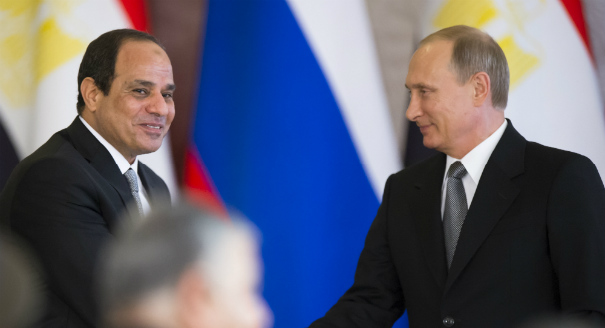
Even though the Egyptian regime can scarcely afford the loss of Gulf aid, a military intervention—in which the Egyptian military would likely suffer heavy causalities—could cause a wide-scale domestic backlash. To avoid such a scenario, Egypt is seeking to cultivate Russia as an economic ally that would impose fewer military demands on Egypt. For example, Egypt has cooperated with Russia in the area of nuclear energy, where it agreed to a $25 billion Russian loan on November 19, 2015 to build a nuclear power plant. And after tensions with Saudi Arabia became public, the two countries agreed to hold joint military exercises from October 15 to 26. This has exacerbated the dissonance between Egyptian promises and actions toward the Gulf states.
Ultimately, the public fallout between the two allies was caused by Egypt’s inability to act as a guarantor of Gulf security. In light of that, Egypt is moving toward other, less demanding allies, most notably Russia. As the fragility of the Egyptian regime increases, the more likely it will drift more into the Russian orbit and seek similar reliable allies who have the added benefit of supporting its repression of domestic opponents.
Maged Mandour is a political analyst and writes the “Chronicles of the Arab Revolt” column for Open Democracy. Follow him on Twitter @MagedMandour.