

Commentary
Judy Dempsey
{
  "authors": [
    "Judy Dempsey"
  ],
  "type": "commentary",
  "blog": "Strategic Europe",
  "centerAffiliationAll": "",
  "centers": [
    "Carnegie Endowment for International Peace",
    "Carnegie Europe"
  ],
  "collections": [],
  "englishNewsletterAll": "",
  "nonEnglishNewsletterAll": "",
  "primaryCenter": "Carnegie Europe",
  "programAffiliation": "",
  "programs": [],
  "projects": [],
  "regions": [
    "Eastern Europe",
    "Russia",
    "Ukraine",
    "Western Europe",
    "United Kingdom",
    "France",
    "Germany",
    "Europe"
  ],
  "topics": [
    "Climate Change",
    "Democracy",
    "EU",
    "Security",
    "Foreign Policy"
  ]
}
Source: Getty
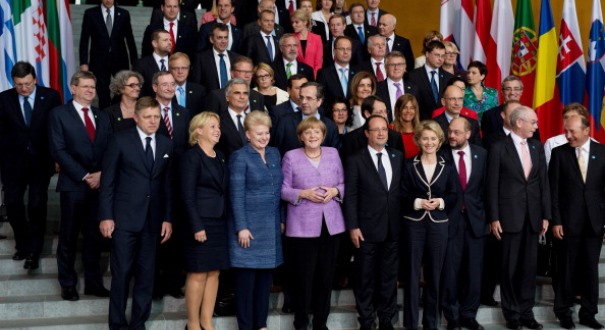
The EU remained united in imposing an initial round of sanctions on Russia. But there are now big differences among member states on whether to introduce further measures.
Europe’s leaders have so far managed to remain united over the Ukraine crisis. On March 17, they even managed to agree to impose a first set of sanctions on Russia.
But behind the scenes, there are now big divisions among EU member states on whether to introduce further targeted sanctions in response to Russia’s annexation of Crimea.
In the South, countries are still deeply preoccupied by the economic crisis. They are far from enthusiastic about the possibility of slapping on additional measures that might harm them too. Cyprus’s reluctance is linked to its status as a lucrative parking place for Russian money. Italy under former prime minister Silvio Berlusconi grew very close to Russia. Berlusconi is gone, of course, but Italy still has strong business ties to Russia through its energy group ENI.
Geography and religion play a big role, too. Spain’s foreign policy priorities are North Africa and the Middle East. Orthodox Christian Greece, by tradition, has close ties to Russia, especially with regard to trade and energy.
As for Western Europeans, Britain dreads tougher sanctions because of the impact they would have on London as a financial center. France worries about the consequences for defense contracts. The Netherlands has close links to Russian energy giant Gazprom, especially through its distribution network.Germany’s influential industry lobbies are completely against sanctions. The country’s political elite is divided, not just for economic reasons but also because of a sense of history and shared ties. Despite that, German Chancellor Angela Merkel seems determined to impose another round of sanctions, as she made clear during a speech to the parliament on March 20.
Eastern Europeans aren’t united, either. Hungarian Prime Minister Viktor Orbán, who recently signed a major nuclear energy contract with Russia, has played down the entire Ukraine crisis and Russia’s annexation of Crimea. In contrast, the Baltic states are so afraid of their giant neighbor’s appetite that they are taking a tough line despite a total dependence on Russian gas.
The table below presents a rough-and-ready Who’s Who of the 28 EU member states and their attitudes toward tougher sanctions on Russia. It also shows the percentage of each country’s natural gas consumption that comes from Russian imports.
| Country | Support for tougher sanctions on Russia | % of total gas consumption from Russian imports* |
|---|---|---|
| Austria | Reluctant | 52 |
| Belgium | Supportive | 43 |
| Bulgaria | Supportive, but big differences among parties | 100 |
| Croatia | Reluctant | 37 |
| Cyprus | Very reluctant | 0 |
| Czech Republic | Reluctant but will support | 80 |
| Denmark | Supportive | 0 |
| Estonia | Supportive | 100 |
| Finland | Reluctant | 100 |
| France | Reluctant | 17 |
| Germany | Reluctant but will support | 40 |
| Greece | Very reluctant | 55 |
| Hungary | Very reluctant | 50 |
| Ireland | Supportive | 0 |
| Italy | Reluctant | 20 |
| Latvia | Supportive | 100 |
| Lithuania | Supportive | 100 |
| Luxembourg | Supportive | 28 |
| Malta | Reluctant | 0 |
| The Netherlands | Reluctant | 6 |
| Poland | Supportive | 52 |
| Portugal | Reluctant | 0 |
| Romania | Supportive | 24 |
| Slovakia | Reluctant but will support | 63 |
| Slovenia | Reluctant but will support | 57 |
| Spain | Reluctant | 0 |
| Sweden | Supportive | 100 |
| United Kingdom | Reluctant | 0 |
Sources: BP Statistical Review of World Energy 2013, Eurogas, Eurostat.
* Note: The percentage of gas that member states import from Russia is distinct from the percentage that gas accounts for in their overall energy consumption.

Nonresident Senior Fellow, Carnegie Europe
Judy Dempsey is a nonresident senior fellow at Carnegie Europe
Recent Work
Judy Dempsey
Judy Dempsey
Carnegie does not take institutional positions on public policy issues; the views represented herein are those of the author(s) and do not necessarily reflect the views of Carnegie, its staff, or its trustees.

The EU’s new migration policy is not suited to today’s realities. With climate change increasingly becoming a driver of displacement, Europe needs to rethink its deterrence-focused approach.

Shana Tabak
The battle over free speech has taken center stage since U.S. Vice President JD Vance accused Europe of censorship. From travel bans to social media regulation, especially around the Israel-Palestine conflict, are liberal democratic governments weaponizing free speech?

Rym Momtaz, ed.
Europe seems to have accepted its sidelining in the Middle East. The EU must reassert its support for the international rules-based order and step up engagement.
Rym Momtaz

Amid uncertainty caused by the Iran war, the global drive for nonproliferation has stalled. With Europe diplomatically marginalized and countries reassessing their nuclear options, efforts to curb the spread of nuclear weapons risk becoming irrelevant.

Jane Darby Menton
Preparing candidate countries for EU membership is no longer enough. As the enlargement process becomes a reality, the union must also prepare its own societies.

Iliriana Gjoni