

Commentary
Judy Dempsey
{
  "authors": [
    "Judy Dempsey"
  ],
  "type": "commentary",
  "blog": "Strategic Europe",
  "centerAffiliationAll": "",
  "centers": [
    "Carnegie Endowment for International Peace",
    "Carnegie Europe"
  ],
  "collections": [],
  "englishNewsletterAll": "",
  "nonEnglishNewsletterAll": "",
  "primaryCenter": "Carnegie Europe",
  "programAffiliation": "",
  "programs": [],
  "projects": [],
  "regions": [
    "Asia",
    "Russia",
    "Europe",
    "East Asia",
    "China",
    "Western Europe",
    "Germany"
  ],
  "topics": [
    "Security",
    "Economy",
    "Climate Change",
    "EU"
  ]
}
Source: Getty
Berlin’s pursuit of economic and political ties with Beijing and Moscow has created dangerous dependencies. A change in strategy would benefit both Germany and the EU.
As if the German government needed to be reminded of the high price of its dependence on Russia and China.
Over the years, these two authoritarian regimes embedded themselves in the German economy and ingratiated themselves with the elites. Such developments prevented the EU from forging a coherent, critical strategy toward both Moscow and Beijing.
The union is now conducting major political and economic reassessments of its relations with Russia and China. But what about Germany, Europe’s biggest economy?
Over the decades, regardless of whether the Social Democrats or the Christian Democrats were in government, both parties consistently pursued economic and political relationships with Russia and China. This pursuit was based on national, not European interests. It was motivated by profit, not values or principles. These policies were also naively based on the idea that closer trade and economic ties would lead to stability, even trust.
The big question is whether Russia’s brutal war against Ukraine that began in February 2022 and China’s relentless authoritarian drive under Xi Jinping, expected to be confirmed this week at the Communist Party’s congress, will fundamentally change the view from Berlin.
It should, for anyone reading an account of a German parliamentary hearing that took place on October 17 with the presidents of the Federal Intelligence Service (BND), the Federal Office for the Protection of the Constitution (BfV) and the Military Counterintelligence Service (MAD).
The three agencies had warned, even before Russia’s illegal annexation of Crimea in 2014, of President Vladimir Putin’s use of violence and force to achieve his goals.
MAD President Martina Rosenberg said she warned about Russia’s cyber attacks, about drones repeatedly flying over Bundeswehr sites where military trainings were taking place, about spying on the defense industry, about disinformation campaigns inside the armed forces. China, she added, was extremely active in these areas too.
So why didn’t the government react to such potential destabilizing interferences?
BND President Bruno Kahl said his reports on Putin’s propensity for violence had always been “quite unreserved.” But, he added, there was the tendency of “politicians and the public to prefer to trust a positive spin.”
Thomas Haldenwang, BfV president, described how Russia uses all channels of spreading false news, attributed to “democracy-destroying relevance.” And in Germany, Russia is helped by pro-Russian “influencers” and “active politicians with particular closeness to Russia, some of whom spread Russian propaganda in the German Bundestag – out of deep conviction or because there’s money in it.”
Indeed, on October 16, the interior minister sacked Arne Schönbohm, who since 2016 was head of the Federal Office for Information Security, the cybersecurity agency. Allegedly he had links with Russian intelligence services.
The top three security and intelligence officials didn’t pull any punches over China either.
Kahl warned about a considerable threat from an “autocratic China rising to become a global power.” He said business, society, and politics in Germany have also been too trusting and “painfully dependent” on a power that “suddenly no longer seems well-disposed.”
All three officials said they had been trying to “raise awareness in the business community” about China’s intentions. The influential Federation of German Industries broke ground in 2019 by writing a critical report on China and how German industry had to understand the consequences of becoming so dependent on China for exports and certain commodities. However, Kahl said, there is still “a lot of trust and naivete… that is not appropriate.”
Despite these analyses, German Chancellor Olaf Scholz is making his first official visit to Beijing in early November, accompanied by a large business delegation with him, just like his predecessor Angela Merkel often did. After all, China is Germany’s most important trading partner; total trade in 2021 amounted to €246.1 billion ($240.8 billion).
China watchers in Berlin and his own ministries have warned Scholz of the inherent short-sightedness of increasing German dependence on China for exports and access to raw materials, which are crucial for Europe’s transition to renewable energy.
The Greens-led Ministry for Economic Affairs and Climate Action wants to diversify access to such materials instead of falling into the same trap that led to Germany becoming dependent on Russian gas.
Germany’s car and chemicals industry sees things differently. BMW recently opened a multibillion-dollar factory extension early this year in Shenyang in the northeast of the country. Audi is building its first electric vehicle plant in China. Airbus recently obtained a contract with a local final assembly line, chalking up an order worth more than $37 billion.
In September, the German chemical producer BASF opened the first stage of its new plant, the largest single foreign investment in China, according to Bloomberg. BASF plans to spend up to €10 billion ($9.8 billion) by 2030.
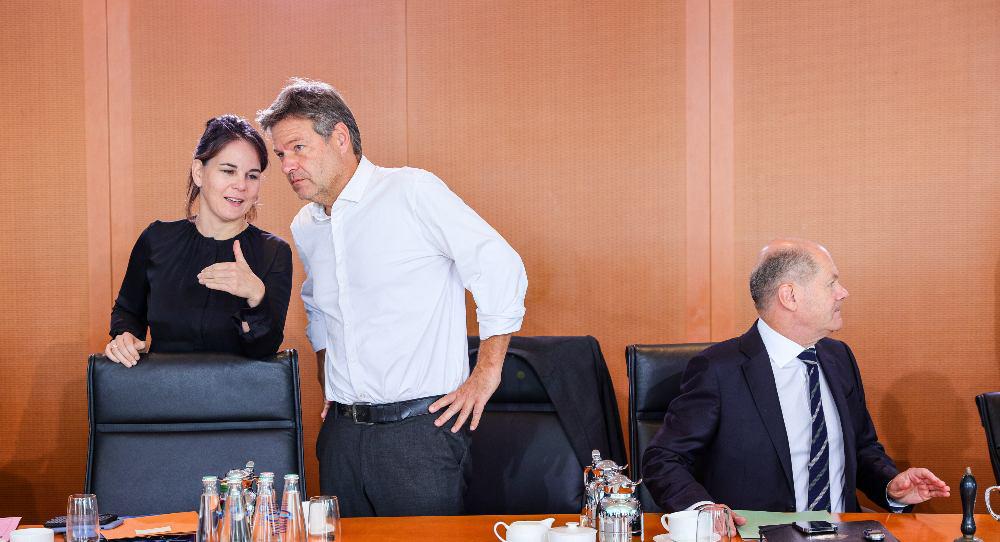
German industry, so dependent on exports, seems to be turning a blind eye to advise by the economics and foreign ministries. Foreign Minister Annalena Baerbock warned on October 17 at the Berlin Forum organized by the Körber Stiftung about the dependence on China.
“I say very clearly that one-sided economic dependence exposes us to political blackmail [...] We must ensure that we don’t make such a mistake again, and that means that we will have to take account of this more strongly in our policy toward China,” she said.
For now, despite how China can use its vast rare earth materials as geosecurity instruments just as Russia used its gas exports to Germany, Baerbock’s warnings have yet to make an impact.
This is bad news for Germany, the EU, and Berlin’s relations with the United States. The more Germany depends on China, the greater the chance of Beijing using its leverage over Berlin, particularly by playing off Berlin against other EU countries. And that’s not to mention its political grip over rare earth materials.
As for how it could sour relations with Washington, just read the speech on U.S. trade policy toward China by national security chief Jake Sullivan. For geostrategic and competitive reasons, it wants the United States to develop its own critical high-tech infrastructure and stop exports of vital technology to China.
Were Germany to introduce a strategy that reduced its dangerous dependence on Beijing and drop all illusions about Russia, it could benefit the EU and strengthen transatlantic ties at the expense of China.

Nonresident Senior Fellow, Carnegie Europe
Judy Dempsey is a nonresident senior fellow at Carnegie Europe
Recent Work
Judy Dempsey
Judy Dempsey

The aftermath of the Ceuta crisis shows Europe has drawn the wrong lessons. Rather than doubling down on failed migration policies, the EU needs to address the underlying roots of such episodes.

Richard Youngs

An overwhelming victory by a far-right-wing party in a small state in eastern Germany will have major repercussions for Chancellor Friedrich Merz’s coalition.
Judy Dempsey

Canadian Prime Minister Mark Carney has twice inspired praise for standing up to U.S. President Donald Trump: at the 2026 World Economic Forum in Davos and on Canada-U.S. trade negotiations. Is Carney showing a third way better than the EU has in dealing with the Trump administration?

Rym Momtaz, ed.

The EU’s responses to two recent incidents expose the gulf between European perceptions and capabilities. Unless the union can bridge that gap, it will never become a real geostrategic power.
Rym Momtaz

In supporting Europe’s far-right, MAGA and Russia both want the same thing: a weaker EU. Europe must defend itself without abandoning the openness these forces exploit.

Armida van Rij