

Report
- +9
Richard Youngs, Erik Jones, Dan Baer, …
{
  "authors": [
    "Rosa Balfour"
  ],
  "type": "commentary",
  "blog": "Strategic Europe",
  "centerAffiliationAll": "",
  "centers": [
    "Carnegie Endowment for International Peace",
    "Carnegie Europe"
  ],
  "collections": [
    "Transatlantic Cooperation"
  ],
  "englishNewsletterAll": "",
  "nonEnglishNewsletterAll": "",
  "primaryCenter": "Carnegie Europe",
  "programAffiliation": "",
  "programs": [],
  "projects": [],
  "regions": [
    "Europe",
    "North America",
    "United States",
    "Western Europe"
  ],
  "topics": [
    "Foreign Policy",
    "Security",
    "Economy",
    "EU",
    "Climate Change"
  ]
}
Source: Getty
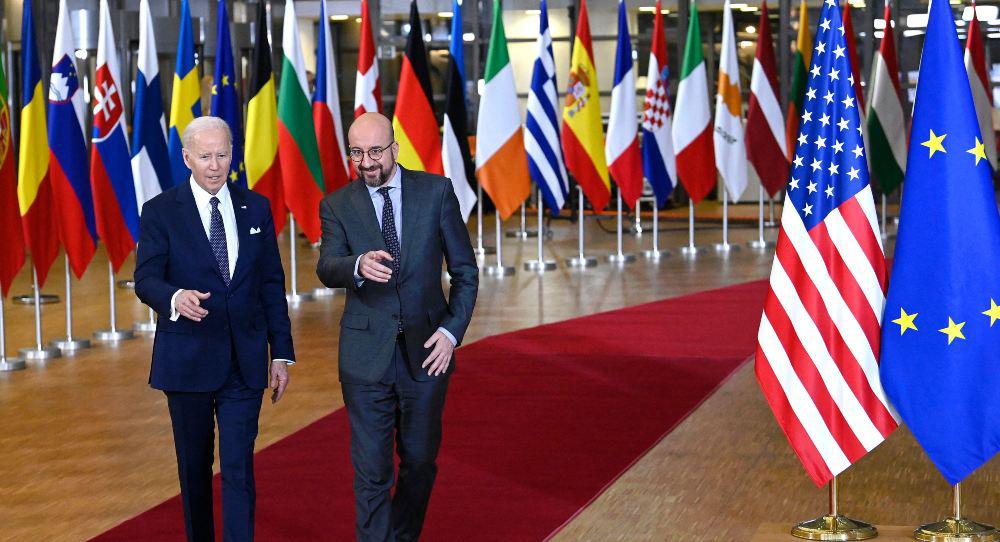
EU-U.S. frictions are emerging over Russia’s war in Ukraine, economic nationalism, and China. Working together on security while fending off for themselves economically is not viable.
Relations between the United States and the EU are going through a rough patch where old frictions are coming to the fore.
There are three main bones of contention: where Russia’s war against Ukraine is going, perceptions of economic nationalism, and how to deal with China. These are all old issues in new clothes that go to the heart of the transatlantic relationship.
Diplomacy can craft solutions, and this week’s state visit of French President Emmanuel Macron to the United States could provide some ahead of next week’s Trade and Technology Council, but neither side can have it all on the three interconnected fronts. When it comes to the link between security and economy, the logics driving the United States and the EU are at odds.
Americans started blinking first on the Russian invasion of Ukraine. With different arguments—to prevent a nuclear escalation, to return to the administration’s main concern of China’s rise, or because it is not seen as the United States’ war—the debates in Washington’s foreign policy circles started to focus on how to end the war.
Europeans are not ready for this. Ukraine’s military successes on the ground have given a much-needed boost to morale for the long, cold winter there. Western Europeans are enduring the brunt of the consequences without the expected public upheavals—for now.
The wartime strategy was crafted in Washington, but the whole response has been quite a feat of transatlantic coordination. Europeans stand by the principle of “nothing about Ukraine without Ukraine” and the impression Washington is abandoning it is a cause for worry. European unity is proving to be more than paper-thin, but not watertight. If the United States falters, the EU may not step in.
Beneath European unity are differing perceptions that prevent the emergence of a clear European leadership. The Franco-German relationship has been struggling and Polish-German relations deteriorating.
While Poland and the Baltic states are active in shaping the EU’s response to the war, there is no northeastern gravitational shift that some have announced. Leadership in Europe follows more complicated patterns. The absence of an agreement between the UK and the EU on the Northern Ireland Protocol also prevents the existing coordination on Ukraine to be upgraded to a leadership role.
Finally, the fears of Central and Eastern European states should be taken seriously. Putin’s revisionism in Central and Eastern Europe and the tireless attacks on infrastructure could have destabilizing consequences other than a direct military confrontation between Russia and NATO. Aside from the trite argument about who spends the most (the United States does in absolute terms), for Europe the economic, energy, and humanitarian costs are of far greater consequence than for the United States.
The second basket of transatlantic tensions relates to the Inflation Reduction Act. While it could put the United States onto the map in the fight against climate change, at long last, the industrial strategy focuses on subsidising American enterprises. The European economy could become collateral damage as U.S. subsidies attract investments away from Europe.
News reports reveal anger seeping through to journalists in Brussels, who accuse Washington of “profiting” from the war in Ukraine—a serious accusation that plays into rooted public scepticism about the United States. The United States, conversely, sees its “profitable” LNG deliveries as helpful to wean Europe off Russian fossil fuels.
U.S. President Joe Biden’s administration’s goal of pursuing a “foreign policy for the middle classes” has been met with caution in Brussels, wondering whether it is window-dressing for the economic nationalism of the Donald Trumpian sort. For Thierry Breton, EU commissioner for the internal market, U.S. “protectionism” represents an “existential challenge” to the EU’s economy when the energy crisis is accelerating deindustrialization.
The U.S. retort that Europe should introduce similar national subsidies—“Buy European”—goes against EU competition norms, creates fears of trade wars, and contravenes WTO rules.
The United States and EU have often managed to work through trade spats, but there are contradictory traps in the notion of allies working together on security while fending off for themselves on the economy.
The third field of tensions is China. Largely in response to U.S. preferences, Europeans have hardened their relations with Beijing in recent months, especially on foreign policy matters and investment screening. But European economies are still reliant on trade with China.
Germany’s Zeitenwende implies deep turnaround in thinking about Russia; it is striking that the lessons learnt about these dependencies are not extended to relations with China. Last month, Germany agreed to Chinese infrastructural investments in the country and Chancellor Olaf Scholz, despite lots of public criticism, visited Beijing with a delegation of business executives and without any European colleague.
This week, European Council President Charles Michel is in China, despite the crackdown on protests there.
Reducing Europe’s ties with China to mercantilism is only part of the story. For European states, the emerging bifurcation of global politics is seen unfavorably even if the EU has not found its place in a multipolar world. There are cases where the EU and United States are fully aligned, such as norms in cyberspace, and others where the EU does not want to be squeezed constrainedby the U.S.-Chinese rivalry, such as in fighting climate change.
The United States’ argument that Europeans cannot have it all—the luxury of U.S. security guarantees, a healthy transatlantic environment, and the liberty to trade with U.S. rivals—goes both ways.
Europeans, too, can argue that Washington cannot have it all: a European ally that takes care of its own security, is economically dependent on the United States, and aligned in its great power rivalry.
This blog is part of the Transatlantic Relations in Review series. Carnegie Europe is grateful to the U.S. Mission to the EU for its support.

Director, Carnegie Europe
Rosa Balfour is the director of Carnegie Europe. Her fields of expertise include European politics, institutions, and foreign and security policy.
Recent Work



Richard Youngs, Erik Jones, Dan Baer, …
Rosa Balfour
Carnegie does not take institutional positions on public policy issues; the views represented herein are those of the author(s) and do not necessarily reflect the views of Carnegie, its staff, or its trustees.

In supporting Europe’s far-right, MAGA and Russia both want the same thing: a weaker EU. Europe must defend itself without abandoning the openness these forces exploit.

Armida van Rij

As we close out another season of Strategic Europe, it is worth taking stock of the deep shifts underway.

Rym Momtaz

The EU had to compromise to adopt a twenty-first sanctions package against Russia, exposing growing cracks in the union’s resolve. Is this latest, weaker round worth it to keep pressure on Moscow?
Rym Momtaz, ed.

Trump is distracted and Ukraine wants Europe to step up. The continent’s leaders must find their voice and assert it in talks with Russia.

Alissa de Carbonnel

Mounting economic strain and battlefield losses will not necessarily make the Kremlin less dangerous. They could instead push Moscow toward a more aggressive hybrid campaign designed to test NATO’s Eastern flank, exploit allied hesitation, and fracture European resolve.

Maksym Beznosiuk