

Commentary
Ahead of a tough winter for Ukraine, Donald Trump’s swing back toward Russia bodes ill. But instead of panicking, Kyiv’s European allies are focusing on action.
Rym Momtaz
{
  "authors": [
    "Rosa Balfour",
    "Stefan Lehne"
  ],
  "type": "commentary",
  "blog": "Strategic Europe",
  "centerAffiliationAll": "",
  "centers": [
    "Carnegie Endowment for International Peace",
    "Carnegie Europe"
  ],
  "collections": [],
  "englishNewsletterAll": "",
  "nonEnglishNewsletterAll": "",
  "primaryCenter": "Carnegie Europe",
  "programAffiliation": "",
  "programs": [],
  "projects": [],
  "regions": [
    "Europe",
    "Western Europe",
    "Russia"
  ],
  "topics": [
    "Foreign Policy",
    "EU",
    "Migration",
    "Democracy",
    "Political Reform",
    "Security"
  ]
}
Source: Getty
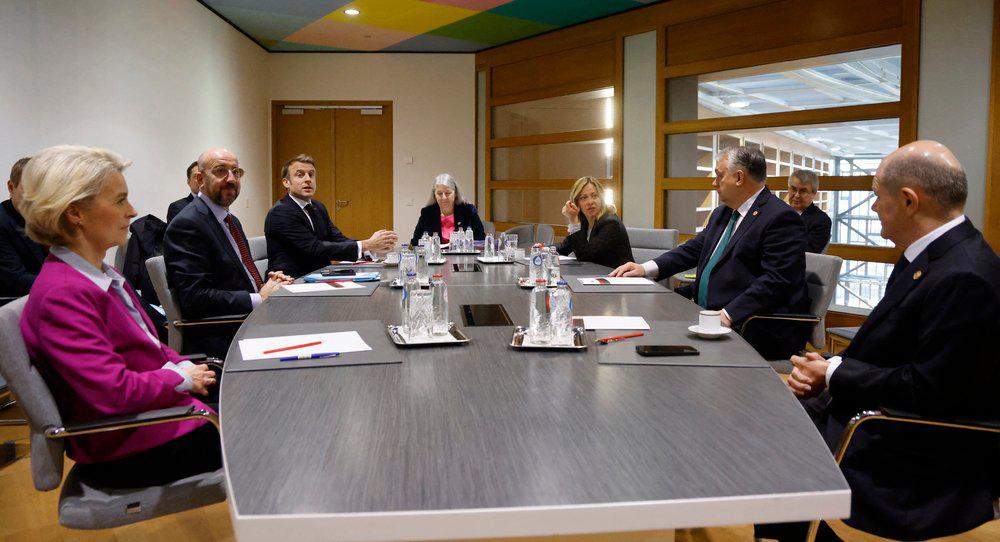
Radical-right forces are already influencing EU policies and could determine the bloc’s future direction. Yet internal divisions give mainstream parties a tactical advantage in this pivotal election year.
Europe’s political landscape is changing rapidly, with the dominant trend favoring the radical right.
Such parties are already in or supporting five governments in the EU. Geert Wilders’s Party for Freedom (PVV) is likely to become part of a Dutch coalition soon. In Belgium, Vlaams Belang could achieve a breakthrough at the national level in June. In Austria, the Freedom Party (FPÖ) is leading the polls for the parliamentary election in September. Meanwhile, in France, Marine Le Pen is considered to have excellent chances to win the presidential election in 2027.
Even countries like Germany, Spain, and Portugal, which for a long time seemed immune to the radical-right virus, have recently seen such parties gain unprecedented levels of support. The radical right in Poland was defeated in the parliamentary election of October 2023, but still enjoys widespread support.
The rise of populist right-wing parties is not a new phenomenon, but in terms of its impact on EU policies, it is clearly reaching a new stage. During the upcoming institutional cycle, the radical right could, for the first time ever, have a major impact on the future direction of the EU.
If more and more radical-right politicians join the European Council and the European Commission, the longstanding rule of a grand coalition of center-right and center-left parties and liberals will come under threat. In policy areas where the EU decides by unanimity, the risk of blockages will increase.
In the European Parliament, the two rightist groupings—the European Conservatives and Reformists (ECR) and Identity and Democracy (ID)—are likely to emerge significantly strengthened from the elections in June. This could affect EU policies particularly on such sensitive topics as migration, climate, and the rule of law.
And a return to the U.S. presidency by Donald Trump could ramp up the disruptive force of radical-right politics in the EU.
In light of these developments, Carnegie Europe will shortly publish a study on the impact of radical-right parties on the EU and its foreign policy. Drawing upon an analysis of the policies of fourteen significant parties across the EU and on interviews with officials and diplomats, we have examined the current and potential impact of the radical right and developed ideas for how liberal parties should deal with this challenge.
Among the report’s findings is that radical-right parties have mostly abandoned demands for leaving the EU or the euro, but they remain profoundly skeptical toward the union. Most of them favor a “Europe of nations” organized strictly along intergovernmental lines and leaving maximum freedom to the member states. They demand the return of some powers to the national level and will resist any attempt to strengthen the union’s competencies. Similarly, they see EU foreign policy at best as a loose coordination mechanism that allows governments to promote their national interests as they see fit.
Primarily focused on domestic politics, most of the parties so far do not have a well-developed foreign policy profile. For now, their biggest impact has been on the external aspects of migration policy, where they have driven mainstream parties to move toward increasingly restrictive policies. They are currently targeting similar efforts at the EU’s climate policies, which they see as an authoritarian elite project that ignores the social and economic costs to citizens.
Radical-right parties have little use for the values agenda of the EU’s foreign policy. This is in part because it conflicts with their deeply conservative family values and in part because they don’t see the point of criticizing important third countries for their human rights records.
When it comes to EU enlargement, these parties are mostly skeptical, except where specific national interests dictate a more open policy. They advocate reducing the EU’s development assistance or leveraging it to obtain cooperation on migration.
As Hungary’s record over recent months shows, pro-Russian sympathies of some these parties present a particular challenge to maintaining the EU’s support for Ukraine. There is a risk that radical-right parties could band together with other pro-Russian forces in the EU. By exploiting war fatigue, compounded by Russian disinformation, the radical right could shift European public support of Ukraine. That said, this issue is hugely divisive within the radical right, which also contains groupings that are sharply hostile to Russia. There are similar divisions over China, with Nordic parties taking a negative stance and Central European ones prioritizing economic relations with China.
More generally, as all these parties are nationalist, and as national interests naturally diverge, they find it difficult to work together effectively. This reduces their overall impact and gives mainstream parties a tactical advantage.
But there is no single template for how to deal with radical-right parties. Keeping them out of power at the national and EU levels through a cordon sanitaire has been effective in some situations but has just enhanced their popular support in others. Sometimes, a policy of engagement aimed at steering such parties toward the mainstream has had positive results. Such efforts on the EU level currently seem to have—for now—success with the Finns Party and the Brothers of Italy (Fratelli d’Italia). But years of engagement have only encouraged Hungary’s Fidesz and Poland’s Law and Justice (PiS) to become more Euroskeptic.
Against this backdrop, three points are fundamentally important for political leaders to consider in this pivotal election year for Europe.
First and foremost, the EU as a liberal, democratic project has no future without its core values. Parties committed to these values need to intensify their cooperation in order to isolate the most determined disruptors and persuade wavering partners to come on board. Our research shows that there is a connection between the deterioration of democracy within the EU and unity in foreign policy.
Second, the primary responsibility to contain the radical right lies with mainstream parties at the national level. They need to resist the temptation to mimic radical-right positions to avoid losing voters to them. Experience has shown that this tactic usually backfires and benefits the radical right itself.
Third, the radical right has gained ground, but it is still a minority and it remains divided. More determined and dynamic leadership of the institutions, more effective decision-making procedures, and tighter cooperation among key stakeholders can make the EU more resilient and better able to withstand this challenge.
Carnegie Europe is grateful to the Ministry for Foreign Affairs of Finland for their support of this work.

Director, Carnegie Europe
Rosa Balfour is the director of Carnegie Europe. Her fields of expertise include European politics, institutions, and foreign and security policy.

Senior Fellow, Carnegie Europe
Stefan Lehne is a senior fellow at Carnegie Europe in Brussels, where his research focuses on the post–Lisbon Treaty development of the European Union’s foreign policy, with a specific focus on relations between the EU and member states.
Carnegie does not take institutional positions on public policy issues; the views represented herein are those of the author(s) and do not necessarily reflect the views of Carnegie, its staff, or its trustees.

Ahead of a tough winter for Ukraine, Donald Trump’s swing back toward Russia bodes ill. But instead of panicking, Kyiv’s European allies are focusing on action.

Rym Momtaz

While the EU and European governments are embracing the much-lauded middle-power moment, this entails three difficult conundrums.

Richard Youngs

Much has been said of the changes Brussels is trying to make to the EU enlargement process. Here’s why gradual integration might—or might not—be the answer.

Dimitar Bechev

The European Commissioner for Trade is headed to China. But after President Xi’s bridge-building visit to Washington, can a more isolated EU overcome Beijing’s stranglehold on critical raw materials? Who will blink first?
Rym Momtaz, ed.

The domestic impacts of how long it is taking to end the war in Ukraine have pushed the French electorate to the political extremes and compromised the country’s diplomatic capacity.
Rym Momtaz