• Research
  • Emissary
  • About
  • Experts
Carnegie Global logoCarnegie lettermark logo
Democracy
  • Donate
{
  "authors": [
    "Douglas H. Paal"
  ],
  "type": "legacyinthemedia",
  "centerAffiliationAll": "dc",
  "centers": [
    "Carnegie Endowment for International Peace"
  ],
  "collections": [
    "Korean Peninsula"
  ],
  "englishNewsletterAll": "asia",
  "nonEnglishNewsletterAll": "",
  "primaryCenter": "Carnegie Endowment for International Peace",
  "programAffiliation": "AP",
  "programs": [
    "Asia",
    "Nuclear Policy"
  ],
  "projects": [],
  "regions": [
    "East Asia",
    "North Korea"
  ],
  "topics": [
    "Security",
    "Military",
    "Foreign Policy",
    "Nuclear Policy"
  ]
}
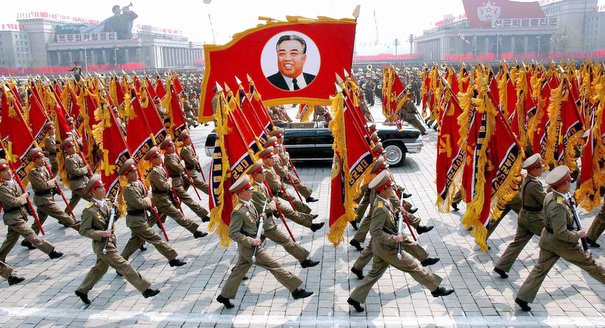
Source: Getty

In The Media

North Korea Poses No Real Threat to the World

Successive American administrations have failed to understand that the North Korea is not prepared to give up its nuclear weapons. The only hope for a shift in North Korea's behavior seems to be an eventual successor to Kim Jong Il.

Link Copied
By Douglas H. Paal
Published on May 26, 2009
Program mobile hero image

Program

Asia

The Asia Program in Washington studies disruptive security, governance, and technological risks that threaten peace, growth, and opportunity in the Asia-Pacific region, including a focus on China, Japan, and the Korean peninsula.

Learn More
Program mobile hero image

Program

Nuclear Policy

The Nuclear Policy Program aims to reduce the risk of nuclear war. Our experts diagnose acute risks stemming from technical and geopolitical developments, generate pragmatic solutions, and use our global network to advance risk-reduction policies. Our work covers deterrence, disarmament, arms control, nonproliferation, and nuclear energy.

Learn More

Source: RIA Novosti

Following North Korea’s underground test of a nuclear device on Monday, RIA Novosti spoke with Douglas H. Paal on the implications of the test.

North Korea Poses No Real Threat to the World: What has allowed North Korea to act in the way it does?
A: The accumulated mistakes of successive administrations to understand that the North Koreans really want to have a nuclear weapon and that they are not prepared to trade it away. There are honest disputes among many people about whether or not North Korea was at one time or another time willing to trade its nuclear weapons. But I think that now, since 1990 through 1994, despite agreements that Clinton had as well as the various agreements under president Bush, it is now very clear that North Korea wants a status very similar to India, where they obtain recognition of their right to retain nuclear weapons, but otherwise normalize relations with their neighbors and the United States.

Q: So what is the solution to the problem: the six-party talks, or something else?
A: The six-party talks are probably the only mechanism that, if there was a desire by Pyongyang to reach a solution, could provide the means to solve it. However, the situation has deteriorated to the point now where the six-party talks have been rejected by the North and I think China would have a very hard time getting the North Koreans back to the six-party talks. And to answer your fundamental question, I think we need to see some kind of change in North Korea. They currently have a powerful domestic motivation for what they are doing and we need to see domestic motivations adjusted in order to get them to take seriously the concerns of their neighbors and the United States.
 
Q: Would it be right to say that as long as Kim is in power nothing will change?
A: That appears to be the case. Because it is a one-man leadership he can change things anytime he wants to. Now, they appeared  to be focused on the succession arrangements, they are rapidly promoting the young son, they are creating arrangements around that son to have a kind of regency, in case Kim dies. To back him up they need the support of the military…and to demonstrate their importance to the country’s survival. The nuclear missile capabilities appear to be at the heart of that. 
 
Q: Do you think North Korea poses a real threat or is it just a political game that they are playing?
A: I am a little different from some observers, because I think the threat is very small. North Korea lacks the industrial capacity to build large numbers of long-ranged missiles. They will not be able to build so many weapons as to become a strategic factor in the region. But I have to acknowledge that they do pose a threat to South Korea both through short-range missiles, and the possibility of using the nuclear weapons in the South, even though there are just a few, or artillery from the North to the South. That would be the end of the North regime if they were to attack the South, but they still have that capacity. Moreover, they may force the Japanese to reconsider their very modest defense program. The Japanese have the capacity to move to a nuclear weapon, I do not think they will, but they certainly can. Certainly, politically Japan will debate whether or not move to a nuclear weapon in the short term because of this development in North Korea. And they do feel threatened by the North Korean short-ranged missiles and nuclear weapon. But as I said, North Korea is an industrial midget and not really in a position to pose a large-scale threat to the neighborhood.
Douglas H. Paal
Distinguished Fellow, Asia Program
Douglas H. Paal
SecurityMilitaryForeign PolicyNuclear PolicyEast AsiaNorth Korea

Carnegie does not take institutional positions on public policy issues; the views represented herein are those of the author(s) and do not necessarily reflect the views of Carnegie, its staff, or its trustees.

More Work from Carnegie Endowment for International Peace

  • Commentary
    Carnegie Politika
    How Will the Loss of Starlink and Telegram Impact Russia’s Military?

    With the blocking of Starlink terminals and restriction of access to Telegram, Russian troops in Ukraine have suffered a double technological blow. But neither service is irreplaceable.

      Maria Kolomychenko

  • Turkey Erdogan Caucasus Central Asia
    Article
    How Turkey Can Help the Economies of the South Caucasus to Diversify

    Over the past two decades, regional collaboration in the South Caucasus has intensified. Turkey and the EU should establish a cooperation framework to accelerate economic development and diversification.

      • Feride Inan
      • Güven Sak
      • Berat Yücel

      Feride İnan, Güven Sak, Berat Yücel

  • BAGHDAD, IRAQ - OCTOBER 30: Turkish Trade Minister Omer Bolat (2nd L) and Iraqi Trade Minister Etir Davud Selman al-Greyri (3rd R) sign the JETCO 2nd Term Protocol and the Memorandum of Understanding on Cooperation in the Field of Exhibition Services during The 2nd Session Meeting of the Joint Economic and Trade Committee (JETCO), held to develop commercial and economic relations between Turkiye and Iraq in Iraq's Baghdad on October 30, 2025.
    Article
    The Evolving Middle Eastern Regional Order: Türkiye-Iraq Relations in Context

    In this moment of geopolitical fluidity, Türkiye and Iraq have been drawn to each other. Economic and security agreements can help solidify the relationship.

      • Meliha Altunışık

      Derya Göçer, Meliha Altunışık

  • Commentary
    Carnegie Politika
    Signs of an Imminent End to the Ukraine War Are Deceptive

    The main source of Russian aggression is a profound mistrust of the West and the firm belief that it intends to inflict a “strategic defeat” on Russia. As long as this fear persists, the war will not end.

      Tatiana Stanovaya

  • Source: North Atlantic Treaty Organization
    Paper
    Are Long-Term NATO–South Korea Defense Ties Possible? Transitioning From an Arms Exporter to a Trusted Defense Partner

    South Korea has emerged as a major weapon exporter. But its relationship with Europe will depend on more than that.

      Chung Min Lee

Get more news and analysis from
Carnegie Endowment for International Peace
Carnegie global logo, stacked
1779 Massachusetts Avenue NWWashington, DC, 20036-2103Phone: 202 483 7600Fax: 202 483 1840
  • Research
  • Emissary
  • About
  • Experts
  • Donate
  • Programs
  • Events
  • Blogs
  • Podcasts
  • Contact
  • Annual Reports
  • Careers
  • Privacy
  • For Media
  • Government Resources
Get more news and analysis from
Carnegie Endowment for International Peace
© 2026 Carnegie Endowment for International Peace. All rights reserved.