The Russian, Israeli, Iranian and U.S. positions on Iran’s nuclear ambitions are open to several interpretations. The most realistic endgame scenario to best serve the chief interests of all players is one in which Iran maintains the ability to produce a nuclear weapon but refrains from testing one.
What's With Iran?As a former U.S. national security official, I have been straining — along with many fellow Americans — to understand the Iranian nuclear puzzle. What is really going on with Iran? While it is difficult to know exactly what or whom to believe, we can try to connect the dots of recent news reports and put forth several hypotheses.
1. The Pittsburgh Gambit. President Obama’s press conference with French President Nicolas Sarkozy and British Prime Minister Gordon Brown at the G-20 summit raised the stakes by revealing a new enrichment facility at Qum and then calling for tougher sanctions if Iran still fails to abide by its obligations under the Non-Proliferation Treaty (NPT).
This was a rhetorical shift for Mr. Obama, who has been experimenting with unconditional engagement. To be sure, he has also been talking about a mix of “bigger sticks and bigger carrots.”
The real question is whether it was a purely tactical move to increase pressure, or whether Mr. Obama and his colleagues actually have a more comprehensive game plan. The latter could be based either on some special knowledge — the expectation of a landmark understanding with Tehran, for example, or confidence that new sanctions would be both agreed and effective.
If not, the Western leaders could be setting themselves up for a further loss of credibility when deadlines again pass without results.
2. Qum. What is it? The Iranians hurriedly informed the International Atomic Energy Agency that something was indeed afoot at Qum. Most experts I have spoken with suspect that it was originally designed as a rocket site and is being converted into a “survival enrichment facility” in case Natanz and other nuclear-program sites are hit. There is probably no fissile material at Qum.
The United States claims to have known about Qum since 2007. Yet there is still no satisfactory explanation why Qum was outed now by both the Iranians and Mr. Obama.
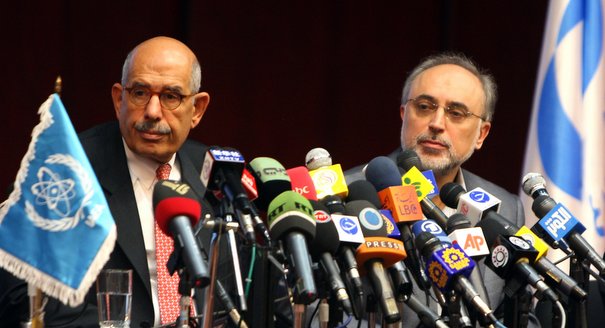
3. The Geneva and Vienna Talks. Iran’s talks with the so-called P5+1 (the five permanent members of the U.N. Security Council and Germany) have been at least superficially productive. Tehran promised to allow inspectors to visit the Qum facility and to send a substantial amount of low-enriched uranium (LEU) to Russia and France for processing.
These steps could represent some progress — or at least “the beginning of the beginning” as one analyst put it — giving Mr. Obama’s engagement strategy a hint of early success. A more skeptical interpretation, prevalent among some veteran Western security analysts, is that the Iranian regime simply did the bare minimum to buy time.
In any case, the promises to allow inspectors as required by the NPT and to shift LEU will be tested soon enough.
4. The Missing Nuclear Scientist. The recent disclosure of the disappearance three months ago of the top Iranian nuclear expert, Dr. Shahran Amiri — coinciding with the June crackdown and before the Qum disclosure — is interesting, particularly interesting in view of the report that Iran’s supply of LEU is running low and riddled with serious impurities that could cause centrifuge failure. Whether he defected or was kidnapped is unclear.
Critics of the Geneva talks immediately noted that these technical problems would explain why Tehran is now eager to transfer LEU to Russia in exchange for new fuel. But this picture also cuts against the notion that the Qum disclosure reveals a more imminent nuclear threat.
5. Moscow’s Swing Vote. Secretary of State Hillary Clinton went to Moscow last week to keep pushing the “reset button.” The main purpose was to advance the nuclear arms-reduction treaty talks. A new treaty, which is widely expected, would show that the United States and Russia are committed to the NPT’s long-term objective of a nuclear-free world.
A related purpose of Mrs. Clinton’s visit was Iran. The Kremlin cannot deliver a deal with the ayatollahs, but it can constrict their options. President Dmitri Medvedev praised the Geneva-Vienna talks and noted that “sanctions are not appropriate at this time.”
The Russians oppose sanctions primarily because they fear what could happen if sanctions fail. They understand that sanctions are not an end in themselves.
If Russia — or China — supported sanctions, they would have been on the dais with Mr. Obama, Mr. Sarkozy and Mr. Brown at the G-20.
But Mr. Medvedev’s final qualifier — “at this time” — was new and significant. Tehran certainly noticed the nuance. The Russians most likely told Mrs. Clinton that they would pressure Tehran to fulfill its renewed NPT commitments.
As a permanent member of the U.N. Security Council and NPT co-architect, Moscow prefers a non-nuclear Iran. But Moscow also probably prefers the status quo — an isolated Iran with nuclear ambitions that vex the West — to an Iranian détente or rapprochement.
Yet Moscow would certainly accept the latter scenario if it could avoid a regionally destabilizing military strike by the U.S. or Israel. Hence, Russia’s half-hearted, incremental cooperation with the West.
6. The Tricky Endgame. Just as in the Afghanistan case, where serious analysts are now floating the once radical idea of withdrawal and containment, new paradigms are starting to surface for Iran.
There are only three theoretical options — a pre-emptive strike, acquiescence and deterrence, or a negotiated framework.
The first is basically untenable if not unfeasible. The second is feasible but undesirable. The last is the best workable scenario.
The most encouraging theory is that the Iranians are not really so close to nuclear testing capacity and, further, that their strategy is in fact to remain in roughly this position.
On this view, Tehran might intend to develop all the needed infrastructure but to remain “18 months away” from testing. This posture could comply with the NPT and was essentially the shah’s strategy in the 1970s.
Several dozen countries, foremost among them Japan, Brazil and South Africa, are in this position today.
Refraining from testing is critical — this is where non-proliferation failed miserably with India and Pakistan.
If Tehran is interested in what is sometimes called the “Japan option” — maintaining an ability to produce a nuclear weapon on short notice, but not actually testing one — this could present a reasonable opportunity for a negotiated framework of inspections, surveillance and early warning. Iran would need to ratify the Comprehensive Test Ban Treaty.
To achieve such a framework would require at least minimal trust between Iran and the West, and also Russia, Israel and the Arab states. A good context would be engaging Iran across a wider frontier of regional security issues.
The trouble is that trust is awfully low between the United States and Iran. Who will move first?
Due to serious domestic fissures, the Iranians may not have the confidence to move in this direction. In a sense, no Iranian leader wants to be a Gorbachev, presiding over regime collapse. All want to be a Putin presiding over consolidation.
7. The Israeli Wild Card. If trust between the United States and Iran is near zero, trust between Israel and Iran is sub-zero.
What is most worrisome is that some Israelis are privately calling Mr. Obama weak and implying they can no longer trust the U.S. on Iran. A new rumor is circulating that Israel intends to strike Iran in the near term.
Israel can start a war against Iran, but it is doubtful Israel could finish such a war. Even if a surgical strike were feasible, it would almost certainly lead to an asymmetrical reply and a wider war in the Middle East.
If the strike scenario cannot work, why do Israelis keep making so much noise? Perhaps noise is the main part of their strategy. Before previous pre-emptive strikes, on Iraqi and Syrian sites, Israel was silent.
But then threatening Israeli noise could also be counterproductive, impelling the Iranians to move faster than they otherwise would.
* * *
A top European official said to me, “There is a serious risk that our policy will be failed talk followed by failed sanctions followed by failed war.” Then he added: “Better to be smart and diplomatic — and to know when there does seem to be an opening.”
Medish served in the Clinton administration as special assistant to the President and senior director for Russian, Ukrainian, and Eurasian Affairs on the National Security Council from 2000 to 2001.
Carnegie does not take institutional positions on public policy issues; the views represented herein are those of the author(s) and do not necessarily reflect the views of Carnegie, its staff, or its trustees.
More Work from Carnegie Endowment for International Peace
The European Commissioner for Trade is headed to China. But after President Xi’s bridge-building visit to Washington, can a more isolated EU overcome Beijing’s stranglehold on critical raw materials? Who will blink first?
European NATO countries are wrestling with the possibility of U.S. disengagement from the alliance. With the continent’s security increasingly uncertain, governments must restore the credibility of their collective defense.