

In The Media
Michele Dunne, Robert Kagan
{
  "authors": [
    "Robert Kagan"
  ],
  "type": "legacyinthemedia",
  "centerAffiliationAll": "",
  "centers": [
    "Carnegie Endowment for International Peace",
    "Carnegie Europe"
  ],
  "collections": [],
  "englishNewsletterAll": "",
  "nonEnglishNewsletterAll": "",
  "primaryCenter": "Carnegie Endowment for International Peace",
  "programAffiliation": "",
  "programs": [],
  "projects": [],
  "regions": [
    "Middle East",
    "Iran"
  ],
  "topics": [
    "Foreign Policy"
  ]
}
Source: Getty
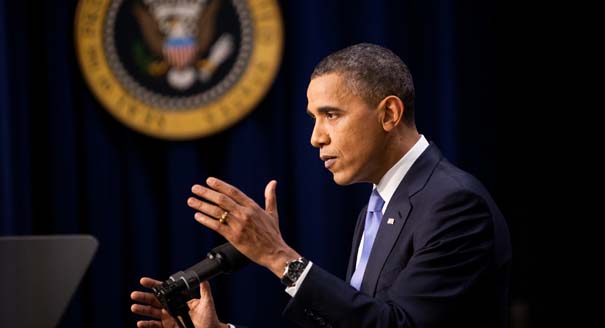
When President Obama and his top national security staff briefed journalists this week on Washington's strategy toward Iran's nuclear program, he was making the case that the administration's approach for isolating Iran is working.
Source: The Washington Post

What was striking was the president's sobriety about the issue, his evident pride in the global diplomatic efforts that produced the latest resolution and his determination to pressure the Tehran regime as much as possible. It was clear that he had no illusions about Iran. When he talked about his "engagement" strategy of the first year, it was not with wistful laments of what might have been or hope about future Iranian willingness to take up the offer to talk seriously about its nuclear program. Rather, Obama described it as a successful tactic in the effort to isolate and put pressure on the regime. By revealing to the world just how unserious the rulers in Tehran were about talks, by proving beyond a doubt that if there was an impasse in the U.S.-Iran relationship, the problem was not in Washington, he had set the stage for Iran's international isolation.
The president also expressed his belief that the sanctions are already starting to pinch the regime. What was interesting, however, was that he did not take this as a sign that there might now be a new opportunity for diplomacy. He and his advisers disparaged recent Iranian mumblings about resuming talks with the "P5-plus-1" (the United States, Russia, China, France, Britain and Germany) as nothing new. And they displayed no eagerness to press for renewed talks or to make new dramatic gestures. The president went out of his way to note that the Iranians are masters of delay and deception. He explained in some detail why the deal Turkey and Brazil struck with Tehran was a nonstarter. He repeatedly acknowledged that the regime may be so "ideologically" committed to getting a bomb that no amount of pain would make a difference. He did make clear that the door was, of course, open to the Iranians to change their minds, that sanctions did not preclude diplomacy and engagement, and that if the Iranians ever decide they wanted to "behave responsibly" by complying with the demands of the international community, then the United States was prepared to welcome them.
It is here that this very straightforward briefing took a bizarre and amusing turn. Some of the journalists present, upon hearing the president's last point about the door still being open to Iran, decided that he was signaling a brand-new diplomatic initiative. They started peppering Obama with questions to ferret out exactly what "new" diplomatic actions he was talking about and, after the president left, they continued probing the senior officials. This put the officials in an awkward position: They didn't want to say flat out that the administration was not pursuing a new diplomatic initiative because this might suggest that the administration was not interested in diplomacy at all. But they made perfectly clear -- in a half-dozen artful formulations -- that, no, there was no new diplomatic initiative in the offing. As one bemused senior official later remarked to me, if the point of the briefing had been diplomacy, then the administration would have brought its top negotiators to the meeting, instead of all the people in charge of putting the squeeze on Iran. Some journalists nevertheless left with the impression that the big "news" out of their meeting with the president was a possible new round of diplomacy.
I left feeling sympathy for this and every administration. Apparently, even spoon-feeding doesn't work. The "news" out of this briefing was that the administration wanted everyone to know how tough it was being on Iran. I was especially struck by the remarks of a senior official, who pointed out that one effect of Iran's growing economic difficulties has been strikes in the bazaars. The student and opposition demonstrations of the past year have been political, but these protests are about economics. If the two ever join, this official suggested, that would pose a real threat to the regime. An interesting point -- though not to the assembled journalists.
Former Senior Associate
Kagan, author of the recent book, The Return of History and the End of Dreams (Knopf 2008), writes a monthly column on world affairs for the Washington Post and is a contributing editor at both the Weekly Standard and the New Republic.
Recent Work

Michele Dunne, Robert Kagan
Robert Kagan, Michele Dunne
Carnegie does not take institutional positions on public policy issues; the views represented herein are those of the author(s) and do not necessarily reflect the views of Carnegie, its staff, or its trustees.

Despite public disputes over trade and immigration, the strategic partnership’s foundations remain sturdy.

Sameer Lalwani
It signals a new era of tech diffusion and warfare.

Steve Feldstein

With its public finances in shambles, the far right polling at 35 percent ahead of the 2027 presidential election, and a growing protest movement, is France’s crisis a threat to the EU’s geopolitical awakening?

Rym Momtaz, ed.

Ahead of a tough winter for Ukraine, Donald Trump’s swing back toward Russia bodes ill. But instead of panicking, Kyiv’s European allies are focusing on action.
Rym Momtaz

Without a ceasefire with Ukraine on attacking each other’s energy infrastructure—to which the Kremlin is unlikely to agree—the diesel agreement between Putin and Trump is largely for show, rather than representing a genuine increase in the volumes of Russian diesel on the global market.

Sergey Vakulenko