

Commentary
Despite its flop at the box office, the film raises important questions for the climate community to answer.
Leonardo Martinez-Diaz
{
  "authors": [
    "Wang Yanjia",
    "William Chandler"
  ],
  "type": "other",
  "centerAffiliationAll": "dc",
  "centers": [
    "Carnegie Endowment for International Peace"
  ],
  "collections": [],
  "englishNewsletterAll": "ctw",
  "nonEnglishNewsletterAll": "",
  "primaryCenter": "Carnegie Endowment for International Peace",
  "programAffiliation": "SCP",
  "programs": [
    "Sustainability, Climate, and Geopolitics"
  ],
  "projects": [],
  "regions": [
    "China",
    "North America"
  ],
  "topics": [
    "Political Reform",
    "Climate Change"
  ]
}
Source: Getty
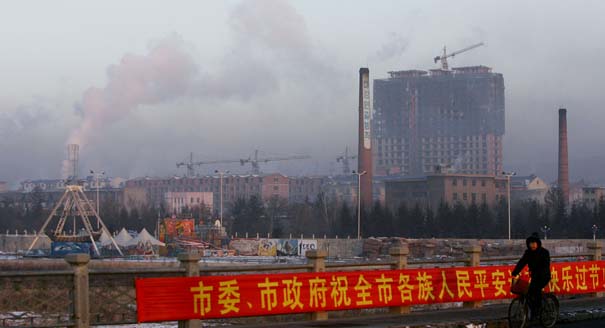
China has claimed success on its ambitious targets to reduce growth in energy demand and greenhouse gas emissions. As these achievements come under increasing scrutiny, China can improve its data quality by applying lessons learned from previous economic census results.
China is the world’s largest national source of greenhouse gas emissions, and energy production and use create most of those emissions. China has set ambitious targets to reduce energy demand growth and, consequently, its greenhouse gas emissions growth, and has claimed dramatic gains in meeting them.
Unfortunately, inadequacies in China’s national statistical system makes it difficult to assess China’s progress toward meeting its goals. The government’s claims of significant progress in reducing carbon intensity are generally plausible. However, due to shortcomings in the data system, China’s progress cannot be proven in detail with a high level of accuracy.
The Chinese government could increase confidence in the energy and emissions data it collects and publishes by improving the methods and capabilities of its statistical collection and reporting system. For example, data collection agencies could make better use of data spot checking, data sampling, and personnel training. Chinese leaders could facilitate capacity building at all levels of data management and administration to guarantee data quality (and consistency) from top to bottom.
Significant data quality improvements could be made by applying lessons learned from the economic census China has developed over the last decade. The statistical shortcomings revealed by the census include large adjustments required for total coal production and in gross domestic product (GDP) for the service sector. The Chinese government could concentrate its efforts on improving data collection, analysis, and processing in these areas.
Measurements of electricity, natural gas, and heat use—which are metered and invoiced by utilities—could be used directly for statistical reporting in place of survey data obtained from enterprises.
Most importantly, additional effort could be made to collect data on coal output, especially from small mines, which could be required to report their production data even if their output is small. This would ensure that all coal output is included, providing more reliable data.
Wang Yanjia

Former Adjunct Senior Associate, Energy and Climate Program
Chandler is a leading expert on energy and climate. As an adjunct senior associate in the Energy and Climate Program he supports Carnegie’s work in these fields, collaborating closely on projects with Carnegie’s offices in Moscow, Beijing, Brussels, and Beirut.
Carnegie does not take institutional positions on public policy issues; the views represented herein are those of the author(s) and do not necessarily reflect the views of Carnegie, its staff, or its trustees.

Despite its flop at the box office, the film raises important questions for the climate community to answer.

Leonardo Martinez-Diaz

While the EU and European governments are embracing the much-lauded middle-power moment, this entails three difficult conundrums.

Richard Youngs

Ex-president Gurbanguly Berdimuhamedov remains interested in politics, but his son Serdar, Turkmenistan’s current president, is becoming increasingly independent and willing to break with his father’s legacy. If their covert rivalry goes too far, both risk losing power.

Galiya Ibragimova

Europe is facing rising populism internally as well as external pressures from Russia, China, Turkey, and the United States.

Dimitar Bechev

A notable degree of participative democracy has firmly arrived in Europe. But to have more far-reaching impact, democratic deliberation needs to move into a radically new phase.
Richard Youngs