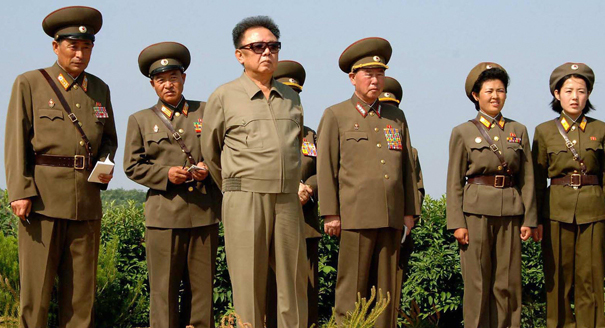
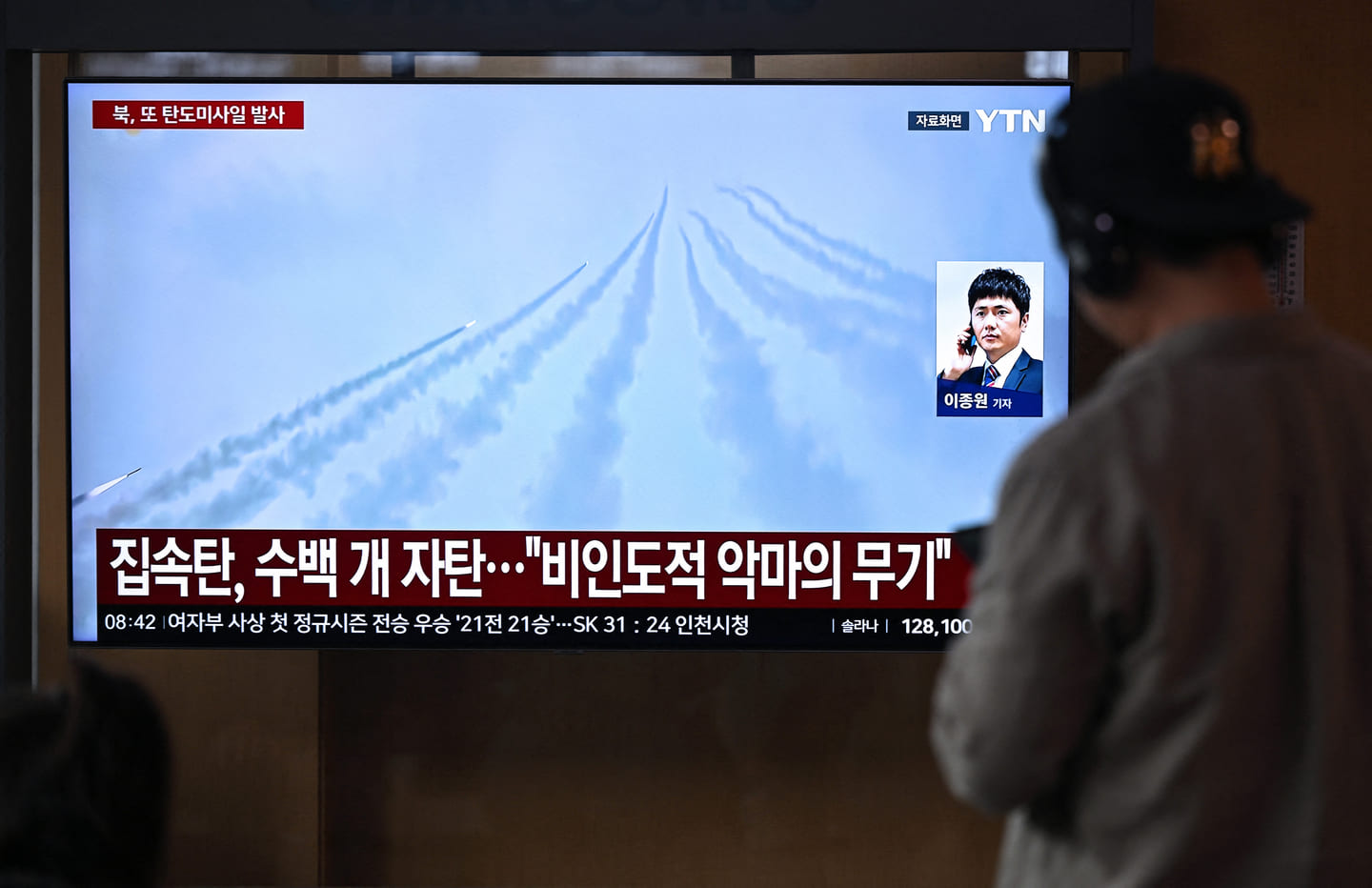
With nuclear weapons a strategic necessity for Pyongyang and central to its identity, it is unlikely that North Korea was ever serious about using them as a bargaining chip.
Jonathan Pollack’s No Exit: North Korea, Nuclear Weapons and International Security is an excellent addition to the literature on North Korea’s nuclear program. While most of this literature is aimed at the international diplomatic process and policy options to disarm North Korea, Pollack focuses almost exclusively on the why and how of North Korea’s nuclear development, to the exclusion of policy analysis. No Exit is nonetheless a timely reminder to policymakers that the depth of North Korea’s commitment to nuclear weapons augurs poorly for those policy options currently on the table and for the prospects of denuclearization in the future.
Pollack meticulously traces the parallel political and nuclear developments in North Korea, including Kim Il-sung’s early interest in a nuclear program and his efforts over the decades to parlay relationships with Moscow and Beijing into nuclear assistance. The picture that emerges is one of an unshakable commitment by the North Korean leadership to a nuclear weapons capability wrapped in the guise of a civil nuclear power program. At the outset, Pollack posits that the driving force behind the nuclear enterprise was the personal conviction of first Kim Il-sung and subsequently Kim Jong-il in the importance of nuclear weapons for North Korea’s security. This Kim-centric account situates Pollack’s work clearly on the psychology-oriented “demand” side of the proliferation literature. In particular, he cites work by Jacques Hymans, who theorizes that “oppositional nationalist” leaders, such as the Kims, “develop a desire for nuclear weapons that goes beyond calculation to self-expression.”1 It is a compelling account. But there are some issues with placing leadership psychology at the center, not least of which is the removal of agency from other actors in North Korea, as well as responsibility on the part of North Korea’s international benefactors for abetting its behavior.
As a theoretical matter, Pollack’s account does offer a great deal of support to the notion that the personal commitment of Kim Il-sung and Kim Jongil to nuclear weapons was critical, as Hymans’s theory predicts, though it is not clear that this commitment developed out of a particular leadership psychology. Though No Exit is clearly not intended to be a theory-driven case study, by noting one theory up front Pollack creates an expectation that he will use that theory to illuminate his argument, or at least return to it at the end. But he does not carry out this line of thought through the book. Readers are thus left to draw their own conclusions about the centrality of the Kim family psychology to the nuclear enterprise and the extent to which this is consistent with Hymans’s own assessment of North Korea’s nuclear program.2 In fact, Pollack’s account also offers copious plausible evidence for realist theories of proliferation, particularly given deep North Korean security anxieties after the collapse of the Soviet Union and the entwined nature of North Korea’s civil and military nuclear programs. For instance, he argues that “even if Kim [Ilsung] was momentarily reassured of Chinese and Soviet strategic intentions, any such assurances were at best conditional” (p. 83). This sounds less like “self-expression” than strategic insecurity.
Undoubtedly, North Korea’s opacity makes research on bureaucratic and military elements of the country’s decisionmaking a very difficult undertaking, and Pollack’s use of archival material is impressive. On occasion, Pollack cites the “powerful domestic constituencies closely identified with the weapons program,” and he writes at length about the political importance of North Korea’s “military-first” policies (p. 101). These constituencies, however, are largely missing from his story of why North Korea developed nuclear weapons. This absence may be less perplexing in the Kim Il-sung era, given his centralization of political power, but is more so under Kim Jong-il. If one accepts, as Pollack does, the assessment of Adrian Buzo that Kim Jong-il had “left no mark or trace of influence on major state policies independent of his father” (p. 87), then it seems a stretch to conclude that his drive alone led to the decision to proceed with development and testing of a nuclear explosive device after Kim Il-sung passed from the scene in 1994. Indeed, one suspects the military has been a significant but unseen protagonist throughout this saga, particularly given the greater reliance of Kim Jong-il on the military for legitimacy and political support. Several questions go begging for answers: What has been the military’s role in nuclear decisionmaking, and what will its role be with regard to nuclear weapons going forward? Is North Korea committed to nuclear weapons under the control of the military, or does it have a more political conception of deterrence? And how much of the inertia for the nuclear weapons effort is due to other constituencies, such as North Korea’s nuclear scientific establishment? Pollack’s Kim-focused account would be more compelling if he could demonstrate that other actors involved in the nuclear program were not instrumental in the decisionmaking.
One of the strengths of the book is Pollack’s careful tracking of the personal relationships between Kim Il-sung and his counterparts in Beijing and Moscow, and in particular Kim’s efforts to play one against the other. As a Sinologist, Pollack is at his best in dissecting the difficult relationships Kim Il-sung maintained with Mao Zedong and Deng Xiaoping and his deep distrust of China’s intentions. But his account of North Korea–China relations lets Beijing off the hook, at least more so than it deserves. On the one hand, the prevailing assumption inside the beltway is that China can and should do more to restrain North Korea’s dangerous activities. Pollack’s narrative shows this assumption to be more hopeful than realistic. On the other hand, Pollack argues that Beijing is without options, that “it has no more of a solution to the nuclear issue than any other power” (p. 204). China’s behavior, especially its increasing investment in North Korea and history of looking the other way on illicit shipments to and from North Korea, suggests that Beijing has leverage it is politically indisposed to use and is thus at least partially responsible for abetting North Korean proliferation. This reluctance was made abundantly clear with China’s overly restrained response to North Korea’s highly provocative sinking of the Cheonan and shelling of Yeonpyeong Island in 2010. It is reasonable to conclude that Beijing has more options—falling somewhere between containment and “buying time indefinitely”—than Pollack is willing to admit (p. 204).
In the end, readers of No Exit are left with a compelling description of North Korea’s inexorable march toward nuclear weapons, punctuated by negotiated pauses but no real change in intent. For those contemplating policy approaches to denuclearization of the Korean Peninsula, Pollack’s account serves as a warning that options are few and messy. With nuclear weapons a strategic necessity for Pyongyang and central to its identity, it is unlikely that North Korea previously was serious about using them as a bargaining chip. This is even truer today. Pollack pointedly concludes that denuclearization is not probable without regime change, until there is “a different type of system in which leaders do not believe that the survival or prosperity of the state depend on continued possession of nuclear weapons” (p. 209). Many in Washington (and presumably Seoul, Beijing, and Tokyo) have hoped for regime change for years, but hope is a poor basis for policy. If one reads between the lines, Pollack suggests that containing the dangers that North Korea might inflict on its neighbors and itself is the only real option in the interim. He is very likely correct, as unsatisfying a conclusion as that is.
1. Jacques E.C. Hymans, “Theories of Nuclear Proliferation,” Nonproliferation Review 13, no. 3 (2006): 459
2. Jacques E.C. Hymans, “Assessing North Korean Nuclear Intentions and Capacities: A New Approach,” Journal of East Asian Studies 8, no. 2 (2008): 259–92.
Senior Fellow and Co-director, Nuclear Policy Program
Toby Dalton is a senior fellow and co-director of the Nuclear Policy Program at the Carnegie Endowment. An expert on nonproliferation and nuclear energy, his work addresses regional security challenges and the evolution of the global nuclear order.
Carnegie does not take institutional positions on public policy issues; the views represented herein are those of the author(s) and do not necessarily reflect the views of Carnegie, its staff, or its trustees.
More Work from Carnegie Endowment for International Peace
China’s rapid technological progress and its first-rate infrastructure are often cited as refuting the claim that China has been systematically overinvesting in non-productive projects for many years. In fact, as the logic of overinvestment and the many historical precedents show, the former is all-too-often consistent with the latter.
Following Ursula von der Leyen’s gaffe equating Turkey to Russia and China, relations with Ankara risk deteriorating even further. Without better, more consistent diplomatic messaging, how can the EU pretend to be a geopolitical power?
Troubled by the growing salience of nuclear debates in East Asia, Moscow has responded in its usual way: with condemnation and threats. But by exacerbating insecurity, Russia is forcing South Korea and Japan to consider radical security options.