

Article
Marina Ottaway, Omar Hossino
{
  "authors": [
    "Marina Ottaway"
  ],
  "type": "legacyinthemedia",
  "centerAffiliationAll": "dc",
  "centers": [
    "Carnegie Endowment for International Peace",
    "Carnegie Europe",
    "Malcolm H. Kerr Carnegie Middle East Center"
  ],
  "collections": [
    "Arab Awakening"
  ],
  "englishNewsletterAll": "menaTransitions",
  "nonEnglishNewsletterAll": "",
  "primaryCenter": "Carnegie Endowment for International Peace",
  "programAffiliation": "MEP",
  "programs": [
    "Middle East"
  ],
  "projects": [],
  "regions": [
    "North Africa",
    "Egypt",
    "Middle East"
  ],
  "topics": [
    "Political Reform"
  ]
}
Source: Getty
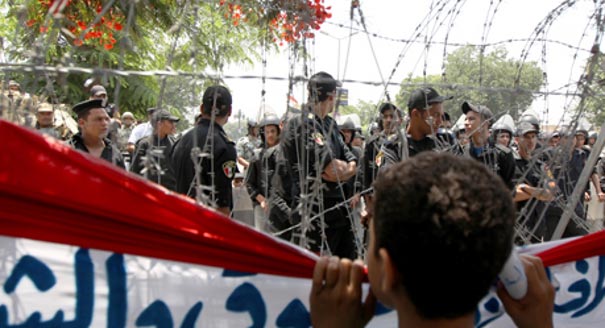
The Egyptian Supreme Constitutional Court’s recent decisions allowing members of the old regime to run for office and striking down a section of the parliamentary election law puts an end to the first phase of the Egyptian transition and is a clear victory for the old regime.
Source: National Interest

The question now centers on the reaction of those Egyptians who marched in Tahrir Square in January 2011 to press their demands for an end to the old regime. In one form or another, they will challenge these latest actions by the old guard.
The court’s decisions were highly political, even if carefully couched in legal language. They amount to an announcement by the guardians of the old order that regime change is not allowed. The court did not shrink from the irony of judging the acceptability of the new laws against the standards of an abrogated constitution. For Egyptians favoring change, the lesson is that they cannot get change by political means; that they will have to take to the streets once again. Whether this happens immediately or later, Egypt faces a difficult period in which hope gives way to resentment and the economy continues to deteriorate.The most immediate consequence of the SCC’s decision will be the return of all power to the Supreme Council of the Armed Forces. For the next few days at least, the SCAF will control executive and legislative power, and it intends to use it. It has already announced that it will now appoint a Constituent Assembly to replace the one the parliament elected on June 11, which has apparently died together with the parliament. It also has hinted that it will issue a new constitutional declaration to replace the one issued in March 2011. The constitutional declaration will probably look impeccably liberal and democratic on paper. How it will be implemented under the present circumstances is a different matter. Even after the presidential election, the power of the SCAF will not be much diminished because Ahmed Shafik, the candidate of the military and the old regime, will be Egypt’s next president.
The election of Shafik is a certainty. He may win the election fairly, with the support of Egyptians either nostalgic for the old order or fearful of the Muslim Brotherhood, or he may prevail because elections are manipulated. We may never know for sure. But clearly a regime that has just carried out a judicial coup against elected institutions in order to safeguard its power will not allow Mohamed Morsi, a Muslim Brother, to become president. Institutionally, the country will go back to where it was before Mubarak was ousted, with a member of the old regime in the presidency, the military returning to its favorite role of wielding influence behind a civilian regime headed by former officer and a parliament that will probably be dominated by the old, tame political parties, with Islamists once again in a much-diminished position.
This return to the status quo will leave the country deeply divided. It will be welcomed by numerous secular politicians who have shown that their commitment to democracy is strong only as long as power remains in the hands of the old elite—preferably with its most liberal exponents in high positions, to be sure—but stops abruptly if a new elite threatens to take over. But many will be deeply disappointed and disillusioned that their “revolution” in early 2011 has fizzled. It is difficult to predict how they will react. In the short run, many probably will boycott the presidential runoff election by spoiling ballots or simply staying home. Some will take to the streets, although fatigue and disillusionment may prevent the massive demonstrations Egypt witnessed in 2011.
In the long run, however, Egypt’s rulers will face an increasingly difficult and dangerous situation. The discontented youth that triggered the change in 2011 are still there, and so are the citizens who in 2012 elected a parliament dominated by Muslim Brothers and Salafis. But this time they will have learned a lesson: real change in Egypt will require more than street marches, because the old regime is fighting back. It still controls the military and all state institutions—the “deep state,” to borrow an apt moniker from Turkey—and know how to put that control to good use, as shown by the decision of the Supreme Constitutional Court.
One possibility is that the battle for change will become a long engagement between the deep state that has reasserted itself and those seeking an alternative. As in Turkey, this battle will be fought over a period of many years, through the formation of new political parties and the contesting of new elections. But another possibility is that the battle will be fought again in the streets, this time with violence, because the military has ceded its image as protector of the revolution. It has become the main force of counterrevolution, and rage will be directed against it. The old regime won the first round, but there will be other rounds.
This article was originally published in the National Interest.
Former Senior Associate, Middle East Program
Before joining the Endowment, Ottaway carried out research in Africa and in the Middle East for many years and taught at the University of Addis Ababa, the University of Zambia, the American University in Cairo, and the University of the Witwatersrand in South Africa.
Recent Work
Marina Ottaway, Omar Hossino
Marina Ottaway
Carnegie does not take institutional positions on public policy issues; the views represented herein are those of the author(s) and do not necessarily reflect the views of Carnegie, its staff, or its trustees.

Ex-president Gurbanguly Berdimuhamedov remains interested in politics, but his son Serdar, Turkmenistan’s current president, is becoming increasingly independent and willing to break with his father’s legacy. If their covert rivalry goes too far, both risk losing power.

Galiya Ibragimova

A notable degree of participative democracy has firmly arrived in Europe. But to have more far-reaching impact, democratic deliberation needs to move into a radically new phase.

Richard Youngs
Fatima El Mansouri is the country’s first female prime minister. She’s also a privileged insider in a largely ceremonial position.

Sarah Yerkes

Sergei Kiriyenko used Russia’s parliamentary vote to further hone his strategy of corporate mobilization that is designed to maximize votes for United Russia.

Andrey Pertsev

Before the next wave of EU enlargement takes place, the union needs to grapple with thorny questions of how power is distributed among its members.


Emil Sondaj Hansen, Ditte Brasso Sørensen