

Paper
Matthew Rojansky
{
  "authors": [
    "Matthew Rojansky"
  ],
  "type": "legacyinthemedia",
  "centerAffiliationAll": "dc",
  "centers": [
    "Carnegie Endowment for International Peace",
    "Carnegie Russia Eurasia Center"
  ],
  "collections": [],
  "englishNewsletterAll": "ctw",
  "nonEnglishNewsletterAll": "",
  "primaryCenter": "Carnegie Endowment for International Peace",
  "programAffiliation": "russia",
  "programs": [
    "Russia and Eurasia"
  ],
  "projects": [
    "U.S.-Russia Bilateral Presidential Commission"
  ],
  "regions": [
    "North America",
    "United States",
    "Russia"
  ],
  "topics": [
    "Foreign Policy"
  ]
}
Source: Getty
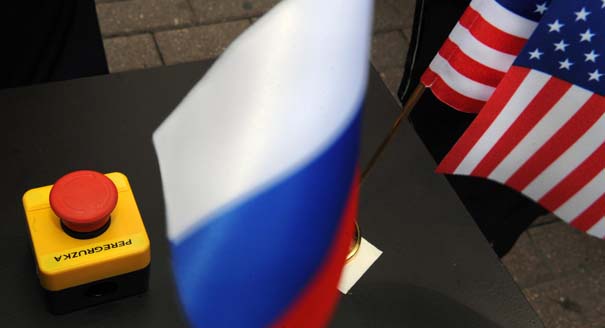
Despite the recent rapid deterioration in relations, the United States and Russia need to continue talk to each other in order to preserve mutually beneficial cooperation.
Source: Guardian
Over the past three months, US-Russia relations have plummeted farther and faster than at any time since the 2008 Russia-Georgia War. In fact, not since those dark days have so many doors in Washington and Moscow slammed shut at the same time, and the silence is deafening.
In December, the US Congress passed win-win trade legislation, but added a poison pill: the Magnitsky Act, which imposes financial and travel sanctions on prominent Russians believed to be responsible for human rights abuses. Russia has answered insult with injury, banning US families from adopting its orphans, undercutting Nunn-Lugar non-proliferation cooperation, and booting USAID from the country, among other provocations. For its part, the Obama administration has pulled out of a bilateral working group on civil society it now considers pointless, and indicated that the president will not accept Vladimir Putin's invitation to come to Russia before next September, when they may meet on the margins of the G20 summit in St Petersburg.Would Obama and Putin even be able to turn things around if they wanted to? Perhaps not. After all, Putin has done everything possible to deflect his domestic problems onto the American bogeyman, and Obama has not stood up to those in Washington who believe that diplomacy is first and foremost a vehicle for exporting American values. But both sides need to recognize that they are tearing down foundations – legal, political and personal – which were painstakingly built over two decades since the Cold War ended.
As these foundations crumble, so too will the everyday cooperation now taken for granted, from trade relations that benefit American businesses and Russian consumers, to coordination that enables NATO supplies to transit Russia en route to Afghanistan, which helps stop terrorists and drug traffickers before they move north into Russia and Europe. President Obama's ambitions for new nuclear reductions? The possibility of working together to defuse the Syrian crisis? You can forget about both.
So what is to be done? As a relationship counselor might advise, let's first call a time out. If the US and Russian governments find their present differences too vast to bridge, they can at least stop escalating the confrontation. Imposing sanctions and canceling agreements only guarantees that incompatible views will be frozen in place or grow farther apart.
Instead, now is the time to open every available channel for dialogue between Russians and Americans, and to do so at every level of society, not just between officials. The whole purpose of engagement, which was once President Obama's signature foreign policy, is to ensure that the other side understands not just what the US wants, but why it wants it. If there is an agreement to disagree sometimes, so be it, but continuing US-Russia dialogue is the only way to figure out which disagreements can ultimately be overcome.
On hard issues like Syria, missile defense, even Russia's own rights abuses, the main reason for conflict between Moscow and Washington seems to be the persistence of deep distrust. Russia's leaders are convinced that the US would like nothing more than to see them go the way of Gaddafi, and even ordinary Russians assume America has gotten involved in the post-Soviet neighborhood mostly to push Russia out. When it comes to Russian and US domestic politics, the worst stereotypes – Russia as a neo-Soviet autocracy, America as a duplicitous hegemon – proliferate on both sides.
The only way to change these perceptions is to enhance dialogue, interaction and exchange between the two sides – not constrain it.
President Obama should speak plainly and often to his Russian counterpart, but not in isolation. In the 1990s, US and Russian legislators had a channel for direct communication: the Congress-Duma Study Group. Reviving it could help break the cycle of tit-for-tat sanctions begun last year, and give both sides a high-profile forum for airing grievances before they metastasize into punitive legislation. The Bilateral Presidential Commission, which links working level officials on issues ranging from space exploration to children's health, is also essential to make sure that when leaders are prepared to cooperate, the infrastructure is in place to do so quickly.
Above all, ordinary Russians and Americans need more opportunities for engagement, not fewer. Over the past decade, the US Title VI budget for area studies, including Russian language training, research, and exchanges, has been slashed by over 40%, while private philanthropists and corporations have largely turned their back on Russia. These trends must be reversed.
After a decade of strong economic growth, Russians themselves can now afford to engage as never before. But the Kremlin must resist the temptation to monitor and control every interaction. Rather than imposing visa bans, Russia should offer streamlined visa-free entry to US and EU citizens, even if western governments are too stodgy to return the favor. Ordinary people – students, tourists, and entrepreneurs – could come in droves, and while Russia would enjoy huge economic benefits, the exponential growth in international dialogue would have an even more transformative effect on political relations.
If Russians and Americans want to see a future relationship that doesn't need a reset every few years, both sides must be willing to sustain the foundations of dialogue and exchange that they have built up since the end of the Cold War. Engagement doesn't promise agreement, but it makes it much easier and less dangerous to manage differences.

Former Deputy Director, Russia and Eurasia Program
Rojansky, formerly executive director of the Partnership for a Secure America, is an expert on U.S. and Russian national security and nuclear-weapon policies.
Recent Work
Matthew Rojansky
Matthew Rojansky
Carnegie does not take institutional positions on public policy issues; the views represented herein are those of the author(s) and do not necessarily reflect the views of Carnegie, its staff, or its trustees.
The real test may come after the leaders leave the room.



Sheena Chestnut Greitens, Oriana Skylar Mastro, Yukon Huang, …

The Horn of Africa countries are among those facing a new security calculus.


Andrew Leber, Lesley Anne Warner

The European far right might fail to steer EU policy in the direction Russia wants, but they will create enough chaos inside Europe to benefit the Kremlin.

Dimitar Bechev

The new U.S.–Denmark–Greenland agreement will help Washington exert political, economic, and financial dominance under the guise of security. Yet, it acknowledged Copenhagen’s and Nuuk’s sovereignty on the island.

Marc Pierini

The nuclear relationship between China and the United States is increasingly shaped by widening perception gaps rather than deliberate strategic design.

Tong Zhao