

Commentary
Dmitri Trenin
{
  "authors": [
    "Dmitri Trenin"
  ],
  "type": "legacyinthemedia",
  "centerAffiliationAll": "",
  "centers": [
    "Carnegie Endowment for International Peace",
    "Carnegie Russia Eurasia Center"
  ],
  "collections": [],
  "englishNewsletterAll": "",
  "nonEnglishNewsletterAll": "",
  "primaryCenter": "Carnegie Russia Eurasia Center",
  "programAffiliation": "",
  "programs": [],
  "projects": [
    "Eurasia in Transition"
  ],
  "regions": [
    "North America",
    "United States",
    "Middle East",
    "Syria",
    "Russia"
  ],
  "topics": [
    "Security",
    "Foreign Policy"
  ]
}
Source: Getty
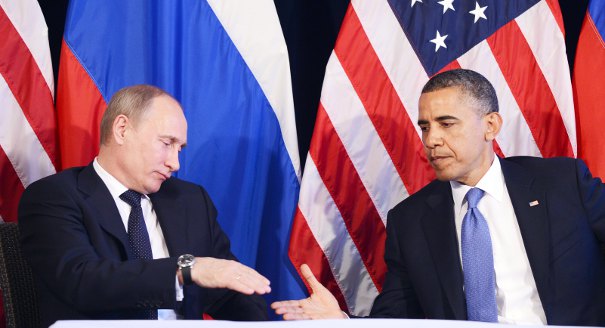
It will be difficult for Washington and Moscow to drag the Syrian regime and opposition to the negotiating table. But for now, the U.S.-Russian effort is the only chance for peace.
Source: International Herald Tribune
The United States and Russia have announced that they will seek to convene an international conference on Syria, hopefully before the end of this month.
The conference would be based on last June’s Geneva agreement, which foresees a cease-fire and negotiations between the regime in Damascus and the opposition groups, leading to the formation of a transitional governing body.
In order to achieve this, Washington and Moscow will “encourage” the Syrian sides to come to the negotiating table and will reach out to their allies and partners in the region to work for a political solution to the Syrian crisis.This announcement, which came after Secretary of State John Kerry’s talks in Moscow with President Vladimir Putin and Foreign Minister Sergey Lavrov, calls for very heavy lifting.
Neither the regime nor its opponents are now willing to walk to the negotiating table: They need to be dragged to it.
No less important, the antagonists’ backers in the region — Iran on one hand; Saudi Arabia, Turkey and Qatar on the other — need to be persuaded that a negotiated solution is preferable to a military one, which all of them are still seeking. Israel, too, should be brought on board.
To many skeptics, this is a mission impossible. But the White House and the Kremlin are prepared to mount a joint effort because failure to stop the war in Syria would leave both substantially worse off.
President Barack Obama is loath to involve the United States in the Syrian mess, but time is working against him. Syria’s chemical weapons may actually be used on a wide scale, or get into the hands of Al Qaeda.
The Russians, whose support for Damascus so far has been predicated on doing anything to forestall the victory of Islamist extremists, now understand that the longer the war continues, the more influence the extremists are gaining.
Thus Moscow and Washington have no better option than to cooperate. But can they?
Over the past year, U.S.-Russian relations have been markedly deteriorating. In the United States, Russia’s public image is abominable; in Russia, anti-Americanism is becoming one of the pillars of official Russian patriotism.
The U.S. Congress passed the Magnitsky Act, and the Russian Duma retaliated by banning U.S. adoptions of Russian orphans. The Kremlin decided to eliminate what it sees as sources of U.S. influence on Russian domestic politics and ordered Russian NGOs that receive foreign funding to register as foreign agents, expelled USAID from Russia and called for renegotiating U.S.-Russian agreements that cast Russia in the role of aid recipient.
It appears, however, that the tide is turning. The visit to Moscow last month by Tom Donilon, the U.S. national security adviser, was rated a success by both Obama and Putin. Since then, the two presidents have been exchanging phone calls. The Boston bombing stressed the need for closer U.S.-Russian collaboration on fighting terrorism. And Kerry was received by Putin at the Kremlin for a long and substantive talk.
Coming to Moscow on the eve of V-E Day, Russia’s biggest national holiday, Kerry became the first U.S. secretary of state to lay a wreath at the Tomb of the Unknown Soldier and to meet with a group of Soviet World War II veterans, and not just civil society activists.
Much more will be needed if the two sides are to turn the tide in Syria. The model that comes to mind is the 1995 Dayton agreement that ended the war in Bosnia. There, however, the United States — or, better said, the U.S. negotiator Richard Holbrooke — held all the cards and pressed all sides into cooperation. The presence of the Russian foreign minister at the closing ceremony was a mere formality.
This time, if they are to pull it off, the United States and Russia need to form a diplomatic alliance and closely coordinate their efforts. A “Dayton by two” is certainly more complicated than one-man diplomatic mastery, but this looks to be the only way it can be done today in Syria, if at all.
Can the Russians deliver Bashar al-Assad? They often profess to have little influence in Damascus. But if the Russians make it clear that they will stop arming Syrian government forces, withdraw their technicians and lift their diplomatic cover at the United Nations, unless Damascus agrees to engage in serious discussions with the opposition, the Kremlin will not be ignored.
An even more difficult question is whether the Americans can deliver the opposition, disunited as it is, and more genuinely represented by the field commanders inside Syria than by the coalitions formed abroad. And even though the Saudis are not happy to see the rise of radicalism among the opposition groups in Syria, convincing them to change tack will be a hard sell.
With all this in mind, however, the U.S.-Russian effort is, for now, the only chance for peace. If it fails, the specter of an “Afghanistan on the Med” will move closer to becoming grim reality.
This article was originally published in the International Herald Tribune.
Former Director, Carnegie Moscow Center
Trenin was director of the Carnegie Moscow Center from 2008 to early 2022.
Recent Work
Dmitri Trenin
Dmitri Trenin
Carnegie does not take institutional positions on public policy issues; the views represented herein are those of the author(s) and do not necessarily reflect the views of Carnegie, its staff, or its trustees.
Washington needs to recognize that influence in the Western Hemisphere comes from presence, delivery, and reliability. It also must recognize that while the United States remains the key external actor, it no longer operates in a permissive environment and cannot presume deference from regional players who have other options, namely China.
Juan S. Gonzalez

Minsk clearly expected the dialogue with Washington to yield more results, in particular the lifting of EU sanctions and permission to export potash.

Artyom Shraibman

A summer of escalation in the Black Sea has hurt Ukraine economically and is exacerbating world food security. A truce is needed—as is a broader reframing of Europe’s Ukraine strategy.

Thomas de Waal

As the U.S. stumbles in its war with Iran, we are likely to see an acceleration of its disengagement from the region.

Michael Young
Why governance of rapidly evolving technology will be distributed and complex.


Stewart Patrick, Scott Singer