

Tehran’s attacks are reshaping the security situation in the Middle East—and forcing the region’s clock to tick backward once again.
Amr Hamzawy
{
"authors": [
"Zhang Chuanjie"
],
"type": "legacyinthemedia",
"centerAffiliationAll": "",
"centers": [
"Carnegie Endowment for International Peace",
"Carnegie China"
],
"collections": [
"U.S.-China Relations",
"China’s Foreign Relations"
],
"englishNewsletterAll": "",
"nonEnglishNewsletterAll": "",
"primaryCenter": "Carnegie China",
"programAffiliation": "",
"programs": [],
"projects": [],
"regions": [
"North America",
"United States",
"East Asia",
"China",
"North Korea"
],
"topics": [
"Security",
"Nuclear Policy"
]
}Source: Getty
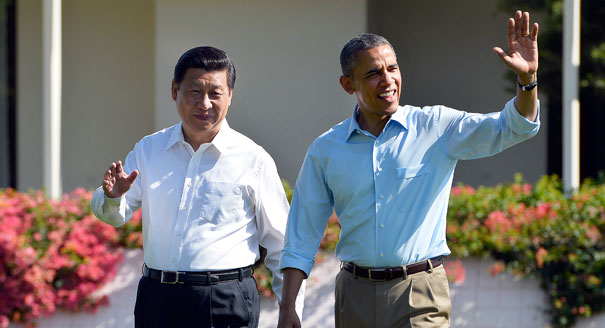
The informal surroundings at Sunnylands enable Xi and Obama to have private and meaningful discussion about critical bilateral and global issues.
Source: CCTV
Speaking on CCTV, Carnegie’s Zhang Chuanjie explained that the benefit of the informal meeting in Sunnylands, California between Presidents Xi Jinping and Barack Obama is that “neither has any pressure to come up with an agreement.”
He predicted that cybersecurity will be an important point of discussion between the two leaders. Zhang suggested that both countries should send groups to work out “rules and regulations” to help improve cooperation on cybersecurity. Another commonality that the two countries should cooperate on is North Korea, since both have a vested interest in stability on the peninsula, he added.
Zhang Chuanjie
Former Resident Scholar, Carnegie-Tsinghua Center for Global Policy
Zhang Chuanjie was a resident scholar at the Carnegie-Tsinghua Center until June 2020.
Carnegie does not take institutional positions on public policy issues; the views represented herein are those of the author(s) and do not necessarily reflect the views of Carnegie, its staff, or its trustees.
Tehran’s attacks are reshaping the security situation in the Middle East—and forcing the region’s clock to tick backward once again.
Amr Hamzawy
Only collective security can protect fragile economic models.
Andrew Leber
In a volatile Middle East, the Omani port of Duqm offers stability, neutrality, and opportunity. Could this hidden port become the ultimate safe harbor for global trade?
Giorgio Cafiero, Samuel Ramani
Europe’s reaction to the war in Iran has been disunited and meek, a far cry from its previously leading role in diplomacy with Tehran. To avoid being condemned to the sidelines while escalation continues, Brussels needs to stand up for international law.
Pierre Vimont
South Korea’s rapid demographic transition previews governance challenges many advanced and middle-income economies will face. This paper argues that aging is not only a care issue but a structural governance challenge—reshaping welfare, productivity, and fiscal sustainability, and reorganizing responsibilities across the state, private sector, and society.
Darcie Draudt-Véjares











