

Commentary
It should address the shortcomings of previous crisis communication efforts and adapt to the demands of frontier AI.
Lucy Luo
{
  "authors": [
    "Karen Leigh",
    "Petr Topychkanov"
  ],
  "type": "legacyinthemedia",
  "centerAffiliationAll": "dc",
  "centers": [
    "Carnegie Endowment for International Peace",
    "Malcolm H. Kerr Carnegie Middle East Center",
    "Carnegie Russia Eurasia Center"
  ],
  "collections": [],
  "englishNewsletterAll": "ctw",
  "nonEnglishNewsletterAll": "",
  "primaryCenter": "Carnegie Russia Eurasia Center",
  "programAffiliation": "russia",
  "programs": [
    "Russia and Eurasia"
  ],
  "projects": [
    "Eurasia in Transition"
  ],
  "regions": [
    "Levant",
    "Middle East",
    "Syria"
  ],
  "topics": [
    "Security",
    "Foreign Policy"
  ]
}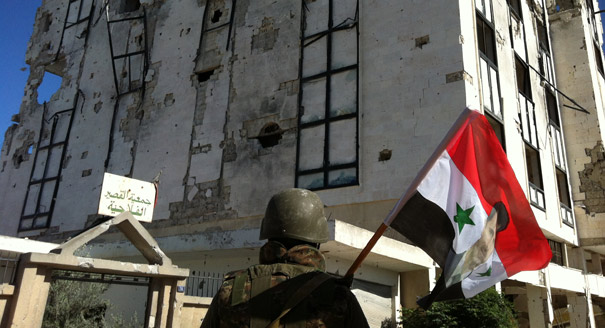
Source: Getty
Investigation of chemical weapons use is in the interest of both the United States and Russia. Russia will continue to support Assad only if there is no evidence that he used chemical weapons.
Source: Syria Deeply
In a weekend call between Russian Foreign Minister Sergei Lavrov and U.S. Secretary of State John Kerry, Lavrov reportedly warned that a U.S. strike on Syria would have “extremely dangerous consequences.”
Russia, a firm ally of President Bashar al-Assad, has vehemently opposed Western intervention against the Syrian regime. That position has put a diplomatic wedge between the Russia and the U.S., one that could widen as the West considers air strikes against Assad in retaliation for an apparent chemical weapons attack outside of Damascus.
Washington and its allies blame Assad for the incident, vowing to take action in response. Assad’s regime has denied responsibility, accusing rebels of using the deadly chemicals as a tactic to provoke foreign intervention. Russia officials have stood by that narrative, pinning the chemical attack on rebels and saying a Western military strike would be a “tragic mistake.”To better understand Russia’s position we spoke to Petr Topychkanov, an analyst with the Carnegie Moscow Center. He weighs in on how the Kremlin might react to a U.S. strike on its Syrian allies.
Petr Topychkanov: First of all, Russia doesn’t seem to be ready to play an active military role in Syria, because it would mean direct confrontation with the U.S. Russia doesn’t have such intentions or capabilities. So Russian reaction to a U.S. strike would depend on the legal and organizational framework of this strike. For example, Russia could agree with the participation of the U.S. in military operations under auspices of the U.N. Security Council [UNSC]. It’s more probable if the UNSC will obtain solid evidence about the use of chemical weapons by the Assad regime.
But if there is not such evidence and the U.S. decides to act without any approval from the UNSC, of course Russia would strongly criticize military action from the U.S. and its allies, and would militarily support Syria. Russia would continue to supply arms and military equipment to the Assad regime, and Russia would develop close relations with the regime in Iran to help that regime to support and provide military help to Assad.
Russia will continue to support Assad only if there is no evidence that he used chemical weapons. It would be impossible to help Assad if he did. So this is the key issue. ...
Karen Leigh
Former Fellow, Nonproliferation Program, Moscow Center
Topychkanov was a fellow in the Carnegie Moscow Center’s Nonproliferation Program.
Carnegie does not take institutional positions on public policy issues; the views represented herein are those of the author(s) and do not necessarily reflect the views of Carnegie, its staff, or its trustees.

It should address the shortcomings of previous crisis communication efforts and adapt to the demands of frontier AI.

Lucy Luo
The Zaidi government’s objective to collect weapons is constrained by regional conflict, but it can take certain measures at home.
Ali Al-Mawlawi
Washington’s decision to support some UN functions while letting others wither is pulling the organization apart at the seams.

Stewart Patrick, Theodore Zaritsky

Are Germany’s economic, industrial, and political struggles becoming a liability for the EU’s ability to rise to the geopolitical moment?

Rym Momtaz, ed.

China’s police training infrastructure construction projects provide benefits to recipient countries, promote China’s image as a major global security provider, and are likely to reinforce alignment between Beijing’s security priorities and those of countries in the Global South.


Cameron Waltz, Sheena Chestnut Greitens, Kim Nguyen, …