

Article
Wang Tao
{
  "authors": [
    "Wang Tao"
  ],
  "type": "legacyinthemedia",
  "centerAffiliationAll": "",
  "centers": [
    "Carnegie Endowment for International Peace",
    "Carnegie China"
  ],
  "collections": [],
  "englishNewsletterAll": "",
  "nonEnglishNewsletterAll": "",
  "primaryCenter": "Carnegie China",
  "programAffiliation": "",
  "programs": [],
  "projects": [],
  "regions": [
    "East Asia",
    "China"
  ],
  "topics": [
    "Climate Change",
    "Economy"
  ]
}
Source: Getty
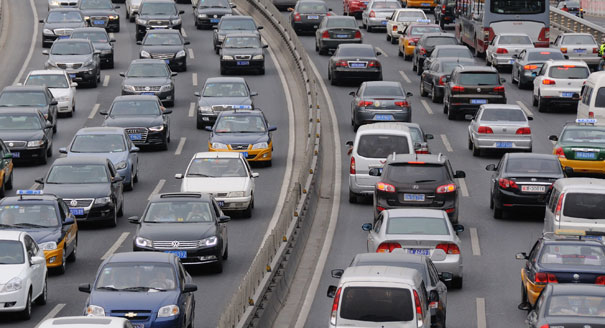
The key to relieving Beijing’s traffic congestion and high pollution levels is to manage the use of cars rather than to restrict their purchase.
Source: Global Times
Following the lead of Beijing, Shanghai, and Guangzhou, eight further Chinese cities are currently planning to impose car purchase restrictions in an effort to reduce traffic congestion and air pollution.
This policy could possibly cut sales by 400,000 vehicles, or 2 percent, a year. However, a vehicle purchase-restriction policy would, at best, only prevent the current pollution and congestion levels from worsening.
The key to relieving traffic congestion and high pollution levels is to manage the use of cars rather than to restrict their purchase. Achieving this goal requires policy in three areas: to increase the cost of using private vehicles, to improve public transportation, and to manage travel demand.Beijing's current measures are a good example of why vehicle use rather than vehicle purchase is key to reducing overall congestion.
Restrictions on purchases and the license plate lottery have only encouraged citizens to seek second cars. Many people join the lottery even though they do not yet need another car yet. They fear not having a permit when they do need it.
This has spurred an unnecessary increase in demand, lowering the success rate, which in turn encourages even more people to enter the lottery. Those in real need of a license plate are squeezed out.
Consequently, Beijing's traffic situation has not improved as expected, and there has been a rise in illegal practices such as the use of expired non-Beijing license plates and transfer of these plates via the black market.
Rapidly increasing private vehicle usage in Chinese cities over the past decade by the growing middle class has led to severe traffic jams and air pollution, but the consequences are shouldered by the population as a whole.
Owners of private vehicles should be made to pay for these external costs. This is the central principle of traffic management policy in many other countries.
In Europe, this is achieved through taxation on fuel. Other measures like increasing the prices for parking in downtown areas, limiting parking availability, and charging traffic congestion fees can also be used to promote the use of public transportation.
In 2011, after increasing the parking prices in central Beijing, daily congestion time within the Fifth Ring Road was reduced, on average, by 105 minutes.
As public transportation improves, local authorities could further restrict vehicle use in the city center by limiting parking space.
Meanwhile, any restrictions on private vehicle use need to be complemented with the availability of convenient, reliable, and affordable public transportation.
The revenue from raising tolls or fees on private vehicles could be invested to support improved public transport. This would be welcomed by the public and ease financial pressures on local authorities.
It is vital that public transportation is both efficient and affordable. Buses in Beijing are very cheap thanks to subsidies from the municipal government. However, long waits, poor maintenance, and convoluted transfers deter potential users.
As the city expands, such a subsidy becomes a heavy burden, even for somewhere as relatively rich as Beijing, and there have already been rumors of price increases in the future.
An efficient public transportation system should connect all of different modes of travel. Only a well integrated system of city trains, buses, and car and bike rentals can collectively provide a convenient and comfortable trip in the public transportation system.
In many cases, it is lack of connectivity or no service in "the last 100 meters" radius around a subway station or bus stop that encourages residents to revert to their car.
In fact, half of Beijing's private car trips are less than 5 kilometers. If even a portion of these car trips could be converted to public transportation, Beijing's traffic conditions would improve.
Eliminating illegal parking spaces, restoring bike lanes, and tackling traffic violations to protect the slow traffic system in the city would also significantly improve the operations of the public transport system.
Road resources in urban areas are by their nature restricted. Limiting vehicle use is a more effective and practical means to share these resources than restricting purchases. Buying new family assets is a right, but abusing public resources is not.
Former Nonresident Scholar, Carnegie-Tsinghua Center for Global Policy
Wang Tao was a nonresident scholar in the Energy and Climate Program based at the Carnegie–Tsinghua Center for Global Policy.
Recent Work
Wang Tao
Wang Tao, Yang Yifang
Carnegie does not take institutional positions on public policy issues; the views represented herein are those of the author(s) and do not necessarily reflect the views of Carnegie, its staff, or its trustees.

This piece argues that India’s central challenge is not managing a single flashpoint but resolving the underlying tension between expansion and institutional coherency of the BRICS grouping.

Vrinda Sahai
Beijing regulated AI—and then Chinese AI companies took off.

Matt Sheehan
Examples from Virginia and Lake Tahoe reveal complex situations that governments could use to fund critical grid upgrades.


Kate Gordon, Noah Gordon
As “unprecedented” temperatures become routine, the country is failing its energy transition stress test.

Kayly Ober

If Indigenous land and water dispossession is ignored, climate adaptation strategies risk reproducing inequalities and worsening acute climate vulnerability.
Frederic Wehrey, Charles H. Johnson