

Commentary
Judy Dempsey
{
  "authors": [
    "Judy Dempsey"
  ],
  "type": "legacyinthemedia",
  "centerAffiliationAll": "dc",
  "centers": [
    "Carnegie Endowment for International Peace",
    "Carnegie Europe",
    "Malcolm H. Kerr Carnegie Middle East Center"
  ],
  "collections": [
    "Europe’s Eastern Neighborhood",
    "Europe’s Southern Neighborhood",
    "Arab Awakening"
  ],
  "englishNewsletterAll": "menaTransitions",
  "nonEnglishNewsletterAll": "",
  "primaryCenter": "Carnegie Europe",
  "programAffiliation": "MEP",
  "programs": [
    "Middle East"
  ],
  "projects": [],
  "regions": [
    "Middle East",
    "Europe",
    "Egypt",
    "Gulf",
    "Levant",
    "Maghreb",
    "North Africa",
    "Western Europe",
    "Germany"
  ],
  "topics": [
    "Civil Society"
  ]
}
Source: Getty
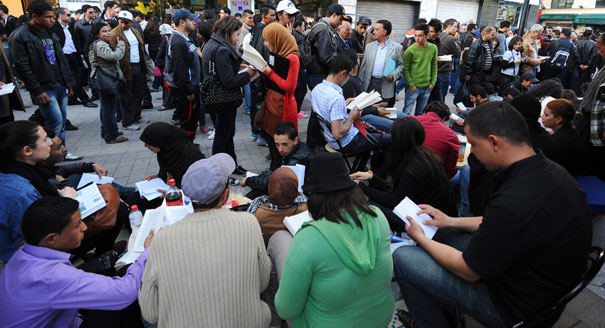
Young people in North Africa and the Middle East want their countries to become more democratic, but in a way that reflects Arabic values, not rules imposed by the West.
Source: New York Times
Last week, a group of young men and women from North African and Middle Eastern countries packed their bags and set off for home, having spent a month on a scholarship funded by the German Parliament.
These annual scholarships were established two years ago, soon after the Arab Spring swept across Europe’s southern neighbors. The aim behind the program was to bring young people to Germany to debate with them how democratic systems function.
“These exchange programs are important,” said Zina Mahmoud Hamada El Nahel, 24, a participant who is employed by a German political foundation in Egypt. “But one of the messages that we want to get across from our side is that European countries should stop selling weapons to the region. And don’t give any money to any of the governments. It will all be stolen.”The participants said more weapons undermined efforts to build democracy. Yet European countries continue to sell arms to many Arab governments. One exception is Syria, but that war-torn country is awash with weapons anyway.
These bright people from Egypt, Jordan, Tunisia, and other Arab countries — many of whom had taken part in the democratic uprisings in 2011 — described their new governments with a considerable amount of skepticism. They were doubtful about their leaders’ commitment to building democratic institutions.
After decades of misrule in the Arab world, corruption and authoritarianism are deeply entrenched, they said. The new governments also have an inherent suspicion of independent thinking.
“Our government, for example, hates the foundations,” said Imen Nefzi, 29, who is involved in a nongovernmental organization in Tunisia. “They think we are foreign agents, that we are trying to undermine the system. It is not easy trying to build democracy even on a small level.”
Some German nonprofit organizations — like the Konrad Adenauer Foundation, which is affiliated with Chancellor Angela Merkel’s Christian Democratic Union party — have been under constant pressure by the Egyptian authorities since 2011. Last June, its offices and property were confiscated.
Maha Wissa, 34, from Egypt, said she had no illusions about how long it would take to build a democratic state in her country. “A decade, at least — and that’s being optimistic,” she said.
In the meantime, she would like the foundations, the European Union and individual European governments to pursue a different tack to facilitate the transition.
“First of all, we have to reach out to schools, to younger people,” Ms. Wissa said.
As it is, German and European foundations have a built-in bias. They tend to focus on university students and those who speak their language.
The German Parliament’s scholarship has particular weaknesses. The Parliament’s administration asked the German Embassy in Cairo for help in finding participants. The embassy then contacted the foundations and other prominent nongovernmental organizations, choosing established, predictable channels rather than reaching out to different strata of society.
One participant, who wished to remain anonymous, was critical of this approach.
“All of us on this scholarship are committed to democracy,” he said. “But it should not only be us who receive these scholarships. The European foundations and the E.U. should be much more ambitious about reaching out to young people and how they target their funding.”
Many participants said that the foundations and the European Union were insular in their approach.
“The foundations have to get out of the capital cities and go to the towns and villages,” Ms. Nefzi said. “You do have the problem of not having staff or funding to do this. But there is another world out there that is very important to relate to. Otherwise you won’t understand how difficult it is to build democracy.”
Other participants said the concentration on the cities by the foundations and the E.U. helped perpetuate the wide gap between the cities and the countryside.
“We don’t have illusions about how difficult it will be to overcome this huge polarization but it is something that we have to deal with if we want to build a democracy that is inclusive,” said Salma Hamed, 22, also from Egypt.
The issue of building a democracy became a recurring theme during the conversations with this fascinating mix of people. What they also want from the European foundations, European donors and the Union itself is transparency in funding.
“The funding should be transparent,” Ms. Wissa said. “We want it to help women, for example, but we also want to know the criteria for this funding.”
Others said that the Europeans were too selective. They supported only liberal parties while shunning the moderate Islamist movements that represent large parts of these countries’ populations. This writer responded that at least Europe’s approach was better than before 2011.
That was when Europe cooperated with authoritarian regimes across the region instead of supporting independent, pro-democracy movements. Even the German foundations had, for a long time, a policy of allocating funding only to nongovernmental organizations sanctioned by the regimes.
As the conversation went on, it inevitably touched on Syria, a country that descended into civil war after the regime tried to put down a democratic uprising. These engaged men and women said they opposed any Western military intervention.
It was a long, thoughtful discussion about experiences, values and the limits of outside help. These bright young Arabs want their countries to change, but according to their own values, not rules imposed by the West.
This article was originally published in the New York Times.

Nonresident Senior Fellow, Carnegie Europe
Judy Dempsey is a nonresident senior fellow at Carnegie Europe
Recent Work
Judy Dempsey
Judy Dempsey
Carnegie does not take institutional positions on public policy issues; the views represented herein are those of the author(s) and do not necessarily reflect the views of Carnegie, its staff, or its trustees.
In Egypt’s dense cities, the disappearance of foliage has health implications and punishes daily commuters.

Angie Omar

If the Russian-speaking community in Latvia cannot articulate their interests without being seen as disloyal, they could end up embracing a pro-Kremlin agenda.

Sergejs Potapkins
The Zaidi government’s objective to collect weapons is constrained by regional conflict, but it can take certain measures at home.
Ali Al-Mawlawi

Are Germany’s economic, industrial, and political struggles becoming a liability for the EU’s ability to rise to the geopolitical moment?

Rym Momtaz, ed.
Despite myriad challenges and occasional stumbles, the new Hungarian government is moving ahead with energy and conviction to uproot years of illiberalism and corruption and rebuild Hungarian democracy.

Thomas Carothers