

Commentary
Thomas de Waal
{
  "authors": [
    "Thomas de Waal"
  ],
  "type": "commentary",
  "centerAffiliationAll": "",
  "centers": [
    "Carnegie Endowment for International Peace",
    "Carnegie Europe",
    "Carnegie Russia Eurasia Center"
  ],
  "collections": [],
  "englishNewsletterAll": "",
  "nonEnglishNewsletterAll": "",
  "primaryCenter": "Carnegie Europe",
  "programAffiliation": "",
  "programs": [],
  "projects": [],
  "regions": [
    "Central Asia",
    "Caucasus",
    "Russia",
    "Eastern Europe"
  ],
  "topics": [
    "Foreign Policy"
  ]
}
Source: Getty
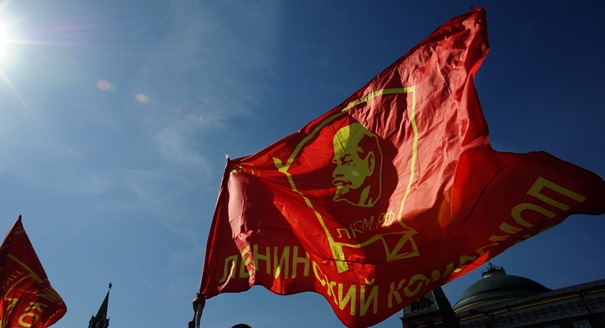
To mention the Soviet Union on most of its former territory evokes pleasant nostalgia, not revulsion. However, no one, beginning with President Putin, is planning its second coming.
What is there to miss about the Soviet Union? "Nothing," say those who live west of the old Soviet border. "The day the USSR ended was a day of liberation."
Hence the gravity intended in the warnings of Western politicians that Vladimir Putin’s Eurasian Union project is a new Soviet Union in disguise. Former U.S. Secretary of State Hillary Clinton set the trend when she commented in December 2012 that the union was "a move to re-Sovietise the region."
Those same leaders should pause to take a look at a Gallup poll taken last month in 11 of the 15 former Soviet republics (Uzbekistan and the Baltic States were left out).
It showed that in seven of the 11 countries more people believe that the break-up of the Soviet Union harmed their country more than it benefited them.
This answer comes from people of all ages and all corners of the former union. In Armenia, Kyrgyzstan, Russia, and Ukraine barely 20 per cent of those polled voicing positive thoughts about the end of the USSR. (The highest rate of approval for the demise of the Soviet Union actually came in authoritarian Turkmenistan, which is a little suspicious—this surely is one place which was actually more free and open 25 years ago than today.)
Of course the Soviet Union people are missing for is a figment of the imagination. It is not that of Stalin or the late 1980s but most likely that of Brezhnev's 1970's consumer boom, an era recalled as one of innocence and prosperity at home and respect and fear abroad.
Vladimir Putin is often quoted as having called the end of the Soviet Union "the greatest geopolitical catastrophe of the [20th] century." The actual quotation, made in his speech to parliament in April 2005, is more ambiguous and could equally be translated as "the tremendous geopolitical catastrophe of the age."
Either way, it was not a programmatic speech. Putin has also more than once approvingly quoted a phrase from the 1990s made popular by the strongman of that era, Alexander Lebed, "Whoever does not regret the destruction of the Soviet Union doesn't have a heart, whoever wants to recreate it doesn't have a head."
Most Russians, it would seem, agree. To mention the Soviet Union on most of its territory evokes pleasant nostalgia, not revulsion. But, fortunately no one, beginning with President Putin, is planning its second coming.

Senior Fellow, Carnegie Europe
De Waal is a senior fellow at Carnegie Europe, specializing in Eastern Europe and the Caucasus.
Recent Work
Thomas de Waal
Thomas de Waal, ed.
Carnegie does not take institutional positions on public policy issues; the views represented herein are those of the author(s) and do not necessarily reflect the views of Carnegie, its staff, or its trustees.
The conflict is exposing the deep energy vulnerabilities of Korea’s chip industry.


Darcie Draudt-Véjares, Tim Sahay

French President Emmanuel Macron has unveiled his country’s new nuclear doctrine. Are the changes he has made enough to reassure France’s European partners in the current geopolitical context?

Rym Momtaz, ed.
The drone strike on the British air base in Akrotiri brings Europe’s proximity to the conflict in Iran into sharp relief. In the fog of war, old tensions in the Eastern Mediterranean risk being reignited, and regional stakeholders must avoid escalation.

Marc Pierini
Domestic mobilization, personalized leadership, and nationalism have reshaped India’s global behavior.
Sandra Destradi
For years, the United States anchored global cyber diplomacy. As Washington rethinks its leadership role, the launch of the UN’s Cyber Global Mechanism may test how allies adjust their engagement.

Patryk Pawlak, Chris Painter