

Article
Thomas de Waal
{
  "authors": [
    "Thomas de Waal"
  ],
  "type": "commentary",
  "centerAffiliationAll": "",
  "centers": [
    "Carnegie Endowment for International Peace",
    "Carnegie Europe",
    "Carnegie Russia Eurasia Center"
  ],
  "collections": [],
  "englishNewsletterAll": "",
  "nonEnglishNewsletterAll": "",
  "primaryCenter": "Carnegie Europe",
  "programAffiliation": "",
  "programs": [],
  "projects": [],
  "regions": [
    "Eastern Europe",
    "Ukraine",
    "Western Europe"
  ],
  "topics": [
    "Political Reform",
    "Foreign Policy"
  ]
}
Source: Getty
As more or less the last international player that can make a pitch to all of Ukraine, the EU will need to re-tool the Eastern Partnership to make a credible offer to all Ukrainian citizens.
As Ukraine struggles to keep itself together and avoid political paralysis or economic meltdown, suddenly the European Union finds itself center-stage.
This is more or less by default. Russia is a player in the current events, feared or resented by a good half of the Ukrainian population. The United States was never going to be seen as an honest broker in all parts of the country, even before the Assistant Secretary of State Victoria Nuland basically disqualified Washington by openly picking sides in Ukraine's politics.
Obviously, the EU has its bias too: it wants to see Ukraine integrate further into Europe. But European integration is not a divisive geopolitical project like NATO expansion. Polls show that even those east Ukrainians who reject the idea of joining NATO want to see their country's economy more closely integrated with Europe.
The Eastern Partnership package the EU offered in 2013 was not a shiny gift. The message was: Make painful structural reforms, pass legislation on minority rights, clean up your customs and border police and you will get visa liberalization, privileged access to the single market—but not even a clear membership perspective.
The benefits were all long-term and the pain all short-term. The main surprise was how long it took President Viktor Yanukovych to say no. He did so finally only on the eve of the Vilnius Summit, casting a pall over the event.
The merit of this approach is that it treats Ukraine and the other Eastern Partnership countries like a subject, asking it to make its own grown-up decisions, rather than an object of a geo-political tug of war (hang your head in shame, Western media, for peddling this line).
The first- and second-term President Vladimir Putin did not regard the EU as a threat to Russian interests, even as he drew his red lines over NATO. Third-term Putin apparently forgot that and picked a fight with Brussels, taking his cue from a new group of ideologues such as the rabid Sergei Glazyev.
Perhaps it didn't help that the two main promoters of the Eastern Partnership project, Swedish and Polish Foreign Ministers Carl Bildt and Radek Sikorski, made it look more glamorous than it actually was. They continually stressed how accepting it would signify a clean break with the Russian model of governance—thereby getting into a duel with Glazyev and co in Moscow.
So, in retrospect the EU approach looked rather naïve. When they were wrong-footed by Yanukovych's games, they had no Plan B.
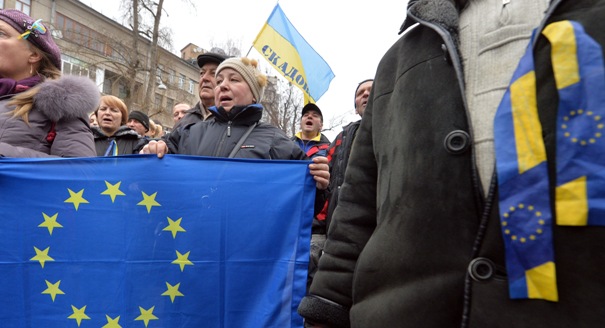
Yet they also managed to generate excitement about Europe in a country, which has been stuck in disappointing limbo for 20 years. When in December the streets of Kyiv filled with Ukrainians waving EU flags, an EU official observed wryly "you don't see that in the capitals of most member states."
The challenge now is even bigger than before. When the new Ukrainian government asks for help, the EU will have to step up to a new role. It will need to re-tool the Eastern Partnership to make a credible offer to all Ukrainian citizens, especially those in the East, while knowing that many Ukrainians' "first sight of Europe" may end up being a drastic IMF/EU economic austerity package.
All this with European elections and a change of Commission just three months away. It's a tough test. But as more or less the last international player that can make a pitch to all of Ukraine, Brussels doesn't really have a choice.

Senior Fellow, Carnegie Europe
Thomas de Waal is a senior fellow at Carnegie Europe, specializing in Eastern Europe and the Caucasus.
Recent Work
Thomas de Waal
Thomas de Waal
Carnegie does not take institutional positions on public policy issues; the views represented herein are those of the author(s) and do not necessarily reflect the views of Carnegie, its staff, or its trustees.
The Bureau of Industry and Security needs to adjust its focus and practices to maintain its position as the U.S. government’s primary champion of international technological competition.
Geoffrey Irving
Despite myriad challenges and occasional stumbles, the new Hungarian government is moving ahead with energy and conviction to uproot years of illiberalism and corruption and rebuild Hungarian democracy.

Thomas Carothers

European Commission President Ursula von der Leyen is about to give her annual address on the state of the EU. Here’s what she won’t—but should—say.

Rym Momtaz

The books, podcasts, and films that explain the world it made.

Andrew Leber

U.S. trading partners in Asia are closely watching the dispute for signs of how it may affect their own interests.

Barbara Weisel