

Commentary
Dmitri Trenin
{
  "authors": [
    "Dmitri Trenin"
  ],
  "type": "legacyinthemedia",
  "centerAffiliationAll": "",
  "centers": [
    "Carnegie Endowment for International Peace",
    "Carnegie Russia Eurasia Center"
  ],
  "collections": [],
  "englishNewsletterAll": "",
  "nonEnglishNewsletterAll": "",
  "primaryCenter": "Carnegie Russia Eurasia Center",
  "programAffiliation": "",
  "programs": [],
  "projects": [
    "Eurasia in Transition"
  ],
  "regions": [
    "Central Asia",
    "Russia"
  ],
  "topics": [
    "Political Reform",
    "Foreign Policy"
  ]
}
Source: Getty
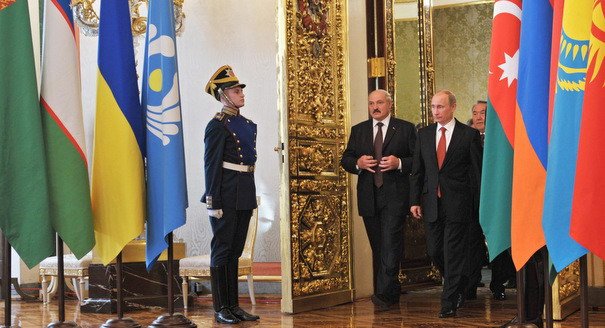
Russia’s Eurasian Union project aims at integrating much of ex-Soviet Eurasia into an economic, political, and security unit. Before that can happen, however, Russia needs to better manage what it already has.
Source: Global Times
In 2014, Russia's first major foreign policy project since the breakup of the Soviet Union will take a decisive step toward realization: In the spring, a treaty on Eurasian Union (EAU) is due to be signed, with the union itself launched on January 1, 2015.
The Customs Union of Belarus, Kazakhstan and Russia, established in 2010 and upgraded in 2012 to a single economic space, is the platform for integrating much of ex-Soviet Eurasia into an economic, political and security unit.
Although the phrase Eurasian Union was first coined by Kazakh president Nursultan Nazarbayev 20 years ago, it was Russian President Vladimir Putin who transformed the idea that had been in the air for some time into a viable political project.Putin drew conclusions from two fundamental facts which became apparent in the 2000s: the unwillingness of the West to embrace Russia as its own and an equal, and the malaise of Western capitalism, which was first felt in the US and which then led to a crisis in the EU.
Putin's answer to those developments was to recast Russia's international identity as both an independent power center, and a leader of a group of countries tied to it by a web of economic, political, and security arrangements, solidified by common historical heritage and shared civilizational trends.
As she was preparing a year ago to depart her job as secretary of state, Hillary Clinton called the Kremlin's EAU project an attempt to bring back the Soviet Union.
Clinton was right in the sense that Russia has revealed its ambition to reconstitute itself as a large geopolitical unit with a global reach, and thus a competitor to US global power.
The EU leaders were brusquely awakened to this fact in November as Putin managed to prevent Ukraine signing an association agreement with the EU.
To Putin, Ukrainians and Russians are "one people," sharing many common traits; thus, Ukraine's integration with the EU rather than Russia would be unnatural, even perverse.
The Russian president is prepared to work hard and long to integrate the 46-million strong Ukraine into the EAU project. This, however, will be anything but easy.
The Ukrainian elite loathe coming back under Moscow's leadership, and Ukrainian nationalism, even in its moderate version, postulates that "Ukraine is not Russia," a view diametrically opposed to Putin's.
The EAU project is facing challenges of deepening as well as enlargement. Kazakhstan has made it clear that while it supports economic integration, it will seek to preserve its sovereignty and political independence. Even Belarus, whose population is not imbued with anything like Ukrainian-style nationalism, insists on a high degree of independence from Russia.
Yet, some enlargement and some consolidation within Eurasia will be taking place. Recently, Armenia has been put on a fast track to join the Eurasian integration project. Kyrgyzstan is habitually bargaining to get the best terms of accession.
The Eurasian Commission, headed by Viktor Khristenko, a former Russian deputy prime minister, is sure to get wider powers.
Since all prospective EAU members and candidates also belong to the Collective Security Treaty Organization (CSTO), there is likely to be more coordination between the EAU and the CSTO. The Russian language as the lingua franca in central Eurasia will get a boost with more cooperation among the integrating countries.
The EAU will doubtlessly increase Russia's standing as regards the EU, making the relationship more coequal. It will also strengthen Russia's position in Central Asia, including versus China, as well as in the South Caucasus.
These gains, however, will be less than groundbreaking, unless the Russian Federation itself manages to relaunch its economy on a basis other than oil and gas, improves the quality of its population, beginning with the elites, and dramatically upgrades its governance.
For Russia to be a great power in the 21st century, it does not require more land, more people, or more allies. It needs to manage much better what it already has.
Former Director, Carnegie Moscow Center
Trenin was director of the Carnegie Moscow Center from 2008 to early 2022.
Recent Work
Dmitri Trenin
Dmitri Trenin
Carnegie does not take institutional positions on public policy issues; the views represented herein are those of the author(s) and do not necessarily reflect the views of Carnegie, its staff, or its trustees.

China’s political future will be shaped between now and next October. As the Communist Party enters its intense “campaign season” to prepare for a major political transition in 2027, reading Beijing's actions and responses may become more difficult as domestic politics weigh on its behavior more than usual.

Damien Ma

The EU can impose sanctions but struggles to enforce them without the United States. With Washington increasingly disinterested in backing European interests, the bloc must now fend for itself.


Nicu Popescu, Tiago Antunes
Global and rising powers will need to engage with Africa’s priorities and agency in order to secure the continent’s increasingly attractive partnerships.
Fonteh Akum

Rubio’s recent visit brought welcome attention, but more capital requires governance changes that may be a hard sell for regional governments.

Jennifer B. Murtazashvili

America’s foreign-policy objectives have grown more demanding while Americans have demanded greater focus on their own affairs.

Stephen Wertheim