

Research
- +4
Milan Vaishnav, Rahul Verma, Rukmini S., …
{
  "authors": [
    "Christophe Jaffrelot"
  ],
  "type": "legacyinthemedia",
  "centerAffiliationAll": "dc",
  "centers": [
    "Carnegie Endowment for International Peace"
  ],
  "collections": [],
  "englishNewsletterAll": "ctw",
  "nonEnglishNewsletterAll": "",
  "primaryCenter": "Carnegie Endowment for International Peace",
  "programAffiliation": "SAP",
  "programs": [
    "South Asia"
  ],
  "projects": [],
  "regions": [
    "South Asia",
    "Pakistan"
  ],
  "topics": [
    "Security"
  ]
}
Source: Getty
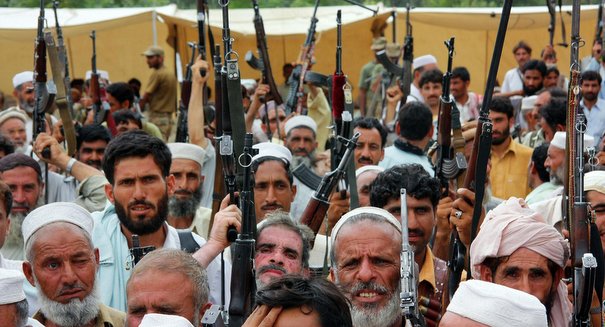
The arrest of Muttahida Qaumi Movement founder Altaf Hussain arrest in the UK could threaten Karachi’s relatively stable state of instability.
Source: Indian Express
The judicial pursuits that have resulted in the arrest of Altaf Hussain in the UK (where he was released on bail last week, four days after being arrested) may mark a turning point for the Muttahida Qaumi Movement (MQM) in Karachi. But what has Hussain’s strategy since the creation of the party been? And who is he?
Hussain first played an active role in the Islami Jamiat Talaba (IJT), the student union of the Jamaat-e-Islami — one that, like others, systematically resorted to violence on university campuses in the 1970s. In 1978, mohajir students created their own union, the All Pakistan Mohajir Students Organisation (APMSO), under his aegis. The union represented the lower middle class of the mohajirs, who were the first to feel the brunt of Zulfikar Ali Bhutto’s pro-Sindhi reforms in the 1970s. Born into a family of modest means, Hussain had trouble getting into medical school to study pharmacology. A clear indication of his social marginalisation was the scorn of the mohajir business elite, which he experienced when he approached industrial houses in Karachi to raise the funds needed to operate the APMSO. The beginning of his career as a student leader was difficult, but he founded the MQM in 1984.
In the 1980s, the mohajirs came to find Zia-ul-Haq’s policies just as detrimental to their community as Bhutto’s. Although they approved of the establishment of courts to enforce Sharia and applauded his decision to make Islam the state religion, they protested against the quotas put in place in the administration, which meant that 10 per cent of civil service posts were reserved for retired military personnel, while Punjabis continued to dominate the army. More importantly, the mohajirs felt besieged in their own cities. Migrants poured into Karachi from all of Pakistan’s provinces, seeking to take advantage of its dynamism; this was also true of refugees from the war in Afghanistan. According to the 1981 census, Karachi’s population was 61 per cent mohajir, 16 per cent Punjabi, 11 per cent Pashtun, 7 per cent “native-born” Sindhi and 5 per cent Baloch. On top of it, mohajirs were losing government jobs as a result of the quotas introduced in 1973: 10 years later, urban Sindhis made up only one-fifth of the senior civil service, compared to one-third earlier. In 1981, they represented only 22.30 per cent of the civil servants hired by the Centre, against 30.30 per cent in 1973.In 1978, the first APMSO manifesto claimed that “Mohajirs should be provided with a province of their own where they can freely practice and exercise their culture” — something their forefathers (including Jinnah) had tried to achieve by creating Pakistan. In 1984, APMSO leaders, including Hussain, created the first iteration of the MQM, the Mohajir Qaumi Mahaz. The party criss-crossed the urban space (especially in Karachi) with a dense network of well-trained activists. This organisation, emulating the pyramidal structure of the Jamaat-e-Islami, was intended to establish a direct relationship between Hussain and local cadres. Since then, this dense local presence of the MQM not only enables it to exert social control over the inhabitants (and even to spy on them), but also to implement a strategy of social work, including the distribution of free food.
Immediately after its creation, the MQM cultivated techniques of violence, which were part of the APMSO’s legacy. MQM cadres routinely paraded with arms. The mohajir elite disliked the MQM’s methods and viewed it as an organisation made up of a lumpen proletariat. But their attitude changed in the 1990s, when MQM activists and the mohajirs were, generally speaking, the victims of violence during the 1992 army operation called “Clean-up”. The army then relied on the support of MQM dissenters, who had just created the Mohajir Qaumi Movement (Haqiqi), literally “the true MQM”. This faction indulged in criminal activities but the army used it anyway.
The military finally withdrew from the city in 1994. The MQM (A) — “A” for Altaf — hailed this as a victory, but Hussain had to flee for the UK at the beginning of the operation, and has never returned. However, he has remained in control of the party and Karachi in a rare case of long-distance nationalism enabled by modern means of communication.
In order to retain control of urban Sindh, Hussain did not rely only on violence, but on electoral politics as well (a combination the Shiv Sena has also observed in Mumbai). Relying on its mohajir vote bank, Hussain’s MQM has forged alliances with each mainstream party when it has achieved power: in 1988, he sided with Benazir Bhutto’s Pakistan Peoples Party and in 1990, with Nawaz Sharif — though only for a short while, since Operation Clean-up took place under Sharif. In 1993 he returned to the PPP, but again switched alliances in 1997. In 2002, he joined hands with the PML(Q), the then president Pervez Musharraf’s party. In exchange for its support in the National Assembly and in Sindh, the MQM was granted the post of governor of Sindh. In 2008, the PPP won the elections but needed partners to form coalition governments at the Centre and in Sindh. The MQM came to its rescue. Five years later, the MQM was back at the PML(N)’s side at the Centre and lent support to the PPP-led government in Sindh.
Hussain’s opportunism makes clear that for him, the defence of the mohajirs meant that he ally with those in office.
Until recently, this combination of electoral politics and paramilitary techniques enabled Hussain’s MQM to retain control of the urban space in Karachi. But growing Pashtun assertiveness has gradually become a major challenge. According to the 1998 census, only 49 per cent of the city population are Urdu-speakers (to whom the Gujaratis, with 8 per cent, must be added to obtain the proportion of mohajirs), whereas Pashto-speakers made up 11.50 per cent, Punjabis 14 per cent, Sindhis 7 per cent and Balochis 4 per cent. But the war in Afghanistan that started in 2001 and the growing instability in Pakistan’s Pashtun belt resulted in the migration of one million people to Karachi, the largest Pashtun city today. The mohajirs felt threatened by these Pashtuns also because of the growing number of Sunni militants and Taliban supporters among them.
To resist the Pashtun more effectively, the MQM has further refined its paramilitary style and introduced sophisticated weaponry. This has meant an unprecedented escalation of violence in Karachi. While the previous wave of killings had resulted in 1,742 deaths in 1995 before a quick return to normalcy, the number of casualties has been rising since 2006 to reach the unprecedented number of over 3,200 casualties in 2013, partly because of the tensions generated by the elections. But it is not that Karachi is mired in chaos. As the mixed strategy described above suggests, and as Laurent Gayer has recently shown in his book, Karachi: Ordered Disorder and the Struggle for the City, there is a rationale behind the conduct of the parallel state that the MQM in Karachi has become.
The judicial vulnerability of Hussain, who had been arrested on suspicion of money laundering and who will have to report to the police again in July, may affect this relatively stable brand of instability. Hussain is the one who keeps the MQM united and has no obvious successor. If the party breaks apart, an already volatile atmosphere may spin out of hand — in spite of the ongoing deployment of security forces.
Former Nonresident Scholar, South Asia Program
Jaffrelot’s core research focuses on theories of nationalism and democracy, mobilization of the lower castes and Dalits (ex-untouchables) in India, the Hindu nationalist movement, and ethnic conflicts in Pakistan.
Recent Work

Milan Vaishnav, Rahul Verma, Rukmini S., …
Christophe Jaffrelot
Carnegie does not take institutional positions on public policy issues; the views represented herein are those of the author(s) and do not necessarily reflect the views of Carnegie, its staff, or its trustees.

Russian strikes are weakening the economy sustaining Ukraine’s war effort. Closing the growing funding gap will require more European support and politically contentious reforms in Kyiv.

Balázs Jarábik

Europe is facing rising populism internally as well as external pressures from Russia, China, Turkey, and the United States.

Dimitar Bechev
Economic recovery has brought Sri Lanka a modicum of stability, but domestic strains and great-power rivalry could test how long it lasts.
Avinash Paliwal

The Horn of Africa countries are among those facing a new security calculus.


Andrew Leber, Lesley Anne Warner

The European far right might fail to steer EU policy in the direction Russia wants, but they will create enough chaos inside Europe to benefit the Kremlin.
Dimitar Bechev