

Commentary
Bayram Balci
{
  "authors": [
    "Bayram Balci"
  ],
  "type": "commentary",
  "centerAffiliationAll": "",
  "centers": [
    "Carnegie Endowment for International Peace",
    "Carnegie Russia Eurasia Center"
  ],
  "collections": [],
  "englishNewsletterAll": "",
  "nonEnglishNewsletterAll": "",
  "primaryCenter": "Carnegie Endowment for International Peace",
  "programAffiliation": "",
  "programs": [],
  "projects": [
    "Eurasia in Transition"
  ],
  "regions": [
    "Middle East",
    "Syria",
    "South Asia",
    "Afghanistan",
    "Central Asia",
    "Uzbekistan"
  ],
  "topics": [
    "Security"
  ]
}
Source: Getty
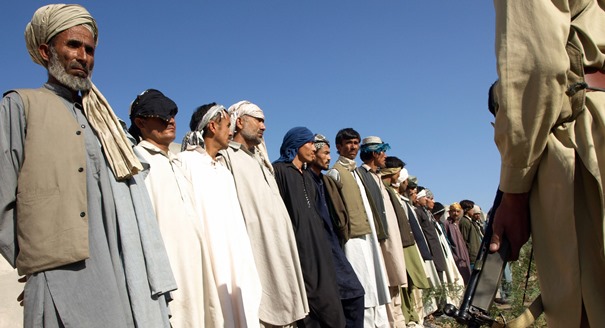
The radical jihadi group known as the Islamic Movement of Uzbekistan (IMU) emerged after the collapse of the Soviet Union. A little bit more than twenty years after it first appeared, this on-going transformation has made it less connected to Uzbekistan, and more to a global jihad.
Following the end of the Soviet Union, a couple of Islamic organizations emerged in the Uzbek city of Namangan in the Fergana Valley, like Islam Lashkarlari (Islam’s solders) or Adolat (Justice). Repressed by the new Uzbek regime, some of them managed to escape and join the United Uzbek Opposition in neighboring Tajikistan. When the Tajik peace agreement was signed between the different factions, ending the civil war, Uzbek Islamists decided not to join it but to set up their own organization, the O'zbekiston Islomiy Harakati, Islamic Movement of Uzbekistan, or IMU. A little bit more than twenty years after it first appeared, this movement has changed considerably in its tactics as well as in its ideology and objectives. This on-going transformation has made this movement and more broadly, Uzbek jihadists, less and less connected to their original homeland, Central Asia, and more and more involved in a global jihad, first in Waziristan, and now in Syria.
The emergence of a new jihad field in Syria has brought q second phase of disengagement of Central Asian jihadists from their homeland. Indeed, there have been several reports attesting to the existence of Central Asian jihadists in Syria since the civil war transformed that country into a new Jihadistan, attracting Islamist nihilists from different parts of the world. Kazakhs, Kirghiz, and of course Uzbek jihadists are reportedly involved in different groups in Syria. Uzbeks are apparently the most important Central Asian group to have joined the civil war in Syria. According to several serious sources, the IMU in Afghanistan and Pakistan is even becoming a secondary force compared to the emergence of a new Uzbek jihadi movement that operates in Syria. According to several digital sources, the Uzbek jihadi group involved in Syria, the Imam al Buhari brigade, is now even stronger than the IMU. A serious and solid work on this movement is not easy to conduct, but, once again, the videos posted by Uzbek jihadists and their own publications give us some signs about their objectives. First of all, it seems that the Uzbek jihadists involved in jihadi actions in Syria and Iraq are mostly Uzbeks of the “diaspora,” that is Uzbek migrants from Russia, but also Uzbeks of Kirgizstan, and apparently, some young Uzbek students who left their country years ago and are living in Turkey and Saud Arabia. Uzbek jihadists in Syria and Iraq are apparently under the command of Abu Yahya and Umar Shishani (a Chechen form Pankisi in Georgia) and fight with other jihadists from the former Soviet Union. The Buhari brigade is actually a new jihadi group that includes a limited number of ex-members of the IMU which continues to be a close ally to Haqqani. Indeed, as the first leaders of IMU had sworn allegiance to Mullah Omar, the current IMU members have to continue this loyalty to the Taliban. It seems that the IMU, because of its allegiance to the Talban, is even reluctant to send its members to the Middle East. However, there is a clear indication that the Buhari brigade and its leaders are loyal to Abu Bakir al Baghdadi.
This de facto “de-uzbekification” we observe in the IMU should not be surprising. Indeed, the first IMU militants left their homeland at the beginning of the 1990s and took refuge in Tajikistan, but then later started to have families in the FATA region of Pakistan. It is, however, true that during the first years of its presence in Tajikistan and then in Afghanistan the IMU continued to recruit Uzbeks from Uzbekistan and other Central Asian countries. But more than twenty years after its departure from its homeland, the IMU felt the need to recruit new militants abroad, among Uzbeks of Afghanistan and even from other ethnic groups. The emergence of Central Asian jihadists in the Middle East, mainly Uzbek, is to a large extent a new and decisive phase of this “de-uzbekification” and disconnection of Central Asian jihadists from their homeland.
Former Nonresident Scholar, Russia and Eurasia Program
Balci was a nonresident scholar in Carnegie’s Russia and Eurasia Program, where his research focuses on Turkey and Turkish foreign policy in Central Asia and the Caucasus.
Recent Work
Bayram Balci
Bayram Balci, Daniyar Kosnazarov
Carnegie does not take institutional positions on public policy issues; the views represented herein are those of the author(s) and do not necessarily reflect the views of Carnegie, its staff, or its trustees.
Why Pakistan, Saudi Arabia, and Turkey are joining forces on regional security.


Alper Coşkun, Amr Hamzawy

The truth of the strategic situation is that Europe and Russia are extremely unlikely to be able to “turn the page” on their confrontation within the next two decades.

Arkady Moshes
Protests in Iran follow a similar pattern: Economic grievances turn into political protests that spread nationwide. But increased state repression has begun to shift the arrangement.

Eric Lob

Despite public disputes over trade and immigration, the strategic partnership’s foundations remain sturdy.

Sameer Lalwani
It signals a new era of tech diffusion and warfare.

Steve Feldstein