

Article
Frederic Wehrey, Charles H. Johnson
{
  "authors": [
    "Frederic Wehrey"
  ],
  "type": "legacyinthemedia",
  "centerAffiliationAll": "dc",
  "centers": [
    "Carnegie Endowment for International Peace",
    "Malcolm H. Kerr Carnegie Middle East Center"
  ],
  "collections": [],
  "englishNewsletterAll": "menaTransitions",
  "nonEnglishNewsletterAll": "",
  "primaryCenter": "Carnegie Endowment for International Peace",
  "programAffiliation": "MEP",
  "programs": [
    "Middle East"
  ],
  "projects": [],
  "regions": [
    "North Africa",
    "Libya",
    "Maghreb"
  ],
  "topics": [
    "Security",
    "Foreign Policy"
  ]
}
Source: Getty
The real story of Libya is that there is no one faction that can really compel or coerce the others.
Source: PBS Newshour
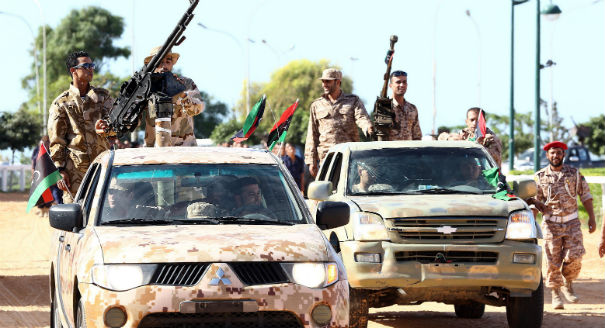
Speaking to Jeffrey Brown on PBS NewsHour, Carnegie’s Frederic Wehrey discussed the deteriorating situation in Libya, where violence has escalated between rival factions. The very complex web of dynamics and alliances has finally arrived to Tripoli, Wehrey said, where fighting has intensified over control of the airport.
Under Qaddafi, Libya didn’t have state institutions, an army, or police. It’s only gotten worst since the revolution, Wehrey said. “The militias are getting funding from Libya’s oil wealth and they’ve really mushroomed. They’ve become their own entities,” he argued. “The real story of Libya is that there’s no one faction that can really compel or coerce the others.”
In Washington, there’s a sense that there’s no partner on the other side, Wehrey explained. They want to help the Libyans but the Libyans first have to help themselves. “I do think the Libyans themselves need to step up to the plate before the outside community can help,” he argued.
Senior Fellow, Middle East Program
Frederic Wehrey is a senior fellow in the Middle East Program at the Carnegie Endowment for International Peace, where his research focuses on governance, conflict, and security in Libya, North Africa, and the Persian Gulf.
Recent Work
Frederic Wehrey, Charles H. Johnson
Frederic Wehrey, Charles H. Johnson
Carnegie does not take institutional positions on public policy issues; the views represented herein are those of the author(s) and do not necessarily reflect the views of Carnegie, its staff, or its trustees.

The Bureau of Industry and Security needs to adjust its focus and practices to maintain its position as the U.S. government’s primary champion of international technological competition.
Geoffrey Irving
They face an uphill climb, but they could draw on a strategy that other diplomats have used in the past.


Shana Tabak, Alejandro Martin Rodriguez

European Commission President Ursula von der Leyen is about to give her annual address on the state of the EU. Here’s what she won’t—but should—say.

Rym Momtaz

Understanding the climatic pain points is necessary for policymakers hoping to minimize the war’s negative environmental consequences.


Alejandro Martin Rodriguez, Joy Arkeh, Sarah Yerkes

The books, podcasts, and films that explain the world it made.

Andrew Leber