

Commentary
It should address the shortcomings of previous crisis communication efforts and adapt to the demands of frontier AI.
Lucy Luo
{
  "authors": [
    "George Volski"
  ],
  "type": "commentary",
  "centerAffiliationAll": "",
  "centers": [
    "Carnegie Endowment for International Peace",
    "Carnegie Russia Eurasia Center"
  ],
  "collections": [],
  "englishNewsletterAll": "",
  "nonEnglishNewsletterAll": "",
  "primaryCenter": "Carnegie Endowment for International Peace",
  "programAffiliation": "",
  "programs": [],
  "projects": [],
  "regions": [
    "Caucasus",
    "Russia",
    "Georgia"
  ],
  "topics": [
    "Security",
    "Military",
    "Foreign Policy"
  ]
}
Source: Getty
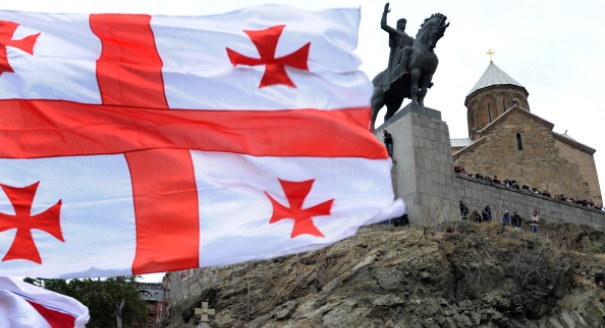
It has been six years since the end of the Russia-Georgia war, but its effects still pervade political debates between the Georgian Dream coalition and the once powerful Mikheil Saakashvili’s United National Movement (UNM).
It has been six years since the end of the Russia-Georgia war, but its aftershocks are still felt in Georgia’s tense political life. They pervade television and parliamentary debates between the representatives of the ruling Georgian Dream coalition and the once powerful United National Movement (UNM), which has now joined the ranks of the opposition. Besides, the details of the 2008 war are still discussed by international experts and politicians in various countries and forums.
The political standoff revolves around the approaches to Georgia’s policy on Russia, which has occupied a significant part of Georgian territory. Having clearly marked the red lines of its strategic vital interests, the new government started negotiating with Moscow on some economic and trade issues in an attempt to lay a foundation for political negotiations. Such a foundation had existed before – in fact, influential international organizations, as well as European states and the United States had worked hard to create it—but it crumbled long before the August war. As early as July 2006, the Saakashvili government effectively rejected an OSCE and UN-backed roadmap to resolving the conflict in Abkhazia and South Ossetia/Tskhinvali Region, instead choosing the path of confrontation with the de facto governments of these unrecognized regions. This choice was made as EU and U.S. participation in the conflict resolution had actually risen to the level that would have enabled Georgia to have balanced relations with Moscow and create an atmosphere of trust between the parties, leading to political negotiations.
Analytical publications in the Western media and statements made by certain politicians, testify to the fact that the PR tactics utilized by the UNM, as well as the information network it created, are still alive and well. By distorting the facts and combining truth and falsehood, Saakashvili’s party is not only shielding itself from responsibility for systemic irregularities and sometimes outright criminal acts, but is also trying to launch a massive PR attack against the government.
Saakashvili’s goal is clear: by accusing the new government of pro-Russian policies, he is out to besmirch its reputation and disparage the palpable changes that have occurred in the country in the sphere of democratization of its political life, social and economic reforms, as well as the progress toward European and Euro-Atlantic integration.
For the most part, Georgians are critical of these tactics and the actions of the former government in general. There is a multitude of reasons for this, but massive human rights violations that brought about the UNM defeat during the October 2012 parliamentary elections tops the list.
Incidentally, some political parties that gained political clout after the 2014 local elections are in fact exploiting the issue of bringing criminal charges against Saakashvili and his associates. The same parties criticize the government for dragging its feet, and “suspicious” tolerance of those who enriched themselves and came to power illegally by sacrificing national interests for “Western values.”
Naturally, the government is not expected to put everyone behind bars as radicals suggest. Nevertheless, justice shall prevail and such a position is not politically motivated at all. In fact, it is Saakashvili and his UNM party that seek to evade responsibility by labeling any claim investigators have against them as “Putin’s order.”
Saakashvili’s strategy to present himself as the defender of Ukrainian interests and ignore the question of what prompted Russia to attack and occupy Georgian territory, should be seen through the same lens. After all, it is his ill-conceived, ludicrous, and, frankly, shady policies that allowed Russia to anchor itself in the South Caucasus.
Most Georgians have every reason to doubt both Saakashvili’s innocence and his commitment to genuine Western values. Besides, his friends’ efforts to shelter him from prosecution benefit those trying to play the anti-Western card.
George Volski is a head of the Georgian Dream Faction Parliament of Georgia.
George Volski
It should address the shortcomings of previous crisis communication efforts and adapt to the demands of frontier AI.

Lucy Luo
Washington’s decision to support some UN functions while letting others wither is pulling the organization apart at the seams.

Stewart Patrick, Theodore Zaritsky

Are Germany’s economic, industrial, and political struggles becoming a liability for the EU’s ability to rise to the geopolitical moment?

Rym Momtaz, ed.

Russia’s ruling party would have benefited from Putin appearing as its distant patron, but as an active frontman imposing his views on the public, he has done nothing but harm both the party’s election campaign and the ruling system overall.

Andrey Pertsev

China’s police training infrastructure construction projects provide benefits to recipient countries, promote China’s image as a major global security provider, and are likely to reinforce alignment between Beijing’s security priorities and those of countries in the Global South.


Cameron Waltz, Sheena Chestnut Greitens, Kim Nguyen, …