

Commentary
Balázs Jarábik
{
  "authors": [
    "Balázs Jarábik"
  ],
  "type": "commentary",
  "centerAffiliationAll": "",
  "centers": [
    "Carnegie Endowment for International Peace",
    "Carnegie Russia Eurasia Center"
  ],
  "collections": [],
  "englishNewsletterAll": "",
  "nonEnglishNewsletterAll": "",
  "primaryCenter": "Carnegie Endowment for International Peace",
  "programAffiliation": "",
  "programs": [],
  "projects": [],
  "regions": [
    "Russia",
    "Eastern Europe",
    "Ukraine",
    "Western Europe"
  ],
  "topics": [
    "Economy",
    "Trade",
    "Foreign Policy"
  ]
}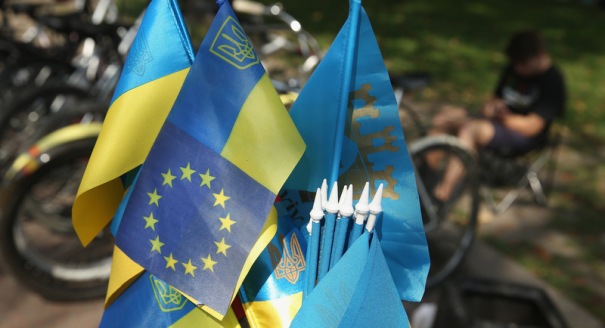
Source: Getty
The EU and Ukraine have suspended provisional application of the Deep and Comprehensive Free Trade Agreement (DCFTA) until the end of 2015. Though their decision might look like Putin’s victory, this conclusion is not obvious. It is high time to stop viewing Ukraine through the prism of Russia policy.
Last Friday, the EU published the third round of Russia sanctions after a brief internal scramble to beat back concerns from a handful of members who argued that new sanctions don’t make sense in the aftermath of the Minsk cease-fire on September 5. Then came the real surprise: a decision to suspend provisional application of the Deep and Comprehensive Free Trade Agreement (DCFTA), the trade part of the “historical” Association Agreement with Ukraine, until the end of 2015.
Western media jumped to the obvious conclusion: Putin has won.
“The statement on delaying the implementation of the agreement on association with the EU made by FM Klimkin was a surprise to me. I hope, rational and practical explanations will be given. The statement sends wrong signals to the aggressor, allies and, most importantly, to Ukrainians. It is the time when our crisis-torn economy has to have a chance to survive. The chance cannot be put off.”
Not so fast. These immediate and emotional reactions reveal that many in the West still view Ukraine through the prism of Russia policy. Yet, as always is the case in trade matters, the devil resides in the details.
First, simultaneous ratification by the Rada and European Parliament of the Association Agreement will go ahead as originally scheduled on September 16. The Association Agreement has huge symbolic value for Ukrainians, and ratification is a good vehicle for Poroshenko and his government to meet those expectations.
Second, the trilateral negotiations between the EU, Ukraine, and Russia showed that the Russians are being obnoxious, demanding the removal of upwards of 20 percent of the tariff lines in the agreement. At the same time, Ukraine is fighting a war in the heart of its industrial base, the Donbas. The Donbas accounted for nearly 16 percent of GDP in 2012 and 23 percent of industrial production in the first quarter of 2014, according to IMF data.
Lost in the discussion about Friday’s surprise decision: the fact that the Association Agreement requires Kyiv to spend tens of billions of dollars (which it obviously doesn't have) to implement a variety of long-term reforms. At the moment, Ukraine faces existential issues as its economy and finances are in ruins. Trade liberalization won’t bring back hot water to Kyiv, or enough gas to heat houses and run hugely inefficient enterprises in the east during the fast-approaching winter.
Third, the Friday announcement in Brussels also included a Russian promise not to impose trade restrictions on Ukraine. Moscow for more than a year has used such measures to try to crush Ukrainian support for closer ties to the EU. This concession could be a very significant step back from the brink, provided that it is implemented in good faith. That is a big if, obviously.
Fourth, the EU will extend its low tariff regime for Ukrainian exports during this period while Ukraine can continue to impose tariffs on EU goods. These steps will provide meaningful financial support to Ukraine’s state coffers without using EU funds—thus, Ukraine has won an important concession from Brussels.
Make no mistake: EU management of the Ukraine crisis is increasingly chaotic, and we don’t know exactly what the new team on the European Commission will do. The desire to return to business as usual with Moscow is still quite strong in Brussels.
At the same time, it is high time to stop thinking about Ukraine as a place where a proxy war with Putin can be fought, let alone won. Persisting in that approach will have a predictable result, and Ukraine will be definitely lost.

Political analyst, former Slovak diplomat, and consultant specializing in Eastern Europe
Recent Work
Balázs Jarábik
Balázs Jarábik
Carnegie does not take institutional positions on public policy issues; the views represented herein are those of the author(s) and do not necessarily reflect the views of Carnegie, its staff, or its trustees.
The Bureau of Industry and Security needs to adjust its focus and practices to maintain its position as the U.S. government’s primary champion of international technological competition.

Geoffrey Irving
Despite myriad challenges and occasional stumbles, the new Hungarian government is moving ahead with energy and conviction to uproot years of illiberalism and corruption and rebuild Hungarian democracy.

Thomas Carothers

European Commission President Ursula von der Leyen is about to give her annual address on the state of the EU. Here’s what she won’t—but should—say.

Rym Momtaz

Depleted financial reserves and a shrinking tax base mean it is no longer possible to simultaneously deliver high defense spending, price stability, and economic growth.

Alexandra Prokopenko

The books, podcasts, and films that explain the world it made.

Andrew Leber