

Commentary
Balázs Jarábik
{
  "authors": [
    "Balázs Jarábik"
  ],
  "type": "commentary",
  "centerAffiliationAll": "",
  "centers": [
    "Carnegie Endowment for International Peace",
    "Carnegie Russia Eurasia Center"
  ],
  "collections": [],
  "englishNewsletterAll": "",
  "nonEnglishNewsletterAll": "",
  "primaryCenter": "Carnegie Endowment for International Peace",
  "programAffiliation": "",
  "programs": [],
  "projects": [],
  "regions": [
    "Russia",
    "Eastern Europe",
    "Ukraine",
    "Western Europe"
  ],
  "topics": [
    "Security",
    "Military",
    "Foreign Policy"
  ]
}
Source: Getty
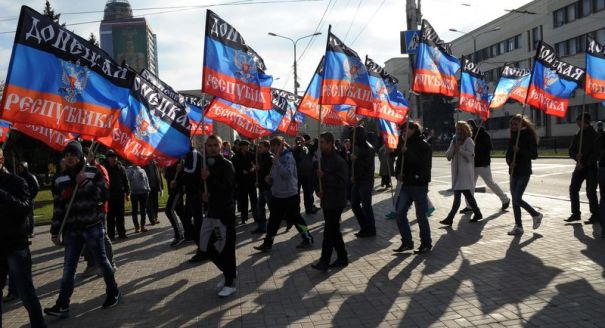
In Donbas, there is mostly a tactical operation aimed at reinforcing rebel positions, not preparation for a full-fledged war. The West may not have a better solution than to accept to freeze Donbas for the winter.
Russia is invading Ukraine, again. As usual, the Russian Ministry of Foreign Affairs has refuted hard evidence from journalists and international observers. Both NATO and the OSCE have confirmed that heavy weaponry and combat troops are moving to Donbas from Russia. A detailed look suggests that although the ceasefire has been seriously violated (again), what we see is mostly a tactical operation aimed at reinforcing rebel positions, not preparation for a full-fledged war.
What has changed? After parliamentary elections in Ukraine on October 26 and separatist-held quasi-elections in Donbas on November 2, the leadership in both regions seems stable for the first time in months. The goals of the elections in Kyiv and the votes in Lugansk and Donetsk were essentially the same: to gain political legitimacy. Moscow recognized the former and “respected” the latter (stopping short of outright recognition), calling for dialogue between Kyiv and the two separatist republics. Held without Kyiv’s endorsement, the separatist elections contravened the Minsk agreement and may ultimately undermine the sort-of-peace that has existed in Ukraine’s east for the past two and a half months. Even the cautious and diplomatic OSCE has admitted that the ceasefire is, for all intents and purposes, dead.
Secondly, Moscow wants to militarily stabilize the separatist republics’ gains. Two parts of the frontline have been particularly violent recently: Debaltseve, an earlier Ukrainian advance, and heavy fighting continues near the Donetsk Airport. If rebels take control of these areas, the frontline may be frozen for the winter, and the separatists’ territory could be easier to defend. The Ukrainian government seems to be preparing for such a freeze. However, the Donetsk Airport, which no longer has any strategic value but retains great symbolic meaning due to the ongoing heroic defense by Ukrainian troops, will not be easy to give up. Mariupol, a key port city on the Azov Sea, remains in tenuous Ukrainian control. Given the size of the city and the Ukrainian military buildup in the surrounding areas, the rebels and their Russian backers may hold off on any attacks.
Thirdly, the Kremlin wants to ensure political control over Donbas. Numerous reports suggest infighting among rebels in Donetsk and Lugansk. Businesses in rebel-controlled parts of Lugansk have stopped operating. Separatist behavior is cause for alarm in Washington and in Moscow—even though the latter cannot admit it. The sudden departure of Igor Bezler, notorious for his alleged role in the shootdown of MH17, opposed the now “elected” Donetsk Prime Minister Aleksandr Zakharchenko, which gives the impression of instability among the new political elite in Donbas. As revealed by a recent interview with Alexander Borodai, the first “Prime Minister” of Donetsk, Bezler was forced out because he did not fit into the developing political establishment in Donbas. Igor Strelkov stroked back that Borodai is the Kremlin agent. For Moscow to ensure the implementation of the Minsk protocols, it needs to assert more control locally.
Last but not least, Russia is left with few good political options in Ukraine. Its main lever of influence is the threat of continued war. Ukraine is in the process of forming a new ruling coalition and a new government. President Putin has a say in the development of this process by threatening an invasion. He can now be almost certain that the West will not go to war with Russia over Ukraine. He is not afraid of sanctions, and may even believe that the Russian people will rally around the government.
What’s more, Russia and Ukraine are locked in a spiral of economic decline. This may lead to the fragmentation of political control and encourage infighting as internal pressure on both sides builds up, especially since Ukraine’s armed forces and political leadership remain in disarray. No wonder that the disagreement about the minister of interior portfolio led the coalition talks into a deadlock.
Given the vulnerability of the economic, social, and political situation in Ukraine, the West may not have a better solution than to accept to freeze Donbas for the winter—even though it can’t admit this.

Political analyst, former Slovak diplomat, and consultant specializing in Eastern Europe
Recent Work
Balázs Jarábik
Balázs Jarábik
Carnegie does not take institutional positions on public policy issues; the views represented herein are those of the author(s) and do not necessarily reflect the views of Carnegie, its staff, or its trustees.

For every ruble allocated to social policy, health, and education in 2027, double that amount is earmarked for the army, the police, and the security services.

Alexandra Prokopenko

The acknowledgment has sparked fears of a new arms race with China and Russia.

Chris O’Meara
Smaller powers cannot go it alone, but Canadian history shows that integration with the United States will not always be benign.
Paul Samson

The European Commissioner for Trade is headed to China. But after President Xi’s bridge-building visit to Washington, can a more isolated EU overcome Beijing’s stranglehold on critical raw materials? Who will blink first?

Rym Momtaz, ed.

The summit may be remembered as a fatal blunder, when Washington, Beijing, and the AI industry collectively chose ceremony over action.

Jeffrey Prescott