

Q&A
Matt Ferchen
{
  "authors": [
    "Matt Ferchen"
  ],
  "type": "legacyinthemedia",
  "centerAffiliationAll": "",
  "centers": [
    "Carnegie Endowment for International Peace",
    "Carnegie China"
  ],
  "collections": [
    "China and the Developing World",
    "China’s Foreign Relations"
  ],
  "englishNewsletterAll": "",
  "nonEnglishNewsletterAll": "",
  "primaryCenter": "Carnegie China",
  "programAffiliation": "",
  "programs": [],
  "projects": [
    "Carnegie Oil Initiative"
  ],
  "regions": [
    "North America",
    "South America",
    "East Asia",
    "China"
  ],
  "topics": [
    "Economy",
    "Climate Change"
  ]
}
Source: Getty
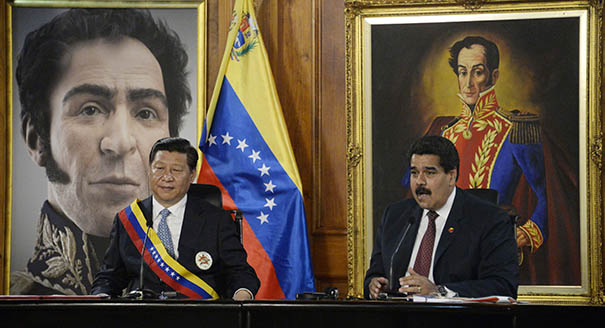
China and the United States could join forces for a more sustainable oil policy in Venezuela.
Source: Diplomat
Dropping oil prices over the last few months have triggered a wave of reports about which countries stand to win and which to lose. While Russia, Iran and others are suffering, Venezuela emerges as the biggest loser of all. With oil accounting for over 95 percent of Venezuela’s export earnings and nearly 50 percent of overall government revenues, the drop in global oil prices from over $110 a barrel during the summer to under $70 today has led to much speculation about a potential Venezuelan sovereign default or even government collapse.
On the other side of the dropping oil price equation sit the United States and China, the world’s two largest oil importers and Venezuela’s most important oil trade and investment partners. Although the U.S. has become decreasingly dependent on Venezuelan oil and China increasingly tied to the Venezuelan petrostate through trade and finance, Venezuela’s deepening crisis presents leaders in both Washington and Beijing, both newly committed to tackling climate change together, with a chance to engage on a cooperative and positive agenda. They are in a position to do so in a way that addresses the climate impacts of Venezuela’s extra-heavy oil as well as helping Caracas toward a more stable economic and environmental path.
Venezuela has the world’s largest proven oil reserves, the vast majority of which is extra-heavy crude in the Orinoco Basin, meaning that upstream and downstream processing has particularly high financial and climate costs. Despite the country’s unrivaled petroleum resources, and even with favorably high oil prices since the 2000s, Venezuela’s economy, society and politics have all become increasingly unstable and polarized.As president from 1999 to 2013, Hugo Chavez used the proceeds from his increasingly personalized control of the country’s oil resources to promote a radical restructuring of domestic Venezuelan politics and society as well as an ideologically confrontational anti-U.S. coalition in the Andes and Caribbean. But well before his death from cancer last year, Chavez’s petro-populism had led to a period of steady crude output decline due to the politicization and mismanagement of PDVSA, the national oil company. Since Chavez’s death, and under the troubled leadership of Nicolas Maduro, the hangover from the Chavismo oil binge has only intensified. The recent global oil price drop has brought into clear relief the already-existing deep dysfunctions and imbalances in the country’s oil-fueled economy.
During the heyday of Chavez’s oil radicalism at home and abroad, Venezuela’s oil and political ties with the United States and China went in opposite directions. While continuing to export more oil to the U.S. than any other country, the flow of Venezuelan oil to the U.S. steadily declined during the 2000s, as U.S. oil majors such as Exxon and Conoco pulled up major Venezuelan investment stakes amidst commercial and diplomatic acrimony. At the same time that U.S.-Venezuelan oil and diplomatic ties were cooling, those between China and Venezuela were heating up. In what both sides touted as a concrete example of mutually beneficial, South-South relations, China and Venezuela entered into a series of state-to-state trade and finance deals meant to dramatically increase the flow of oil between the two countries. While the flow of oil to China from Venezuela, financed by the flow of credit from China to Venezuela, has steadily increased over the last decade, actual oil trade and investment has been far less than Venezuelan officials often claim, and which Chinese government and corporate officials had expected.
One aspect of Venezuela’s oil economy that has received much less attention than the country’s economic woes is the climate impact of greater global use of the country’s oil. Venezuelan oils require more complex “coking” refineries that are more climate intensive than simpler refineries handling lighter oils, such as those coming from America’s shale boom. If, like in the United States, refineries in major oil importing regions like Asia and Europe retrofit to handle extra-heavy oils, this would fly in the face of efforts to limit carbon emissions given that such oils can be twice as carbon intensive as conventional oil.
Despite the different directions and forces propelling U.S. and Chinese oil ties to Venezuela, there are important reasons why Venezuela’s deepening crisis can also be seen as an opportunity to set a positive agenda for a more sustainable pattern of development for Venezuelan oil and possibly for Venezuela itself. In the long run Venezuela’s extra-heavy oil, along with the Canadian Oil Sands, will likely continue to be a major source of energy for the United States, China and beyond. In light of Chinese President Xi Jinping’s and U.S. President Barack Obama’s recent agreement to tackle carbon emissions; policies on the use of extra-heavy oil should play an important part not only in meeting those goals but also in creating standards for global best practice. China and the U.S. should seek ways to work with government, business and civil society counterparts in Venezuela on how the country’s oil can be developed in a more sustainable way for Venezuela and the world. Today’s crisis could then set the stage for a new beginning.

Former Nonresident Scholar, Carnegie-Tsinghua Center for Global Policy
Ferchen specializes in China’s political-economic relations with emerging economies. At the Carnegie–Tsinghua Center for Global Policy, he ran a program on China’s economic and political relations with the developing world, including Latin America.
Recent Work
Matt Ferchen
Matt Ferchen, Anarkalee Perera
Carnegie does not take institutional positions on public policy issues; the views represented herein are those of the author(s) and do not necessarily reflect the views of Carnegie, its staff, or its trustees.
Policy proposals on sovereign debt must both match the scale of the challenge and be implementable within existing political constraints.

David McNair

For every ruble allocated to social policy, health, and education in 2027, double that amount is earmarked for the army, the police, and the security services.

Alexandra Prokopenko
The acknowledgment has sparked fears of a new arms race with China and Russia.

Chris O’Meara

The European Commissioner for Trade is headed to China. But after President Xi’s bridge-building visit to Washington, can a more isolated EU overcome Beijing’s stranglehold on critical raw materials? Who will blink first?

Rym Momtaz, ed.
The summit may be remembered as a fatal blunder, when Washington, Beijing, and the AI industry collectively chose ceremony over action.

Jeffrey Prescott