

Commentary
If the Russian-speaking community in Latvia cannot articulate their interests without being seen as disloyal, they could end up embracing a pro-Kremlin agenda.
Sergejs Potapkins
{
  "authors": [
    "Farea Al-Muslimi",
    "Laura Kasinof"
  ],
  "type": "legacyinthemedia",
  "centerAffiliationAll": "",
  "centers": [
    "Carnegie Endowment for International Peace",
    "Malcolm H. Kerr Carnegie Middle East Center"
  ],
  "collections": [],
  "englishNewsletterAll": "",
  "nonEnglishNewsletterAll": "",
  "primaryCenter": "Malcolm H. Kerr Carnegie Middle East Center",
  "programAffiliation": "",
  "programs": [],
  "projects": [],
  "regions": [
    "Gulf",
    "Yemen",
    "Middle East"
  ],
  "topics": [
    "Political Reform",
    "Security"
  ]
}
Source: Getty
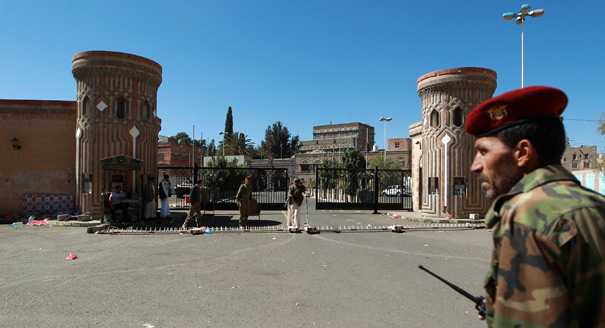
The violence in Sanaa has pushed the Yemeni government to the brink, and what is happening inside will almost certainly reverberate across the globe.
Source: CBC Radio The Current
This week, rebel fighters of Yemen—the Houthis—attacked the president's residence. It seems President Abed Rabbu Mansour Hadi barely had much power anyway. Yemen is a patchwork quilt of militias from Al Qaeda to the Houthis, whose support comes from Iran. All of which sets the stage for a confrontation that will make Western leaders sit up and notice ... nervously.
The violence in Sanaa, the capital of Yemen, has pushed the government to the brink, and what's happening inside the small country on the southern tip of the Arabian peninsula, will almost certainly reverberate across the globe.
Its neighbor, Saudi Arabia, is wary of Houthi rebels with Iranian backing gaining the upper hand.
And as for the rest of the world, there was a vivid reminder in Paris this month that Yemen remains home to one of the most vicious terror cells on the globe—Al Qaeda in the Arabian Peninsula—or AQAP—having claimed responsibility for the deadly attack on Charlie Hebdo.
Farea al-Muslimi is a visiting scholar at the Carnegie Middle East Center and an expert on Yemen and Gulf state politics. He was in Sanaa, Yemen.
Politics in Yemen can be complicated and fluid at the best of times. And it's not a country with a strong international media presence. That all adds up to make the country a rather opaque place to the rest of the world.
Laura Kasinof is a freelance journalist who has lived in and reported extensively from Yemen. She is also the author of "Don't Be Afraid of the Bullets: An Accidental War Correspondent in Yemen." Laura Kasinof was in Washington, DC.
This segment was produced by CBC Radio The Current's Howard Goldenthal and Naheed Mustafa.
Research fellow at Chatham House’s Middle East and North Africa Programme
Farea Al-Muslimi is a research fellow at Chatham House’s Middle East and North Africa Programme.
Laura Kasinof
Carnegie does not take institutional positions on public policy issues; the views represented herein are those of the author(s) and do not necessarily reflect the views of Carnegie, its staff, or its trustees.

If the Russian-speaking community in Latvia cannot articulate their interests without being seen as disloyal, they could end up embracing a pro-Kremlin agenda.

Sergejs Potapkins

Are Germany’s economic, industrial, and political struggles becoming a liability for the EU’s ability to rise to the geopolitical moment?

Rym Momtaz, ed.

Russia’s ruling party would have benefited from Putin appearing as its distant patron, but as an active frontman imposing his views on the public, he has done nothing but harm both the party’s election campaign and the ruling system overall.

Andrey Pertsev

China’s police training infrastructure construction projects provide benefits to recipient countries, promote China’s image as a major global security provider, and are likely to reinforce alignment between Beijing’s security priorities and those of countries in the Global South.

Cameron Waltz, Sheena Chestnut Greitens, Kim Nguyen, …
They face an uphill climb, but they could draw on a strategy that other diplomats have used in the past.


Shana Tabak, Alejandro Martin Rodriguez