

Article
Marc Pierini
{
  "authors": [
    "Marc Pierini"
  ],
  "type": "legacyinthemedia",
  "centerAffiliationAll": "dc",
  "centers": [
    "Carnegie Endowment for International Peace",
    "Carnegie Europe"
  ],
  "collections": [
    "Turkey’s Transformation",
    "Europe’s Eastern Neighborhood"
  ],
  "englishNewsletterAll": "ctw",
  "nonEnglishNewsletterAll": "",
  "primaryCenter": "Carnegie Europe",
  "programAffiliation": "EP",
  "programs": [
    "Europe"
  ],
  "projects": [],
  "regions": [
    "Middle East",
    "Russia",
    "Europe",
    "Türkiye",
    "Iran"
  ],
  "topics": [
    "Foreign Policy"
  ]
}
Source: Getty
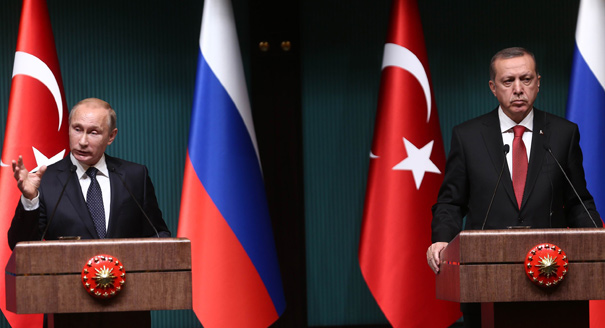
Putin and Erdogan will keep contradicting or chastising the EU as often as their highly charged populist political style requires, while engaging the EU for vital economic reasons.
Source: EUobserver
For decades, the European Union symbolised “liberal democracy” as a political project, one that would be disseminated through its enlargement and neighborhood policies.
In 2014, the EU discovered two major hurdles in its near abroad.
Russian leader Vladimir Putin’s assertiveness put a spanner in the works of the EU’s “Eastern Partnership”.Meanwhile, Turkey’s Recep Tayyip Erdogan publicly signaled that he doesn’t worry much about liberal democratic values – least of all when the EU is perceived as teaching “lessons” to his “New Turkey.”
It doesn’t take a crystal ball to guess that 2015 will see more of the same.
Despite many differences between these two important neighbours, it is quite obvious that, for their own reasons, both Putin and Erdogan will keep contradicting or chastising the EU as often as needed in their highly-charged populist political style, while engaging the EU for vital economic reasons.
The EU’s style of liberal democracy was already vigorously challenged across the entire Arab world, where Europeans chose to co-operate with dictators in the name of fighting terrorism post-9/11.
The wave of Arab revolutions didn’t improve the situation much, with the notable exception of Tunisia (although it was the Tunisians themselves, not the Europeans, who promoted liberal democracy).
Then, Putin endeavored to recreate the marches of the defunct Soviet empire and to oppose “Western domination” of the world order.
In 2015, Putin and Erdogan will keep contradicting or chastising the EU.Tweet This
Five main vehicles were used for this strategy: “Novorossia,” an ethnic Russian concept strong enough to justify the annexation of Crimea and the dispatching of heavily-armed Russian troops in eastern Ukraine; a renewed sense of nationalism, promoted through a massive public relations effort; the Eurasian Union, a loosely defined economic and political project; rebuilding the Russian army and emphasising its renewed confidence with an unprecedented number of harassment incidents of Western air forces and navies; and, finally, blaming any problem on a “foreign plot,” including depicting the EU as annexing Ukraine and the West more generally as attempting to extend Nato further eastward.
In Turkey, the EU accession process has been showing its limits since 2011, as the ruling party, the AKP, increasingly sees the accession requirements (including public procurement, competition, and fundamental freedoms policies) as impediments to its lasting predominance.
The Gezi protests in June 2013 highlighted the illiberal leanings of then prime minister Erdogan. Alleged corruption cases that dogged the Turkish government in December 2013 triggered a massive rollback of the rule of law architecture, under the justifications of both “foreign” and “terrorism” plots.
With the “New Turkey” ushered in following the election of Erdogan as the country’s first directly-elected president last August, a distinct turn toward authoritarianism was taken, touching every segment of public life from the right of dissent to compulsory classic Ottoman language lessons and from women’s role in society to freedom of religion.
In both Russia and Turkey, the EU and the liberal values it carries have been designated as contrary to national interests.
In both countries, a modern-looking facade has been erected in front of authoritarian policies through a massive communication effort by government-controlled media and social media, even when it takes the form of outright faking of information (e.g. the Russian case on the downing of flight MH17) or embracing bold but shallow strategies (e.g. the “EU strategy” of Turkey).
The challenge for the EU is not so much direct confrontation with Russia or the discarding of the accession request by Turkey.
Moscow and Ankara are unlikely to move into such hazardous terrains. The challenge rather lies in the growing distance between rhetoric and reality, which translates into a rapid-fire dual discourse vis-a-vis the EU.
For example, Russia keeps sending troops to eastern Ukraine, while seemingly favoring an ever-elusive ceasefire and telling EU leaders (e.g. France’s Hollande) that it has no intention to annex the Donbas region.
At the same time, Russia, crippled by sanctions and low gas prices, has a vital need to remain the largest gas supplier to the EU.
Both Putin's and Erdogan's authoritarianism is loaded with contradictions.Tweet This
Similarly, the political survival of Turkey’s ruling party hinges on restraining fundamental liberties and halting corruption inquiries while the country’s economic prosperity, through exports and foreign direct investments, rests in large part on good relations with the EU and the pro forma continuation of accession negotiations.
Their authoritarianism is loaded with contradictions.
In such an environment, the EU is faced with assertive political cultures, which are now entirely at odds with the concept of a “common European house” long used with Russia and indeed with the fundamentals of Turkey’s accession process.
Good at principled statements and at sanctions, the EU is often divided over its economic interests in both Russia and Turkey. As a result, it may waver between protecting its values and its business needs.
There is no real reason why the EU should disregard the liberal democratic aspirations of Ukrainian or Turkish people.Tweet This
Yet, there is no real reason why it should disregard the liberal democratic aspirations of Ukrainian or Turkish people.
The European brand of liberal democracy may have found its opponents in Moscow’s Kremlin and Ankara’s Ak Saray and it may be used as a scapegoat because of its support of free press, social media, and civil society.
But in response the EU leadership has to fine-tune its foreign policy toolbox in order to stand firm as the major peace and democracy project in today’s world.

Senior Fellow, Carnegie Europe
Marc Pierini is a senior fellow at Carnegie Europe, where his research focuses on developments in the Middle East and Turkey from a European perspective.
Recent Work
Marc Pierini
Marc Pierini
Carnegie does not take institutional positions on public policy issues; the views represented herein are those of the author(s) and do not necessarily reflect the views of Carnegie, its staff, or its trustees.

It should address the shortcomings of previous crisis communication efforts and adapt to the demands of frontier AI.

Lucy Luo

If the Russian-speaking community in Latvia cannot articulate their interests without being seen as disloyal, they could end up embracing a pro-Kremlin agenda.

Sergejs Potapkins

Washington’s decision to support some UN functions while letting others wither is pulling the organization apart at the seams.

Stewart Patrick, Theodore Zaritsky

Are Germany’s economic, industrial, and political struggles becoming a liability for the EU’s ability to rise to the geopolitical moment?

Rym Momtaz, ed.

Russia’s ruling party would have benefited from Putin appearing as its distant patron, but as an active frontman imposing his views on the public, he has done nothing but harm both the party’s election campaign and the ruling system overall.

Andrey Pertsev