

Commentary
A leak of Russian gas price data helps establish that China is paying Russia far less than Central Asian countries and Gazprom’s former European customers.
Sergey Vakulenko
{
  "authors": [
    "James F. Collins",
    "Michael Sfraga",
    "Ross A. Virginia",
    "Kenneth Yalowitz"
  ],
  "type": "legacyinthemedia",
  "centerAffiliationAll": "dc",
  "centers": [
    "Carnegie Endowment for International Peace"
  ],
  "collections": [],
  "englishNewsletterAll": "ctw",
  "nonEnglishNewsletterAll": "",
  "primaryCenter": "Carnegie Endowment for International Peace",
  "programAffiliation": "russia",
  "programs": [
    "Russia and Eurasia"
  ],
  "projects": [],
  "regions": [
    "North America",
    "United States",
    "Russia"
  ],
  "topics": [
    "Climate Change",
    "Foreign Policy",
    "Global Governance"
  ]
}
Source: Getty
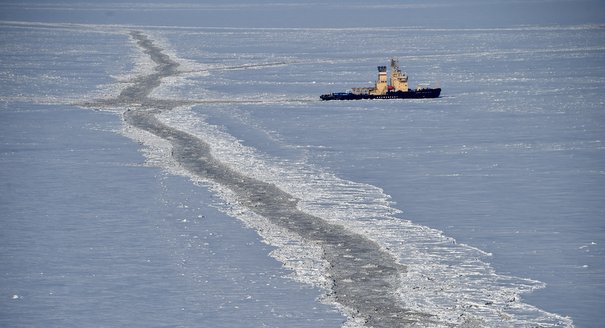
The United States must make clear that it is prepared to continue Arctic cooperation and welcomes constructive Russian activity in the region.
Source: National Interest
On April 24, the United States will assume the chairmanship of the Arctic Council for two years. The Council is an eight-country forum, which since its inception in 1996, has successfully governed pan-Arctic cooperation on a consensus basis. A key question for the United States is whether the current complex geopolitical environment and tense atmosphere in Russian relations with the West will impinge future Arctic cooperation. According to the report of an international group of leading experts, cooperation can be maintained, provided all Arctic countries continue to address Arctic issues on their own merits and manage competing national interests within a framework of international cooperation that has shielded this region since the end of the Cold War. The task of the United States will be to provide the leadership and political vision to keep the Arctic Council and the Arctic on a positive path.
In the post–Cold War era, tensions in the Arctic were replaced by the constructive work of the Arctic Council on environmental protection, sustainable development and commitment to responsible stewardship of a rapidly changing region. These efforts were facilitated by the UN Treaty on the Law of the Sea (UNCLOS), which has provided an accepted framework to resolve border conflicts and set rules of the game for dividing up seabed natural riches and ensuring rights of passage in the Arctic Ocean.This vision is now being challenged by events in the region and outside. Russia’s recently increased military presence and large-scale military maneuvers in the region have sparked concerns among its Arctic partners about a more militarized Arctic, and U.S. energy sanctions on Russian oil and gas projects in response to Russia’s involvement in the war in Ukraine have injected outside political issues into the Arctic’s economic development. The press at times has described these developments in sensational terms as the beginning of a new “great game” in which Arctic states are locked in open-ended competition for territory, resources and prestige.
The fact is, however, that there is scant evidence to support this portrayal. Rather, extended seabed claims beyond the 200-nautical-mile zone granted each state under UNCLOS are being considered by UNCLOS bodies, and so far, all concerned states are committed to this diplomatic process. Further, most accessible and known offshore oil and gas deposits in the Arctic are located within the 200-nautical-mile exclusive economic zones of the Arctic states and are not contested. One question is how Russia or other states would react if their extensive claims to additional extended territorial shelf limits are not accepted. Several Arctic states have made competing claims and several besides Russia have taken steps to increase their military presence in the Arctic. All argue this is necessary to defend borders and natural resources therein.
Since October, 2014, a group of approximately fifty international experts, government officials and representatives of leading NGO’s convened by the Carnegie Endowment for International Peace, Dartmouth, the University of Alaska Fairbanks and the University of the Arctic has been meeting to discuss prospects for the Arctic and prepare policy recommendations for the U.S. Arctic Council chairmanship program. Meeting on February 23 in Washington, the group unanimously concluded that the Arctic must and, with adequate political will, can remain an area for peaceful cooperation, scientific research and sustainable economic development, and should be kept apart from the current complex geopolitical environment.
All agreed that U.S. failure to ratify UNCLOS continues to weaken the American voice in the Arctic and that ratification would enhance U.S. authority on Arctic issues, as well as underscore its commitment to peaceful development of the Arctic and avoidance of border conflict. As is well known, the Arctic is experiencing significant change due to global warming, resulting in the rapid melting of sea ice, potential increases in Arctic shipping and planning for the development of energy and natural resources.
U.S. planning for its chairmanship is well advanced under the newly formed position of Special Arctic Representative, occupied by the recently appointed retired Coast Guard Admiral Robert Papp. That planning focuses on three areas—addressing the impacts of climate change, improving economic and living conditions and Arctic Ocean safety, security and stewardship. The February conference endorsed these plans and also decided a series of recommendations in a report to the U.S. government on additional steps to pursue within the Arctic Council with a particular focus on the geopolitical context. These included:
Arctic issues are beyond the scientific understanding and management capacity of any single country, and cooperation is essential in the face of enormous challenges there. This will take political will and commitment on all sides in the current environment. The United States must make clear that it is prepared to continue Arctic cooperation and welcomes constructive Russian activity in the region. Only time will tell, but the Arctic remains one of the few promising pathways, despite the major downturn in Western relations with Russia.
This article was originally published in the National Interest.
Nonresident Senior Fellow, Russia and Eurasia Program; Diplomat in Residence
Ambassador Collins was the U.S. ambassador to the Russian Federation from 1997 to 2001 and is an expert on the former Soviet Union, its successor states, and the Middle East.
Michael Sfraga
Sfraga currently serves as vice chancellor for university and student advancement and is professor of arctic policy in the School of Natural Resources and Extension.
Ross A. Virginia
Dartmouth College
Kenneth Yalowitz
Kenneth S. Yalowitz is a Global Fellow at the Kennan Institute and Polar Initiative at the Woodrow Wilson International Center for Scholars.
Carnegie does not take institutional positions on public policy issues; the views represented herein are those of the author(s) and do not necessarily reflect the views of Carnegie, its staff, or its trustees.
A leak of Russian gas price data helps establish that China is paying Russia far less than Central Asian countries and Gazprom’s former European customers.

Sergey Vakulenko

The EU can impose sanctions but struggles to enforce them without the United States. With Washington increasingly disinterested in backing European interests, the bloc must now fend for itself.


Nicu Popescu, Tiago Antunes

Global and rising powers will need to engage with Africa’s priorities and agency in order to secure the continent’s increasingly attractive partnerships.

Fonteh Akum

Rubio’s recent visit brought welcome attention, but more capital requires governance changes that may be a hard sell for regional governments.

Jennifer B. Murtazashvili
America’s foreign-policy objectives have grown more demanding while Americans have demanded greater focus on their own affairs.

Stephen Wertheim