

Research
- +10
Rosa Balfour, Frances Z. Brown, Yasmine Farouk, …
{
  "authors": [
    "Moisés Naím"
  ],
  "type": "legacyinthemedia",
  "centerAffiliationAll": "",
  "centers": [
    "Carnegie Endowment for International Peace"
  ],
  "collections": [],
  "englishNewsletterAll": "",
  "nonEnglishNewsletterAll": "",
  "primaryCenter": "Carnegie Endowment for International Peace",
  "programAffiliation": "",
  "programs": [],
  "projects": [],
  "regions": [
    "North America",
    "United States",
    "South America"
  ],
  "topics": [
    "Political Reform",
    "Democracy",
    "Foreign Policy"
  ]
}
Source: Getty
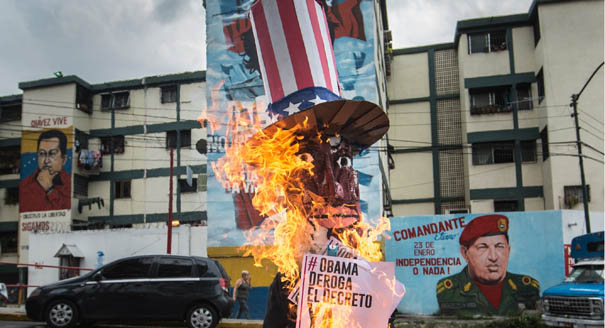
As Latin American leaders gather in Panama, Venezuela is blaming all its problems on the United States.
Source: Atlantic
As heads of state gather this week in Panama for the Summit of the Americas, expect a celebration, a confrontation, and lots of lies.
The gathering will be celebrating the restoration of relations between the United States and Cuba. Barack Obama and Raul Castro will shake hands, signaling the start of a new era for the two countries. At the same time, Venezuelan President Nicolas Maduro and his allies will denounce the United States for a lot of things, but mostly for having recently imposed sanctions on Venezuela.
The handshake between Obama and Castro will represent a possible future for the hemisphere, while the opera buffa put on by the Venezuelan government will represent the past. This is a past in which leaders resorted to lies and manipulation to confuse and deceive their populations in order to remain in power. Maduro and his posse of regional allies (Argentina, Nicaragua, Ecuador, etc.) will remind us that they have not moved beyond that past. And Cuba, whose methods of manipulation Venezuela has long emulated, will star in both pictures: In one, making peace with its historical enemy; in the other, engaging with neighbors who feed on division and blame Washington for all their woes.And what other choice does Maduro have? After all, it is essential for his political survival to convince the world—and especially his own citizens—that Washington is behind his country’s catastrophic situation. Otherwise, it’s hard to explain the world’s highest inflation rate, a severe shortage of basic necessities, an economy spiraling out of control, and one of the world’s highest murder rates—all in a nation with the planet’s largest oil reserves. Maduro and his lieutenants claim that this mess is all the result of America’s stealthy actions to destabilize the country and change the regime, in part by plotting to assassinate the Venezuelan president.
In Panama, Maduro plans to give Obama a book containing the signatures of millions of Venezuelans asking him to repeal the sanctions against Venezuela. The truth is that Venezuelan civil servants, students, and others who depend on the state were likely coerced into signing the petition to the American president. Take the case of Raiza Aular Rengifo, the director of Caracas’s health department. She sent the following memo, which I managed to obtain, to her employees: “I send you Bolivarian, Socialist and Revolutionary greetings. It is my pleasure to write to you today enclosing two (02) booklets for the collection of signatures for the ‘Obama repeal the decree now’ [petition], which should be returned … to this address.” She then ordered her subordinates to: “Mobilize three hundred (300) people from each health center” in the city to participate in a march led by the minister of health, adding, “All doctors should attend with their white coats and all other staff should dress in white and red and bring their respective banners.”
Similar orders appear to have been delivered to professors, teachers, civil servants, pensioners, members of the military, and all those who depend on government subsidies for their livelihoods. Staged protests are being paired with continuous radio and television campaigns warning the population that “the U.S. has declared Venezuela a threat to its interests and is preparing to intervene—and even use military force.”
It’s no surprise, then, that many Venezuelans believe a U.S. military intervention is imminent. Like all clever manipulations, the government’s campaign relies on a kernel of truth to make its lies more credible. It is true that the United States has sanctioned Venezuela, and that in the text justifying that sanction the White House labeled the country a threat to its national interests. And it’s true that in the past the United States did plot assassinations and support coups in Latin America, and even invaded the Dominican Republic, Panama, and Grenada, producing enduring paranoia about American intentions.
But the reality is that these sanctions are not against the Venezuelan people; they aren’t even leveled against the Venezuelan government or its economy (the United States continues to be Venezuela’s main commercial partner and one of the few clients that actually pays market prices for Venezuelan oil). The sanctions are against seven carefully selected individuals who, according to the U.S. government, are guilty of brutal human-rights violations against the Venezuelan people. The sanctions consist of denying the named individuals visas to enter the United States and the ability to own property in the country, among other similarly innocuous penalties.
These penalties may seem too little, too late (or too early, as their timing a few weeks before the Panama summit played into the hands of Maduro and his propaganda machinery). But the sanctions actually represent the only concrete measure that any government has taken to support Venezuela’s political prisoners and beleaguered dissidents in the face of the Maduro regime’s systematic repression. None of the Latin American leaders who will be in Panama this week giving fiery speeches in praise of democracy, justice, and human rights has taken any material steps to limit the Venezuelan government’s abuses. Barack Obama is the exception. But in Panama, he will be denounced while Raul Castro will be praised.
The U.S. declaration that Venezuela is a “threat to national security” is more a legal move than a strategic one. Simply put, a provision requires the United States to label countries a national-security threat before sanctioning them. U.S. officials have insisted that the sanctions only pertain to human rights and do not change the government’s assessment of the threat Venezuela poses to America. But this truth has disappeared, buried under the lies spewing from Caracas—and, this week, from the Summit of the Americas.

Distinguished Fellow
Moisés Naím is a distinguished fellow at the Carnegie Endowment for International Peace, a best-selling author, and an internationally syndicated columnist.
Recent Work



Rosa Balfour, Frances Z. Brown, Yasmine Farouk, …
Moisés Naím
Carnegie does not take institutional positions on public policy issues; the views represented herein are those of the author(s) and do not necessarily reflect the views of Carnegie, its staff, or its trustees.
Despite its flop at the box office, the film raises important questions for the climate community to answer.
Leonardo Martinez-Diaz

Funding Ukraine remains a priority for European leaders. As Russia’s war of aggression heads into another winter, two feasible options to mobilize support for Kyiv should be fast-tracked.


Vladyslav Rashkovan, Gregory P. Wilson

In an interview, Rozina Ali discusses her new book on the rise and manifestations of Islamophobia in the United States.

Michael Young

While the EU and European governments are embracing the much-lauded middle-power moment, this entails three difficult conundrums.

Richard Youngs
The middle power moment will not be defined by sovereign states alone, and California stands out for its potential contributions to international cooperation.


Ian Klaus, Stewart Patrick