

Paper
James L. Schoff, Douglas E. Rake, Joshua Levy
{
  "authors": [
    "James L. Schoff"
  ],
  "type": "legacyinthemedia",
  "centerAffiliationAll": "dc",
  "centers": [
    "Carnegie Endowment for International Peace"
  ],
  "collections": [],
  "englishNewsletterAll": "asia",
  "nonEnglishNewsletterAll": "",
  "primaryCenter": "Carnegie Endowment for International Peace",
  "programAffiliation": "AP",
  "programs": [
    "Asia"
  ],
  "projects": [],
  "regions": [
    "North America",
    "United States",
    "East Asia",
    "South Korea",
    "China",
    "Japan"
  ],
  "topics": [
    "Security",
    "Military",
    "Foreign Policy",
    "Nuclear Policy"
  ]
}
Source: Getty
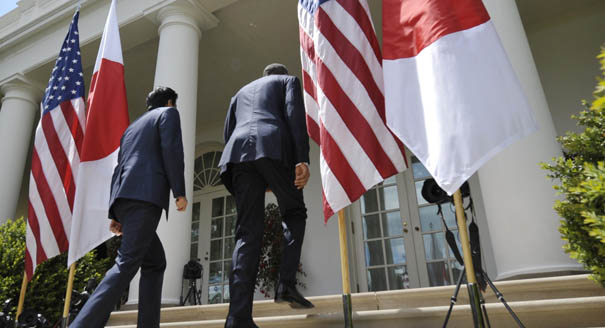
A changing landscape in East Asia calls for greater diplomacy between the United States, Japan, and South Korea.
Source: U.S. News and World Report
In the 70 years since the end of World War II, Japan, with access to open markets and a security guarantee from the United States, has risen from the ashes of war and transformed itself from vanquished foe to prosperous and steadfast friend.
The strong U.S.-Japan alliance has played a major role in maintaining peace in the region.
But some dark clouds are forming for the future. East Asia, an emerging powerhouse for the world's economic growth, is undergoing a transition that could lead to productive harmony – or to devastating conflict. Much depends on how skillfully the United States and its key Asian allies adjust to (and try to shape) the changing dynamics.Now the relationship has matured, and the two countries have a more equal partnership, spanning the globe in the fields of security, trade, technology, health and many others. At the same time, conditions throughout East Asia have changed. China has become a preeminent economic power in the region and is reasserting its influence economically, politically and militarily. Resurgent nationalism has reignited smoldering disputes, and North Korea's unpredictable dictator is threatening the use of nuclear weapons more credibly than before.
These developments call for judicious diplomacy as the United States pursues its priorities, which continue to be maintaining stability, openness and access in this vital region.
We cannot do this on our own.
Japan is currently taking reasonable steps to strengthen its ability to defend itself from coercion and contribute modestly to multilateral security initiatives by loosening restrictions on how its Self Defense Force can cooperate with partners. Legislation proposed by Prime Minister Shinzo Abe would allow Japan to plug into the operations of U.S. forces more effectively, for example, when Japan's security is directly threatened or as part of a broader regional effort to preserve stability. A stronger foundation for collective action should deter attempts to change the status quo through force.
The Abe proposals would permit the activation of the new Defense Cooperation Guidelines, which Japan and the United States adopted this spring to integrate their defense efforts. They would allow Japan to play an earlier and more substantive role in collective action to defeat North Korean aggression, among other possible missions.
Making these changes is not easy. The Abe legislation is meeting loud opposition from the pacifist-leaning Japanese public. Abe's push for the right of his nation to engage in "collective self-defense" has caused a slump in his once high approval ratings in opinion polls, but in this case it is an unfortunate price of prudent leadership. A bigger role for Japan's defense force is essential in this new era, in which Japan can no longer delegate its defense to the U.S. military and when uncertainty about the future can breed instability in the absence of solidarity among leading nations.
Japan is already taking the initiative on the diplomatic front. Abe has reached out to countries in Southeast Asia to build regional coalitions that balance China's economic dominance and help fend off its attempts at coercion. This opens the door for the United States to coordinate with Japan and reinforce its own Asia strategy.
Another key U.S. ally, South Korea, has also grown in importance. The U.S.-South Korea alliance remains vital to managing the number one security concern in the region, the threat of a nuclear attack from North Korea, but South Korea is also an increasingly important participant in multilateral institutions and in responding to crises overseas, be it battling the Ebola outbreak or assisting in disaster relief.
In the coming years, U.S. officials should urge South Koreans to further develop overseas partnerships. Korea is too important and capable a player to have on the sidelines and its participation will serve Korea's interests as well.
More challenging for U.S. diplomacy is the poor state of relations between Japan and Korea over historical perspectives going back to Japan's colonization of the Korean Peninsula about a century ago. The tension between its two crucial allies is something the United States can neither solve nor ignore.
An effort to de-politicize the process and engage in more truth-seeking at the grassroots level will help steady relations, but that will take time and is beyond U.S. control.
For now, the best U.S. policy is to focus on building a trilateral coalition to counter the danger posed by North Korea and look for other high profile shared security concerns so that the people of Japan and South Korea can see such cooperation as beneficial and a matter of course, independent of bilateral grievances.
While these alliances are a means to contain North Korea and can be a counterweight to maintain stability in a dynamic region in the near term, they should ultimately become a core group that helps build a truly multilateral framework for Asia and the Pacific into the future.
This article originally appeared in U.S. News and World Report.

Former Senior Fellow, Asia Program
James L. Schoff was a senior fellow in the Carnegie Asia Program. His research focuses on U.S.-Japan relations and regional engagement, Japanese technology innovation, and regional trade and security dynamics.
Recent Work
James L. Schoff, Douglas E. Rake, Joshua Levy
James L. Schoff
Carnegie does not take institutional positions on public policy issues; the views represented herein are those of the author(s) and do not necessarily reflect the views of Carnegie, its staff, or its trustees.

AI capabilities are moving fast. Most institutions—including governments—can’t keep up.


Anton Leicht, Scott Singer

The Bureau of Industry and Security needs to adjust its focus and practices to maintain its position as the U.S. government’s primary champion of international technological competition.

Geoffrey Irving
They face an uphill climb, but they could draw on a strategy that other diplomats have used in the past.


Shana Tabak, Alejandro Martin Rodriguez

European Commission President Ursula von der Leyen is about to give her annual address on the state of the EU. Here’s what she won’t—but should—say.

Rym Momtaz

Understanding the climatic pain points is necessary for policymakers hoping to minimize the war’s negative environmental consequences.


Alejandro Martin Rodriguez, Joy Arkeh, Sarah Yerkes