

Commentary
Alexander Gabuev, Temur Umarov
{
  "authors": [
    "Alexander Gabuev"
  ],
  "type": "legacyinthemedia",
  "centerAffiliationAll": "",
  "centers": [
    "Carnegie Endowment for International Peace",
    "Carnegie Russia Eurasia Center"
  ],
  "collections": [],
  "englishNewsletterAll": "",
  "nonEnglishNewsletterAll": "",
  "primaryCenter": "Carnegie Endowment for International Peace",
  "programAffiliation": "",
  "programs": [],
  "projects": [],
  "regions": [
    "East Asia",
    "China",
    "Russia"
  ],
  "topics": [
    "Economy",
    "Foreign Policy"
  ]
}
Source: Getty
Chaos in China’s financial markets could have dire implications for the Kremlin’s plans.
Source: Diplomat
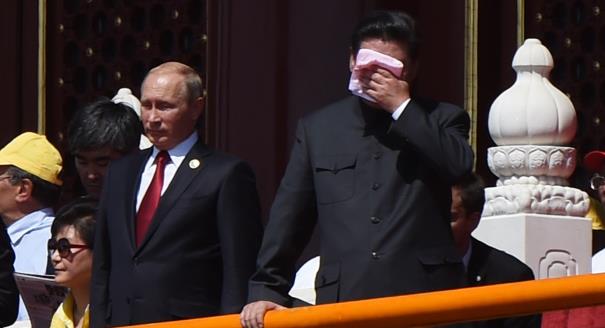
During Vladimir Putin’s visit to Beijing this week, he will be at pains to downplay the ongoing chaos in Chinese financial markets, drop in global crude prices, and lackluster Sino-Russian trade figures. Taken together, these developments are a huge disappointment for a Kremlin that just a few months ago was betting on China to serve as an economic lifeline for the Russian economy in the wake of Western sanctions.
It wasn’t supposed to be this way. After being frozen out of Western capital markets by waves of sanctions, a great many top Russian government and corporate players had loyally heeded the Kremlin’s directive, “Go east, young man!” The Kremlin’s pivot to Asia was intended not only to form a Russia-Chinese alliance of likeminded authoritarian states, but also to re-orient the Russian economy toward the East. This effort was intended to provide Vladimir Putin with financial means to sustain himself in office and his current foreign policy course. Securing “a stable Chinese” alternative to Western capital markets was the key element in this game plan.
Now, with the devaluation of the renminbi (RMB) and the Shanghai and Shenzen indices off by roughly the equivalent of three times Russia’s current GDP, the Kremlin’s China dreams may be going up in smoke. Many in the Russian leadership are now worried sick that if Chinese growth quickly decelerates, Russian GDP and state coffers are bound to be among the biggest losers. After all, it is largely Chinese demand for oil, metals, and other commodities that drives the price behavior of the Russian economy’s main exports. The PBOC’s moves to adjust the mechanism for setting the RMB exchange rate have raised global worries about China’s prospects and triggered a selloff in global crude and commodities markets.Putting a brave face on the RMB devaluation, the Russian Central Bank issued a statement – which the markets swiftly ignored. “In the mid-term, it is to be expected that a weaker yuan will help China to increase exports and stimulate growth,” the Bank stated. “This will eventually have a positive impact on global commodity prices – including oil prices, which in turn will strengthen the ruble.”
Until recently the main disappointment for Kremlin decision-makers had been the paltry flow of investment and loans from its newly discovered partner in the East. In the first half of 2014 several high-ranking officials had made the rounds in Asian financial capitals to explore opportunities for Russian debt and equity listings. The chilly reception they received nearly everywhere surprised them a great deal. Perhaps the largest disappointment was Hong Kong. Despite being a “Chinese” stock exchange, Hong Kong market participants are too internationalized to cast a blind eye toward the attitudes of U.S. government and EU regulators. To cite just one example, Hong Kong banks are currently reluctant even to open bank accounts for Russian passport holders.
The only place where Russian officials received a warm welcome was Shanghai. Top-level Chinese officials reportedly entertained the guests by telling them that all bureaucratic obstacles for foreign listings would soon be removed. In response to these assurances, several of the largest Russian companies, including large state-owned banks like VTB, announced their interest in issuing new shares and bonds in Mainland exchanges.
Making matters even worse is the fact that many these false Russian hopes have also rested on the expectation that a stable RMB might offset the continued volatility of the ruble. Amid persistent fears that Russia’s ability to clear transactions through the U.S. and EU-based financial system might be targeted by future rounds of international sanctions, the idea of having a Chinese escape hatch has steadily grown in practical importance throughout the Ukraine crisis.
How important will the Chinese market turmoil and RMB devaluation be for the flagging Russian economy and Putin’s regime? It’s too early to draw definitive conclusions, of course, but Russian players now have plenty of basis to be skeptical about China’s ability to serve as a driver for global growth in the future or a trade partner, which may compensate for shriveling trade with the EU. In the first half of 2015, bilateral trade with China fell by 31 percent, and Chinese investment to Russia fell by 20 percent.
All told the latest events are an extremely depressing reality-check for Russian companies. Beijing still has enough money to buy assets in Russia (at knocked-down prices, of course) and to provide loans for Chinese companies doing business there. But the vision of a “Chinese version” of London for Russian companies in Shanghai is almost certainly dead. And so is the Russian vision of RMB as a stable global currency that sooner rather than later, many hoped, might replaced the much-maligned U.S. dollar.
Despite grave consequences for the Russian economy, China’s financial rout may paradoxically strengthen Kremlin’s grip over the Russian business elite – at least, for the short term. As the West closes loopholes in the sanctions regime and more Russian players wake up to the changing realities in China, many will face an uncomfortable situation of having nowhere else to turn other than the Russian government. That silver lining, of course, is probably not lost on anyone in the Kremlin.

Director, Carnegie Russia Eurasia Center
Alexander Gabuev is director of the Carnegie Russia Eurasia Center. Gabuev’s research is focused on Russian foreign policy with particular focus on the impact of the war in Ukraine and the Sino-Russia relationship. Since joining Carnegie in 2015, Gabuev has contributed commentary and analysis to a wide range of publications, including the Financial Times, the New York Times, the Wall Street Journal, and the Economist.
Recent Work

Alexander Gabuev, Temur Umarov
Alexander Gabuev
Carnegie does not take institutional positions on public policy issues; the views represented herein are those of the author(s) and do not necessarily reflect the views of Carnegie, its staff, or its trustees.
The United States ignores the region’s lived experience—and the tough political and social trade-offs the war has produced—at its peril.

Evan A. Feigenbaum

The prospect of a total block on Russia’s most popular messaging app has sparked disagreement between the regime’s political managers and its security agencies.

Andrey Pertsev

The GDP measure is an attempt to measure value creation in an economy. This measure, however, can vary greatly between economies that have disciplinary mechanisms that force them to recognize investment losses quickly and economies that don’t, and can postpone this recognition for many years.

Michael Pettis
Ukraine’s asymmetric approach has rendered Russia’s Black Sea Fleet functionally useless. But a long-term commitment will be needed to maintain this balance of power.
Alina Frolova, Stepan Yakymiak

As the Iran war shocks oil prices, countries that have invested in renewables, EVs, and battery development since the 2022 Russian invasion of Ukraine are seeing the value of their investments.

Noah Gordon