

Article
Dalia Ghanem
{
  "authors": [
    "Dalia Ghanem"
  ],
  "type": "legacyinthemedia",
  "centerAffiliationAll": "dc",
  "centers": [
    "Carnegie Endowment for International Peace",
    "Malcolm H. Kerr Carnegie Middle East Center"
  ],
  "collections": [],
  "englishNewsletterAll": "menaTransitions",
  "nonEnglishNewsletterAll": "",
  "primaryCenter": "Malcolm H. Kerr Carnegie Middle East Center",
  "programAffiliation": "MEP",
  "programs": [
    "Middle East"
  ],
  "projects": [],
  "regions": [
    "Maghreb",
    "Algeria",
    "Morocco",
    "Libya",
    "North Africa",
    "Mauritania",
    "Mali"
  ],
  "topics": [
    "Political Reform",
    "Security"
  ]
}
Source: Getty
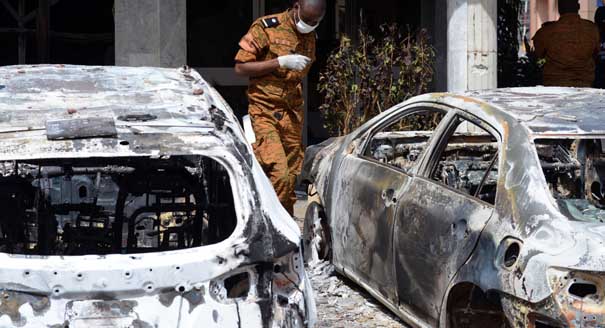
Al-Qaeda in the Islamic Maghreb remains a looming threat, with its proven adaptability and resilience, and its high capacity for destruction.
Source: The New Arab
On March 18, the Salafi-jihadist group, al-Qaeda in the Islamic Maghreb (AQIM), attacked a gas facility in the locality of Khrechba, near Ain Salah in Algeria. A few days before, on March 13, AQIM attacked L'Etoile du Sud resort in the city of Grand Bassam, South of Ivory Coast killing 18 people. On January 16, AQIM fighters stormed the luxury Splendid Hotel and an adjacent café in Ouagadougou and killed 29 people.
In the volatile Sahel region, these attacks, in addition to the kidnapping of dozens and even killing of some Westerners, prove that AQIM remains a looming threat. AQIM is highly adaptive and resilient, giving it a high capacity for destruction.
The GSPC continued the fight against the Algerian state and its security forces, without attacking civilians, in order to regain their support. In 2007, Hattab’s successor, Droudkel decided to rally al-Qaeda and rebranded the GSPC al-Qaeda in the Islamic Maghreb. This marriage de raison was beneficial for GSPC’s image. Besides being more visible (media coverage), being under the al-Qaeda's umbrella allowed it to galvanize people and increase its recruitment. As for al-Qaeda, the union was also advantageous because the organisation wanted to expand, or at least give the impression of expansion, and maintain its reputation as an omnipotent organisation that could grow and draw recruits even in North Africa.
AQIM conducts attacks principally against Algerian targets (603 attacks since 2007).1 And the main objective remains the overthrow of the Algerian taghout [impious] regime. Yet, the group has been able to hit further than its original target, thanks to its capacity to adapt. The creation of the "Sahara emirate" in 2009 by an offshoot of al-Qaeda under the leadership of Mokhtar Bel Mokhtar allowed for the proliferation of extensive networks with local communities, criminal organisations and institutions. As a result, AQIM and its various cells and partners, has been able to conduct attacks beyond Algeria: in Mali (227), Mauritania (32), Tunisia (25), Niger (17), Morocco (11) and Libya (7).
The fall of Gaddafi in 2011 gave AQIM the ability to acquire weapons easily, refill its stocks and recruit more fighters such as the highly equipped and experienced Touaregs who were supported by Gaddafi and went back home to Mali after his fall. In 2012, AQIM joined forces with radical Touareg groups called Ansar Al Dine and the Movement for Unity and Jihad in West Africa (MUJAO), and they were able to seize important parts of northern Mali including Gao, Kidal and Timbuktu. In January 2013, French intervention in Mali (Serval operation) to stop AQIM’s advancement forced the jihadists to look for shelter in neighbouring countries.
Also, the security vacuum in post-Gaddafi Libya allowed AQIM to open training camps like the one in Ubari (Southwestern Libya) where Bel Mokhtar trained his commando for the January 16, 2013 attack on the gas complex of Ain Amenas in Algeria. AQIM’s activities are linked to high-scale corruption at different levels. Because of its financial ease thanks to dozens of kidnappings (earning $4.5 million per hostage) and smuggling activities (about $100 million), AQIM is able to buy the loyalty of local communities as well as security forces.
During more than a decade of existence, AQIM has been able to extend from its Northern front in Algeria to a Southern one that includes the Sahel countries. With its multiple cells, offshoots and partners, the organisation became harder to target and is able to gain stronghold as shown by the Malian experience in 2012. A military intervention will not suffice to put an end to this highly malleable yet organised power.
The ground that led AQIM to develop and grow in the first place – terrible socioeconomic conditions, extreme poverty, weak governance, spread of crime, marginalisation, ethnic conflicts and limited development – is still fertile. The breakdown of the social contract between the ruling elite and their populations made the latter vulnerable to participate in cross-border crimes and rebellion.
The topography of the Sahel is also a major obstacle for counterterrorism operations. In addition to under-staffed, inexperienced and poorly equipped militaries (with the exception of Algeria and Morocco), there is a lack of financial and logistical resources, lack of security sector reform, and weak coordination of efforts against security threats in the Sahel countries. For instance, the joint patrol that was supposed to be created in 2010 by the Comité d’état-major opérationnel conjoint (CEMOC) between Algeria, Niger, Mauritania and Mali did not see the light. Not to mention that strategic countries such as Libya, Tunisia and Morocco were excluded from this initiative, revealing the lack of trust between them.
AQIM’s priorities remain regional and it is likely that the group will expand to new Sahel countries where the conditions are favourable for recruiting, fundraising, refilling weapon stocks and conducting attacks. The groups is also boosting with money, weapon and experience other criminal groups that are "salafi-jihadist" by convenience. AQIM is a lasting threat for North Africa and the Sahel. It is unlikely that the group will conduct any attack on European soil. Nevertheless, because of France’s interest in the region, we might witness another intervention once again.
1Data on AQIM’s attacks in Algeria compiled from Armed Conflict Location & Event Data Project (ACLED) website.
Former Senior Resident Scholar, Malcolm H. Kerr Carnegie Middle East Center
Dalia Ghanem was a senior resident scholar at the Malcolm H. Kerr Carnegie Middle East Center in Beirut, where her research focuses on Algeria’s political, economic, social, and security developments. Her research also examines political violence, radicalization, civil-military relationships, transborder dynamics, and gender.
Recent Work
Dalia Ghanem


Frances Z. Brown, Judy Dempsey, Dalia Ghanem, …
Carnegie does not take institutional positions on public policy issues; the views represented herein are those of the author(s) and do not necessarily reflect the views of Carnegie, its staff, or its trustees.

Japan’s long-term security policy is driven by concerns about China, and there is little appetite for (or interest in) pursuing a confrontation with Moscow.

James D.J. Brown

Russia is testing the waters of NATO’s mutual defense clause. What do strikes in Romanian territorial waters mean for the alliance’s posture toward Moscow?

Dimitar Bechev
Why Pakistan, Saudi Arabia, and Turkey are joining forces on regional security.


Alper Coşkun, Amr Hamzawy

The truth of the strategic situation is that Europe and Russia are extremely unlikely to be able to “turn the page” on their confrontation within the next two decades.

Arkady Moshes

Despite public disputes over trade and immigration, the strategic partnership’s foundations remain sturdy.

Sameer Lalwani