
• Research
  • Emissary
  • About
  • Experts
Carnegie Global logoCarnegie lettermark logo
DemocracyIran
  • Donate
{
  "authors": [
    "Marwan Muasher"
  ],
  "type": "legacyinthemedia",
  "centerAffiliationAll": "dc",
  "centers": [
    "Carnegie Endowment for International Peace"
  ],
  "collections": [
    "Arab Awakening"
  ],
  "englishNewsletterAll": "menaTransitions",
  "nonEnglishNewsletterAll": "",
  "primaryCenter": "Carnegie Endowment for International Peace",
  "programAffiliation": "MEP",
  "programs": [
    "Middle East"
  ],
  "projects": [],
  "regions": [
    "North Africa",
    "Tunisia"
  ],
  "topics": [
    "Political Reform",
    "Democracy",
    "Security"
  ]
}
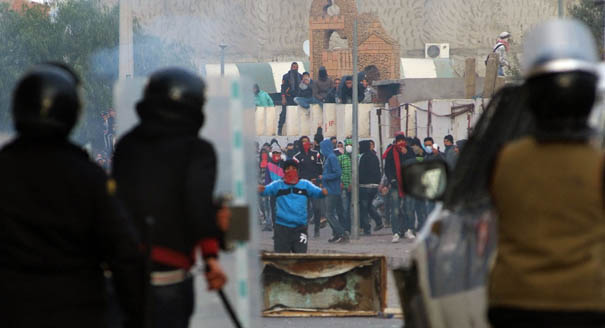
Source: Getty

In The Media

Why Tunisia’s Success Story Risks Falling Apart

Growing grievances in Tunisia must be dealt with if democracy is to be preserved.

Link Copied
By Marwan Muasher
Published on Apr 14, 2016
Program mobile hero image

Program

Middle East

The Middle East Program in Washington combines in-depth regional knowledge with incisive comparative analysis to provide deeply informed recommendations. With expertise in the Gulf, North Africa, Iran, and Israel/Palestine, we examine crosscutting themes of political, economic, and social change in both English and Arabic.

Learn More

Source: CNN

Speaking on CNN International, Carnegie’s Vice President for Studies Marwan Muasher discussed Tunisia’s worrisome trajectory and the path forward to building a successful and stable democracy int he coutnry.

This interview originally appeared at CNN.

About the Author

Marwan Muasher

Vice President for Studies

Marwan Muasher is vice president for studies at Carnegie, where he oversees research in Washington and Beirut on the Middle East. Muasher served as foreign minister (2002–2004) and deputy prime minister (2004–2005) of Jordan, and his career has spanned the areas of diplomacy, development, civil society, and communications.

    Recent Work

  • Commentary
    The Iran War Is Uncovering the Weakness in U.S.-Gulf Ties

      Marwan Muasher

  • Commentary
    Bombing Campaigns Do Not Bring About Democracy. Nor Does Regime Change Without a Plan.

      Marwan Muasher

Marwan Muasher
Vice President for Studies
Marwan Muasher
Political ReformDemocracySecurityNorth AfricaTunisia

Carnegie does not take institutional positions on public policy issues; the views represented herein are those of the author(s) and do not necessarily reflect the views of Carnegie, its staff, or its trustees.
More Work from Carnegie Endowment for International Peace

  • The tops of people's heads. Raised above their heads are "No Kings" signs, an upside-down American flag, and a rainbow flag.
    Commentary
    Emissary
    Protests Like No Kings Can Only Go So Far to Stem Authoritarianism

    Lessons from other backsliding democracies show that mass mobilization needs to feed into an electoral strategy. 

      Saskia Brechenmacher, Shreya Joshi

  • Commentary
    Strategic Europe
    Win or Lose, Orbán has Broken Hungary’s Democracy

    Hungarians head to the polls on April 12 for an election of national and European consequence. Three different outcomes are on the cards, each with their own implications for the EU.

      Zsuzsanna Szelényi

  • A member of "Timur's Special Forces Unit" of the Defence Intelligence of Ukraine looks on on Snake Island, also known as Zmiinyi Island, located in the Black Sea, on August 14, 2025, amid the Russian invasion of Ukraine.
    Article
    The Changing Military Balance in the Black Sea: A Ukrainian Perspective

    Ukraine’s asymmetric approach has rendered Russia’s Black Sea Fleet functionally useless. But a long-term commitment will be needed to maintain this balance of power.

      Alina Frolova, Stepan Yakymiak

  • Commentary
    Emissary
    The Iran War Is Uncovering the Weakness in U.S.-Gulf Ties

    Neither the Abraham Accords nor the presence of large U.S. bases are enough to protect Arab Gulf states.

      Marwan Muasher

  • Commentary
    Carnegie Politika
    The Afghanistan–Pakistan War Poses Awkward Questions for Russia

    Not only does the fighting jeopardize regional security, it undermines Russian attempts to promote alternatives to the Western-dominated world order.

      Ruslan Suleymanov

Get more news and analysis from
Carnegie Endowment for International Peace
Carnegie global logo, stacked
1779 Massachusetts Avenue NWWashington, DC, 20036-2103Phone: 202 483 7600Fax: 202 483 1840
  • Research
  • Emissary
  • About
  • Experts
  • Donate
  • Programs
  • Events
  • Blogs
  • Podcasts
  • Contact
  • Annual Reports
  • Careers
  • Privacy
  • For Media
  • Government Resources
Get more news and analysis from
Carnegie Endowment for International Peace
© 2026 Carnegie Endowment for International Peace. All rights reserved.











