

Paper
Renad Mansour, Faleh A. Jabar
{
  "authors": [
    "Renad Mansour"
  ],
  "type": "legacyinthemedia",
  "centerAffiliationAll": "dc",
  "centers": [
    "Carnegie Endowment for International Peace",
    "Malcolm H. Kerr Carnegie Middle East Center"
  ],
  "collections": [],
  "englishNewsletterAll": "menaTransitions",
  "nonEnglishNewsletterAll": "",
  "primaryCenter": "Malcolm H. Kerr Carnegie Middle East Center",
  "programAffiliation": "MEP",
  "programs": [
    "Middle East"
  ],
  "projects": [],
  "regions": [
    "Levant",
    "Iraq",
    "Middle East"
  ],
  "topics": [
    "Political Reform"
  ]
}
Source: Getty
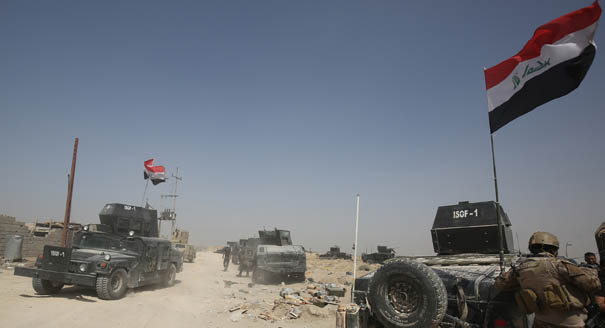
Fallujah is an opportunity for the central government to regain the trust of Iraq's Sunni population.
Source: Al-Jazeera
As Iraqi forces, backed by a coalition of the Iraqi Security Forces (ISF), Popular Mobilisation Forces (al-Hashd al-Shaabi), and local tribes, fight to recapture Fallujah, the battle represents a major effort against ISIL, which took over the city in January 2014.
Ever since, Fallujah's predominantly Sunni Arab residents have lived under ISIL jurisdiction with no connection to Baghdad, which is only an hour's drive away.
The battle to reclaim Fallujah has implications not only for the city and its residents, but more generally for the larger fight against the Islamic State of Iraq and the Levant (ISIL, also known as ISIS). For the battle for Fallujah is not only a military undertaking. There is a political element that needs to be addressed simultaneously, rather than after the fact.According to Sunni Arab leaders in the city, many of their constituents are not necessarily pro or anti-Islamic State. Rather, they remain indifferent. This means they may be willing to jump from one camp to the other, or from ISIL ranks to the central government.
This will only come to fruition, however, with the provision of certain guarantees associated with greater local autonomy and revenue sharing. Without such guarantees, Fallujah will continue to be a hot spot.
This has already been evident in May, when the frequency of ISIL attacks on civilians in Baghdad increased significantly. Although over the past two years the central government has grown confident that the threat of Baghdad being overaken or conquered is unlikely, it is evidently less certain about bombings, as ISIL returns to the more accustomed tactics of its predecessor, al-Qaeda.
Given that background, Fallujah become even more significant: its proximity yet seclusion from Baghdad makes it an ideal spot from which to plan attacks on the capital. More critically, Fallujah is a microcosm of Iraq's crisis of representation, which has acutely affected the Sunni Arab population.
It was the first major city to be taken by ISIL, in other words, its residents were the first to allow for this alternative to the central government. This sense of disenfranchisement among Fallujah's residents grew rapidly during former Prime Minister Nouri al-Maliki's second term, 2010-2014, when overcentralisation policies marginalised the local population.
In spirit with the so-called Arab Spring, local residents took to the streets to voice their grievances and protest against Maliki's policies, including his targeting of their leadership. In response, the former premier opened fire. Fallujah was the first city to see Iraqi forces killing protesters. As repression grew, so did resistance. This eventually paved the way for the re-emergence of ISIL, only a few years after al-Qaeda was kicked out of the city.
This predicament is not only inter-sect. In fact, intra-Sunni Arab disagreements further complicate the crisis of representation leading to an emerging rivalry between Fallujah and Ramadi - even though they are predominantly Sunni Arab cities in the same province (Anbar).
Many in Fallujah feel as if the Sahwa movement (Awakening), which was a successful effort by the central government to re-engage with Sunni Arabs in Iraq by offering money, weapons and land to successfully fight off al-Qaeda in Iraq, had an unfair bias towards Ramadi.
The famous Sahwa leader Ahmad Abu Risha was from Ramadi. Several Sunni Arab residents, from Fallujah and elsewhere, do not view Abu Risha as their legitimate representative. Many complain that he leads a small tribe of merely 2,000 members.
In short, Fallujah is significant not only because it represents the extremes of Sunni Arab grievances against their central government, but it also showcases the Fallujah-Ramadi problem and therefore intra-sect struggles - an underanalysed yet equally critical phenomenon.
There is also the question of the timing of the battle to recapture Fallujah. Many express surprise that Iraqi Prime Minister Haidar al-Abadi announced an offensive to retake Fallujah at a time when the political discourse centred around overtaking Mosul, a bigger prize for ISIL, which declared its Caliphate after taking over Mosul in June 2014.
However, the battle in Fallujah serves as a test of whether Iraqi forces are prepared and adept enough to fight in Sunni Arab areas that they have not controlled for two years or longer. It is an opportunity for the central government to regain the trust of Sunni Arab Iraqis.
The residents of Mosul will carefully analyse this battle. If the coalition of Iraqi forces is able to expel ISIL from Fallujah and facilitate the re-emergence of local leadership, without resorting to sectarian violence or over-extending the central government's reach, it may quell anxieties in Mosul.
Al-Abadi also views the battle for Fallujah as a key test of his leadership. Faced with tough challeneges politically as he failed three times in April to carry out a cabinet reshuffle, and with protesters storming the Green Zone and deadly ISIL attacks in Baghdad, Abadi's authority is in question.
A victory in Fallujah will help him to prove his critics - both outside and inside his camp - wrong.
Iraqi forces are making considerable ground in pushing ISIL back. However, similar to the Sahwa movement, the political is the key; in other words, winning back the segments of the Sunni population that remain indifferent is just as important as an effective bombing campaign.
To quell Sunni Arab anxieties, the ISF, predominantly Sunni, has taken the lead to move into the city, while the PMF, predominantly Shia, stays on the outskirts.
Despite the opportunity that Fallujah presents for the war against ISIL, the effort to win it back has also faced some setbacks. Notably, the presence of Iran's Islamic Revolutionary Guard Corps (IRGC) Quds Force leader Qassim Sulaimani only adds to the fears of Fallujah's residents, many of whom are convinced that there is an Iranian/Shia conspiracy to control their land.
More critically, a hung parliament that has not had many effective sessions in the past few months drives the crisis of representation, which is at the core of the problem.
For now, from Fallujah, the political horizon remains cloudy in the effort to move past the 13-year conflict that the city endured, moving from engagement to disengagement with the central government.
The question, then, is whether this battle can stop the cycle by addressing the fundamental needs and concerns of the city's residents.
Former El-Erian Fellow, Middle East Center
Mansour was an El-Erian fellow at the Carnegie Middle East Center, where his research focuses on Iraq, Iran, and Kurdish affairs.
Recent Work
Renad Mansour, Faleh A. Jabar
Renad Mansour
Carnegie does not take institutional positions on public policy issues; the views represented herein are those of the author(s) and do not necessarily reflect the views of Carnegie, its staff, or its trustees.

Understanding the climatic pain points is necessary for policymakers hoping to minimize the war’s negative environmental consequences.



Alejandro Martin Rodriguez, Joy Arkeh, Sarah Yerkes

Huawei pushed hard to enter the Egyptian data centers market, until the Americans made a better offer.

Angie Omar

The books, podcasts, and films that explain the world it made.

Andrew Leber

In the tenth year of his presidency, President Mirziyoyev’s system is becoming even more personalized than that of his predecessor Karimov.

Galiya Ibragimova

Amid celebrations of bilateral ties was a deeper focus on stability in the Middle East.

Amr Hamzawy